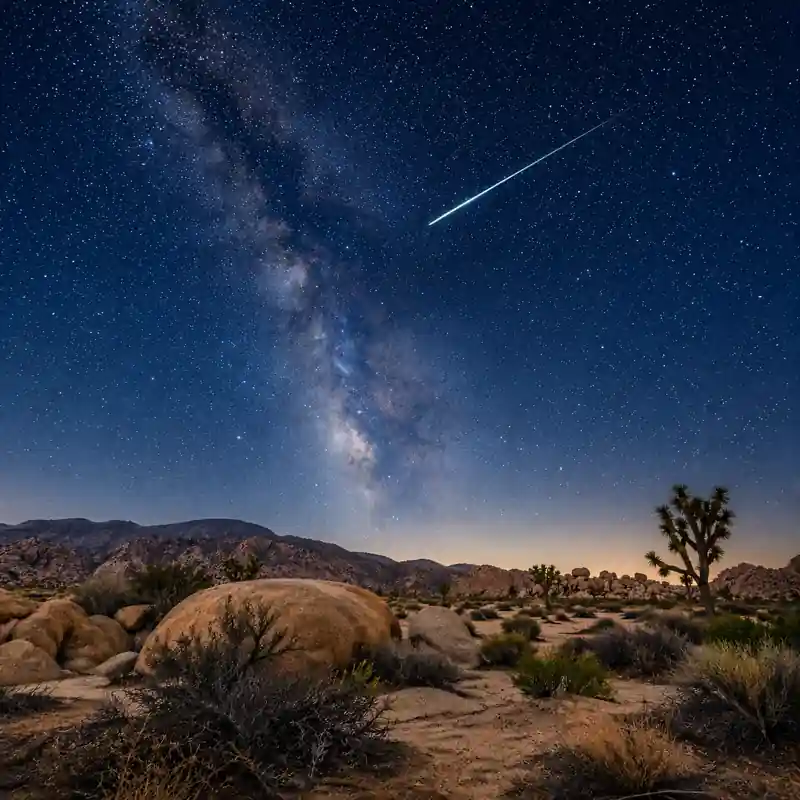

Search interest around “meteor shower tonight” has stayed high even after the Lyrids passed their brightest window, and that makes sense. For many people, meteor showers can sound like one-night-only events, but the sky rarely works in such a tidy way. The Lyrids may have reached their strongest activity in the early hours of April 22, yet the display has not switched off. It remains active through the end of the month, giving latecomers, casual skywatchers, and even people who were clouded out during peak night another reason to step outside and look up.
That continuing visibility is what keeps the story alive. The biggest burst of activity may be behind us, but the shower is still producing meteors, and that matters more than many headlines suggest. The difference now is not whether the Lyrids can still be seen, but how viewers should think about the experience. Instead of expecting a nonstop sky show, it helps to treat the remaining nights as an opportunity for quieter, more patient stargazing, where a few clean streaks across a dark sky can feel more memorable than a rush of numbers.
The Lyrids return every April as Earth moves through the dusty trail left behind by Comet Thatcher, a long-period comet that takes roughly 415 years to circle the Sun. Tiny grains of debris slam into Earth’s atmosphere at high speed and burn up, creating the short flashes people call shooting stars. That science is well established, but the reason this year’s event has carried extra momentum is more visual than technical. A NASA astronaut aboard the International Space Station captured an image of a Lyrid meteor from orbit, turning a familiar annual shower into something that suddenly felt bigger, stranger and more immediate.
That orbital image adds a layer most sky events never get. On the ground, people scan open patches of sky and wait for a sudden streak. From the space station, the same event becomes part of a much wider scene, with Earth’s curve, the dark edge of the atmosphere and glowing city lights below. It changes the mood of the story. The Lyrids are no longer just an annual April meteor shower that astronomy fans mark on a calendar. For a moment, they become a shared event seen from two radically different vantage points: a backyard on Earth and a window 250 miles above it.
That contrast is one reason the shower still has traction after peak night. Another is that real-world viewing reports have reinforced the idea that people did not “miss everything” if they were not outside at the exact best hour. Some observers were already seeing meteors before peak, while others have kept spotting them afterward. Even in areas with light pollution, patient skywatchers have managed to catch activity. In darker areas, the experience can be much better. The American Meteor Society notes that the Lyrids are capable of producing bright meteors, sometimes called fireballs, which gives the shower an extra edge even when overall rates are not especially high. Its annual meteor calendar remains one of the most useful public references for tracking activity and expectations.
For anyone deciding whether it is worth trying tonight, the honest answer is yes, with realistic expectations. The peak has passed, so the number of meteors per hour is likely to be lower than it was during the strongest window. That is the trade-off. But lower activity is not the same as no activity. A post-peak meteor shower can still be rewarding, especially when conditions cooperate. A clear sky, a darker location and a little patience can make the difference between assuming nothing is happening and suddenly catching several meteors in a short stretch.
The best approach is surprisingly simple. Give your eyes time to adjust to darkness. Put the phone away. Do not stare at one fixed point. Instead, take in a broad section of the sky and stay with it for a while. Meteor watching is less like following a scheduled performance and more like waiting for small unpredictable moments. That is part of its appeal. The remaining Lyrids are not selling spectacle as much as they are offering possibility.
There is also a deeper reason the shower continues to resonate. The Lyrids are one of the oldest recorded meteor showers, with observations stretching back more than 2,500 years. Long before space stations and DSLR cameras, people were seeing the same April streaks and trying to make sense of them. That continuity gives the event unusual weight. It is a reminder that even in a world shaped by constant updates and faster news cycles, some phenomena arrive on time, year after year, and still manage to feel fresh when conditions line up.
This year, the timing has helped. Spring skies, lingering public interest, reports of sightings and the added boost from an astronaut’s photograph have kept the Lyrids in circulation beyond their narrow peak. In practical terms, the story now shifts from “when was the best moment?” to “is there still something worth seeing?” The answer is still yes. Not every observer will get a dramatic show, and some locations will naturally perform better than others, but the viewing window remains open through April 30.
For readers who follow seasonal sky events, this is also the kind of moment that rewards consistency more than urgency. Missing the peak does not mean missing the shower. It simply means approaching it differently. That is a useful distinction, especially for casual readers who may only now be hearing about the Lyrids. The strongest burst may be over, but the shower still offers one of the easier ways to reconnect with the night sky before April closes out.
If you are planning to watch, think of the next few nights as a bonus round rather than a consolation prize. You may see fewer meteors than peak-night observers did, but what remains is still part of the same annual event that has drawn attention for centuries. And after a week when the shower was seen from both Earth and orbit, the Lyrids have already done something rare: they have made an old sky story feel current again.

Make Swikblog your go-to source on Google for reliable updates, smart insights, and daily trends.