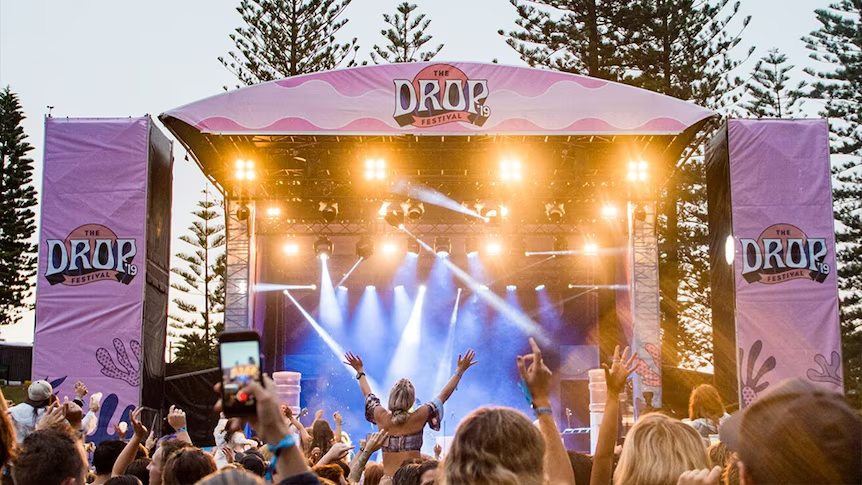

For some Australian music fans, the pandemic-era festival chaos never really ended. The cancelled shows are old news, the line-ups are long forgotten and the websites have gone dark. But the missing refunds are still very real.
The Drop festival, which called off several 2020 events during the COVID period, is still yet to return money to a number of ticketholders six years later. What makes the story stand out is not only the length of the delay, but the pattern that followed: repeated promises, shifting timelines, silent communication channels and no final resolution for customers who say they have been left chasing answers on their own.
The cancelled dates included Manly, Coolangatta, Torquay and Busselton. At the time, festivalgoers were dealing with the same uncertainty that hit the broader live events sector. Many people were willing to be patient. Some accepted the idea of rolling over tickets if new dates could be arranged. Others simply expected that, even if the events could not be saved, refunds would eventually be processed once the business stabilised.
That patience has now worn thin.
One former ticketholder, Eloise Rawson, bought her ticket to The Drop’s Torquay event in 2019 when she was 19. She is now 26 and still owed $115.80. Another customer, Matt Tesoriero, paid $351.16 for four discounted tickets for himself and friends. In practical terms, these are not the kind of sums that usually trigger a long legal fight. But that is exactly why the issue continues to resonate. When a business owes hundreds of people amounts that are individually modest but collectively meaningful, many customers eventually stop pushing simply because the process becomes too draining.
That appears to be part of the frustration here. Fans say the festival did not attract the same level of national scrutiny as larger Australian events, which may have allowed the issue to fade from mainstream attention while those affected remained out of pocket. For buyers, the result is the same either way: money paid for a show that never happened and still has not been returned.
The problem also did not unfold in a single moment. It stretched out over years. The festival’s managing director, Ken O’Brien, had previously spoken about plans to reschedule events and raise capital from new investors. At one stage, The Drop announced new shows for Coffs Harbour and Bondi Beach in October 2022, with a line-up that included Tones and I, Matt Corby, Dune Rats, Cub Sport and Gretta Ray. Ticketholders were given the option to roll their tickets into those events.
Those shows never took place.
Refund promises then shifted again. Customers were first told they could expect repayment by the end of 2022. That timeline was later pushed out to the end of 2024, with insurance-related issues cited as part of the delay. But 2024 came and went, and the refunds still did not arrive.
The silence that followed appears to have made the situation worse. Customers say email responses dried up, the festival website began redirecting to a broken link and social accounts no longer offered any meaningful path to support. For consumers trying to recover money years after a cancelled event, that kind of disappearance can feel like the most discouraging stage of all. It is not just the lack of payment. It is the sense that there is no longer anyone willing to explain what happened.
The business status surrounding the festival has only added to those concerns. The Drop’s Australian Business Number and its registration with the Australian Securities and Investments Commission were reported as inactive from January 2025. For ticketholders, that does not automatically answer whether refunds are impossible, but it does make the outlook look more uncertain. Without an active public-facing operation, a functioning customer channel or a clear insolvency process announced to consumers, people are left in an uncomfortable limbo.
The case also highlights how limited a customer’s options can become once time passes. Some ticketholders had been communicating through Eventbrite, the platform used for ticketing. But Eventbrite said it did not hold the proceeds from The Drop’s ticket sales and that those funds had already been paid out to the organiser. In other words, the platform was not in a position to simply return the money itself.
That may reflect how many ticketing arrangements operate behind the scenes, but it clashes with public expectation. Buyers often assume the platform processing the payment will have a stronger role if something goes wrong. Instead, they can end up caught between a seller that no longer responds and a platform that says it cannot intervene financially.
Consumer rights in event cancellations are not always straightforward either. The Australian Competition and Consumer Commission explains that a customer may not automatically be entitled to a remedy when a cancellation happens because of circumstances outside the organiser’s control, including government restrictions or events beyond human control. That matters in the context of 2020. But this case is not only about whether the original cancellation was unavoidable. It is also about what happened after organisers repeatedly indicated that refunds would be made.
That is the point many customers are focused on now. The dispute has moved beyond pandemic disruption and into a larger question of accountability. Once refund commitments are made, delayed and then delayed again, consumers understandably stop viewing it as a temporary setback. They see it as a broken promise.
Consumer advocates say there is no easy fix left for buyers in this position. Bank chargeback windows for purchases made in 2019 or 2020 are likely long closed. There has been no public liquidation announcement that would give customers a more formal route to lodge claims. That leaves ongoing pressure, public complaints and media attention as some of the few remaining ways to keep the issue alive.
For the wider festival industry, this is more than an old refund dispute. It is a trust issue. Live events depend on advance payments and goodwill. Fans are asked to spend money months before a gate opens, often with limited clarity about what happens if plans unravel. When one case drags on for years without resolution, it can damage confidence far beyond the original event.
The Drop refund saga is a reminder that for consumers, cancelled festivals are not always over when the music stops. Sometimes the longest part of the story is what comes after: the unanswered emails, the missed deadlines and the money that never made its way home.
Read more of our coverage on consumer issues, festival business fallout and entertainment industry accountability in our latest news section.
You may also like: AA Hidden Fee Refunds: How to Check if You’re Owed Money Back.

Make Swikblog your go-to source on Google for reliable updates, smart insights, and daily trends.