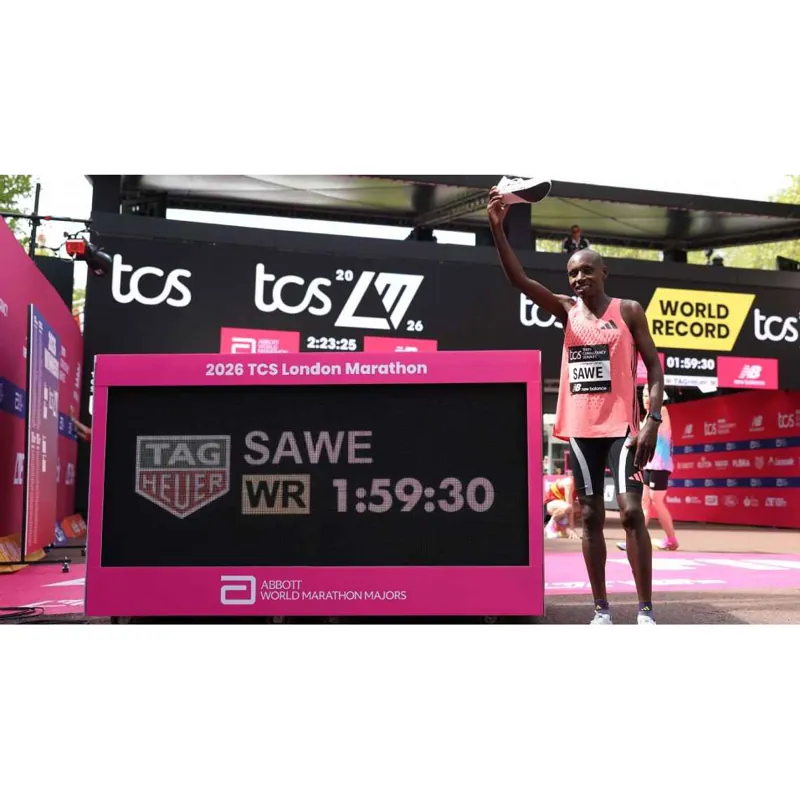

Sabastian Sawe did not just win the London Marathon 2026. He changed the ceiling of marathon running. The Kenyan athlete crossed the finish line in 1:59:30 on Sunday, becoming the first runner to break the two-hour marathon barrier in an official, record-eligible race.
For decades, the idea of a legal sub-two-hour marathon belonged more to theory than reality. Coaches discussed it, scientists studied it, shoe companies built around it, and runners chased it. In London, Sawe finally turned that pursuit into a result that will sit among the most important achievements in athletics history.
His winning time was 65 seconds faster than the previous men’s marathon world record of 2:00:35, set by Kelvin Kiptum at the Chicago Marathon in 2023. That margin is enormous at the elite level, where world records are often cut by only a few seconds. Sawe’s run did not feel like a small improvement. It felt like the sport had moved into a new era.
According to World Athletics, Sawe won the TCS London Marathon in 1:59:30, making him the first man to officially break two hours for the distance. The result also placed London at the centre of one of the biggest moments in road-running history.
The race was not historic because of Sawe alone. Ethiopia’s Yomif Kejelcha finished second in 1:59:41, also running inside two hours in his marathon debut. Uganda’s Jacob Kiplimo came third in 2:00:28, which was faster than the previous world record. That meant the top three men all beat Kiptum’s old mark, turning the London course into the fastest marathon stage ever seen.
Sawe’s performance was built on patience as much as speed. He stayed composed through the early miles, allowing the race to develop before increasing pressure after the 30-kilometre mark. Kejelcha remained close, but Sawe’s strength in the final section proved decisive. Over the last two kilometres, he broke clear and drove toward The Mall with the kind of controlled aggression that separates great runners from record breakers.
His second half was reported at 59:01, an astonishing split for an athlete already moving at world-record pace. That detail matters because it shows Sawe was not simply hanging on after a fast start. He was getting stronger as the race became harder. In marathon terms, that is the difference between surviving and dominating.
The breakthrough also gives official status to a barrier that had already been crossed once outside normal racing rules. Eliud Kipchoge ran 1:59:40 in Vienna in 2019, but that event used controlled conditions, rotating pacemakers and a specially designed setup, so it was not recognised as an official world record. Sawe’s London run came inside a competitive marathon, against rivals, on a recognised course, with the pressure of race-day uncertainty.
That distinction is why this result carries such weight. A laboratory-style run can prove what the human body might be capable of. A major marathon proves what can happen when weather, tactics, crowds, rivals and pressure all exist at once. Sawe handled all of it and still finished under two hours.
The role of modern footwear will remain part of the debate. Sawe and several leading athletes raced in the latest generation of lightweight carbon-plated shoes, part of the “supershoe” wave that has reshaped distance running since Nike’s Vaporfly era began. Reports around the race noted that the new Adidas shoes worn by leading runners weighed about 97 grams and cost around $500 a pair.
But shoes do not run 26.2 miles by themselves. Technology can improve running economy, but the athlete still has to hold a brutal pace for nearly two hours, respond to rivals and stay mentally calm when the body is under extreme stress. Sawe’s record was a combination of equipment, preparation, racing intelligence and rare physical talent.
The women’s race made the day even more memorable. Tigst Assefa of Ethiopia defended her title in 2:15:41, the fastest time ever recorded in a women-only marathon. Kenya’s Hellen Obiri finished second in 2:15:53, while Joyciline Jepkosgei was third in 2:15:55. It was the first time three women had finished under 2:16 in the same marathon, underlining how deep elite women’s road racing has become.
The wheelchair races also produced a Swiss double. Marcel Hug won the men’s wheelchair title, continuing his remarkable dominance in London, while Catherine Debrunner defended the women’s wheelchair crown after a close finish. Their victories added to a day where nearly every elite race carried a major storyline.
Beyond the elite field, London’s scale showed why the event remains one of the world’s leading marathons. More than 59,000 runners took part, while applications reportedly passed 1.1 million. That level of demand reflects the post-pandemic running boom, with more people treating marathon training as both a personal challenge and a community experience.
The official TCS London Marathon has already become a global showcase for charity running, elite competition and mass participation. After Sawe’s record, its status has only grown. Organisers have even considered whether the event could eventually move to a two-day format, opening the door for far more runners to take part.
Sawe’s 1:59:30 will now become a reference point for every elite marathoner chasing history. The question is no longer whether an official sub-two-hour marathon is possible. The question is how quickly the next one arrives, and how far below two hours the record can eventually go.
London Marathon 2026 will be remembered as the day the sport’s most famous barrier finally fell in a real race. Sabastian Sawe did more than win a major marathon. He gave distance running a new benchmark, and his name will remain attached to the moment the impossible became official.
For more sports stories and record-breaking updates, visit Swikblog.
You may like: London Marathon 2027 Ballot: Entry Dates, Odds and Two-Day Plan

Make Swikblog your go-to source on Google for reliable updates, smart insights, and daily trends.