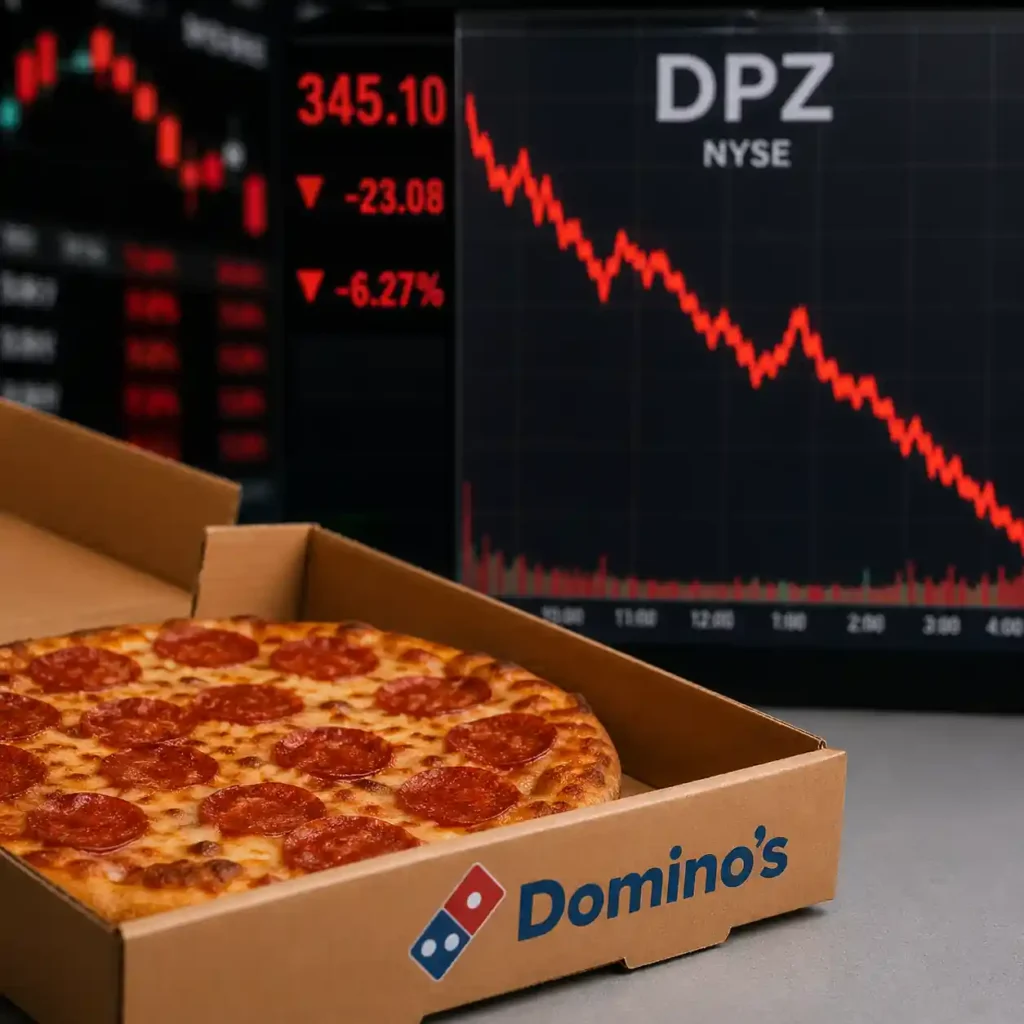

Domino’s Pizza Inc. (NYSE: DPZ) opened the week under pressure after its latest quarterly update showed that even one of the strongest names in quick-service pizza is not fully insulated from a more cautious consumer backdrop.
Shares of Domino’s fell sharply in premarket trading, sliding about 6% to nearly $345 after the company’s first-quarter numbers missed Wall Street expectations on both sales and earnings. The stock had closed the previous session at $368.18, meaning investors quickly erased more than $20 per share from the pizza chain’s market value before the opening bell.
The biggest concern was not revenue growth, which remained positive. It was the pace of demand at existing restaurants. Domino’s reported U.S. same-store sales growth of 0.9% for the quarter ended March 22, far below analyst expectations of roughly 2.6% to 2.7%. For a company that has long been viewed as a dependable operator in value-driven dining, that gap was large enough to spark an immediate sell-off.
Domino’s sales growth slows as consumers get selective
Same-store sales matter because they show how established restaurants are performing without the boost from new store openings. A 0.9% gain is still growth, but it was well short of the pace investors expected from Domino’s at the start of fiscal 2026.
The disappointment also came after expectations had already moved lower. Analysts had been looking for stronger momentum earlier in the year, especially because Domino’s previously suggested that U.S. same-store sales growth could be stronger in the first half of the year than the second. That made the first-quarter miss harder for the market to ignore.
The weakness was not limited to the U.S. International same-store sales declined 0.4%, missing expectations for a small gain. That is important because Domino’s international business remains a major part of its long-term growth story. The company continues to open new stores outside the U.S., but investors want to see those markets produce stronger sales at existing locations too.
Total revenue increased 3.5% year over year to $1.15 billion, compared with $1.11 billion in the prior-year period. However, the figure was slightly below Wall Street’s estimate of about $1.16 billion. The miss was not dramatic on revenue alone, but combined with weaker comparable sales and lower earnings, it pointed to a softer quarter than investors had priced in.
Domino’s also reported supply chain revenue growth of 2.6%, supported in part by higher ingredient costs tied to sales of goods to franchise restaurants. While that helped lift reported revenue, it did not fully offset concerns about consumer traffic and order trends.
Profit falls despite stronger operating income
Domino’s diluted earnings per share came in at $4.13, down from $4.33 a year earlier and below analyst expectations of roughly $4.26 to $4.27. Net income fell 6.6% to $139.8 million, while income from operations rose 9.6% to $230.4 million.
That split shows why the quarter was not simply weak across the board. Domino’s still generated stronger operating income, but a $30 million pre-tax charge tied to its stake in DPC Dash weighed on the bottom line. Investors tend to look through some one-time charges, but in this case the earnings miss arrived alongside slower sales, making the overall report harder to defend.
Chief Executive Officer Russell Weiner pointed to an “intensifying macro and competitive environment,” while saying Domino’s scale and store-level profitability continue to position the company well in the quick-service pizza category. The message was clear: management still believes the brand is gaining share, but the broader market backdrop has become more difficult.
That backdrop matters. Domino’s has meaningful exposure to value-focused consumers, including households that may be more sensitive to higher food, fuel and energy costs. When these customers pull back, restaurant chains often respond with promotions, bundles and lower-priced offers to protect traffic.
Domino’s has already been moving in that direction. The company has leaned on offers such as the $9.99 “Best Deal Ever,” “Mix and Match,” and “Emergency Pizza”. It has also added product innovation, including a Parmesan-stuffed crust pizza, as it works to keep customers engaged in a crowded pizza market.
The challenge is that promotions can drive orders but may also pressure profitability if discounting becomes too aggressive. That is one reason investors are watching Domino’s margins, franchise economics and customer traffic closely as the year progresses.
Store growth remained one of the brighter parts of the update. Domino’s added 180 net new stores during the quarter, including 19 in the U.S. and 161 international locations. The company ended the period with 22,322 stores across more than 90 markets. Global retail sales rose 3.4%, excluding currency effects.
For long-term investors, that expansion still supports Domino’s broader growth case. The concern is whether new unit growth can offset slower demand at existing restaurants if consumer spending stays under pressure.
Domino’s also tried to reassure shareholders with capital returns. The board approved a new $1 billion share repurchase program, adding to $290.2 million remaining under its previous authorization. That gives the company about $1.29 billion available for future buybacks. During the quarter, Domino’s repurchased 188,304 shares for $75.1 million.
The company also declared a quarterly dividend of $1.99 per share, payable June 30 to shareholders of record as of June 15. For investors focused on cash returns, the buyback and dividend remain supportive. Still, Monday’s stock reaction suggests the market is more focused on sales momentum than shareholder payouts right now.
Domino’s latest report also puts pressure on management’s outlook. The company had previously projected full-year U.S. same-store sales growth of around 3% for fiscal 2026. After a 0.9% first-quarter gain, investors may look for more clarity on whether that target still looks realistic, especially if competition remains intense and consumers continue to trade carefully.
Compared with peers such as Papa John’s International Inc. (NASDAQ: PZZA) and Yum! Brands Inc. (NYSE: YUM), Domino’s still benefits from a highly recognized brand, a large franchise system and a strong delivery-focused model. But the latest quarter shows that even category leaders can face pressure when expectations are high and consumer demand cools.
For official company financial releases and quarterly updates, investors can review Domino’s disclosures on its investor relations website. Broader restaurant industry sales and consumer trend data can also be followed through the U.S. Census Bureau retail reports.
For more earnings and stock market coverage, visit our stock market news section.
For now, the market’s reaction is straightforward. Domino’s is still growing revenue, opening stores and returning cash to shareholders, but the first-quarter miss changed the tone around DPZ stock. Investors wanted faster same-store sales growth and a cleaner earnings beat. Instead, they got slowing demand, a profit miss and a reminder that value-conscious consumers are becoming harder to win.
You may like: Chipotle Stock Falls 42% on Weak Sales Outlook

Make Swikblog your go-to source on Google for reliable updates, smart insights, and daily trends.