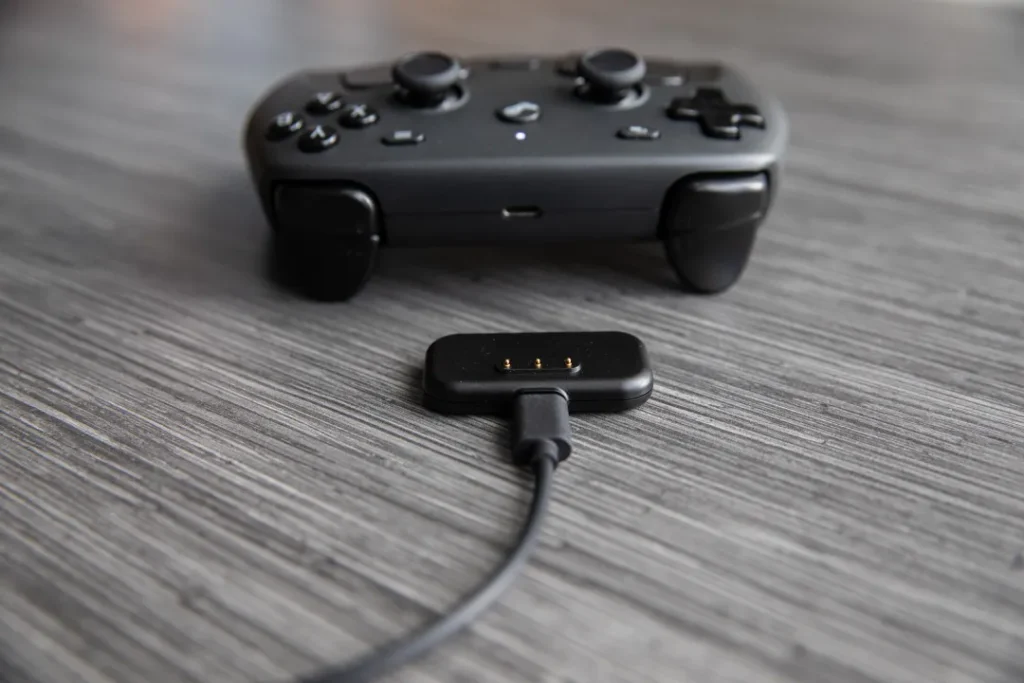

Valve’s new Steam Controller has arrived with a clear message: the company does not want PC gaming to stay tied to a desk. The controller is designed for players who want Steam to feel natural on a television, handheld dock, or future living-room setup. Early reviews are positive on the hardware, but the $99 price has made the launch more complicated than a simple win.
This is not just a second attempt at the old Steam Controller from 2015. Valve’s latest version looks more like a product shaped by the Steam Deck era. It combines familiar gamepad controls with PC-focused features such as dual touchpads, gyro aiming, programmable rear buttons, and a dedicated wireless receiver. The result is a controller that feels less like a basic Xbox alternative and more like a bridge between keyboard-and-mouse gaming and couch play.
The build quality appears to be one of its safest strengths. Reviewers have described the controller as sturdy, balanced, and comfortable, with a matte finish that gives it a premium feel. The face buttons are responsive, the triggers offer smooth travel, and the rear buttons are positioned where fingers naturally rest. For a $99 device, that kind of polish is expected, but Valve seems to have cleared that bar.
One of the most important hardware choices is the use of TMR thumbsticks. These magnetic sticks are designed to reduce the risk of drift, a problem that has frustrated players across several modern controllers. That gives Valve a stronger durability argument, especially for buyers who have already replaced drifting gamepads in recent years.
Still, the real identity of the Steam Controller comes from its touchpads. These are aimed at PC games that do not translate cleanly to thumbsticks. Strategy games, management titles, older PC releases, and games with heavy cursor movement can all feel awkward on a standard controller. Valve’s touchpads give players a more mouse-like way to move through menus and control pointers without needing a desk setup.
The touchpads also create a different option for first-person games. Instead of relying only on analog stick aiming, players can use quick thumb flicks for faster turning and smaller movements for precision adjustments. It will not fully replace a mouse for competitive players, but it gives couch gaming more flexibility than a traditional pad.
Valve has paired that with haptic feedback that makes the touchpads feel more physical than they look. The small clicks and vibration help players understand movement speed and direction, making the input feel closer to a tiny trackball than a flat surface. That detail matters because it turns a feature that could feel experimental into something more practical.
The controller also includes gyro controls, which add another layer of precision. Instead of forcing users to dedicate a button to motion aiming, the system can activate based on thumb or palm detection. That should help reduce accidental movement while making gyro input easier to use during gameplay.
Connectivity is another area where Valve is trying to justify the premium price. The Steam Controller can use Bluetooth, but the bigger selling point is the small USB-C receiver Valve calls the Puck. It creates a dedicated wireless connection with lower latency and stronger range than many Bluetooth setups. Valve says the controller can reach around 8ms latency through the Puck, close to wired performance.
The Puck is also more than a receiver. It can connect two Steam Controllers, help the controller switch between devices, and work as a magnetic charging dock. Instead of plugging in a cable after each session, users can simply place the controller near the dock and let it snap into place. With battery life advertised at more than 35 hours, charging should not be a constant concern.
That makes the Steam Controller especially interesting for Steam Deck owners, living-room PC players, and anyone planning to use Valve’s upcoming Steam Machine. It is clearly designed around the idea that Steam should work smoothly across different screens, not only on a monitor beside a keyboard.
But that focus also creates the biggest limitation. This is not the most open controller on the market. To get the best experience, users need to run games through Steam, including non-Steam titles added manually to the library. For players who already keep most of their games on Steam, that may not matter much. For users who switch between Epic Games Store, Battle.net, Xbox, Riot, or other launchers, it adds friction.
This is where the debate around the $99 price becomes serious. A standard Xbox controller or reliable third-party Bluetooth pad can cost far less and work well for most controller-friendly games. Valve’s controller offers more advanced features, but those features are most valuable to a specific kind of player.
Coverage from Ars Technica and Engadget suggests the early consensus is not that the controller is bad. The question is whether its best ideas are essential enough for mainstream buyers.
For players who mainly play racing games, sports titles, platformers, or action games built around standard controller layouts, the Steam Controller may feel expensive. For players who want to control mouse-heavy PC games from a sofa, reduce Bluetooth problems, or stay fully inside Valve’s ecosystem, it makes much more sense.
Valve has built a smart, premium controller with features that ordinary gamepads do not offer. The challenge is convincing enough players that those features are worth paying nearly $100 for. The Steam Controller may not be the best choice for everyone, but for Steam-first gamers, it could become one of the most useful PC gaming accessories of the year.
For more gaming hardware updates and PC gaming coverage, visit our gaming news section.
You may like: Sony 720Hz Gaming Monitor INZONE M10S II

Make Swikblog your go-to source on Google for reliable updates, smart insights, and daily trends.