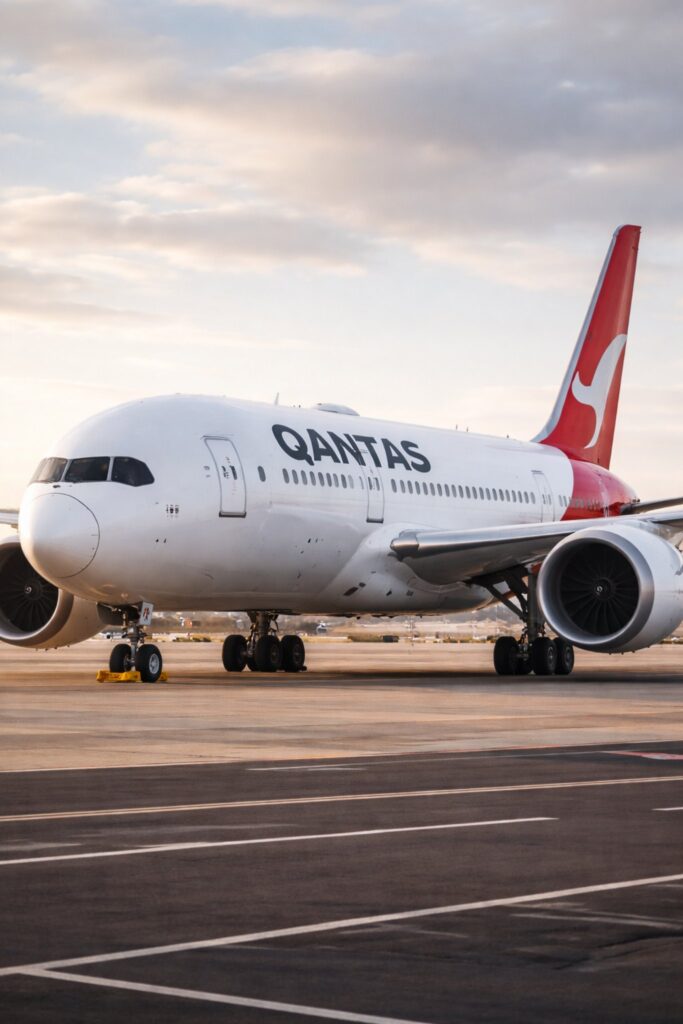

A Qantas Boeing 737-800 engine failure during take-off from Sydney has drawn fresh attention to pilot training, aircraft maintenance limits and the hidden stresses inside modern jet engines. The serious incident ended safely, but the findings show how quickly a routine domestic flight can turn into a high-pressure emergency.
The aircraft, registered VH-VYH, was operating from Sydney to Brisbane on November 8, 2024, when its right-hand CFM International CFM56-7B engine failed during the take-off roll from runway 34R. The failure happened just as the jet reached V1, the critical decision speed after which pilots are trained to continue the take-off rather than attempt a high-speed stop.
For passengers, the first sign of trouble was a loud bang and a shudder. In the cockpit, warning indications quickly confirmed that the right engine had failed. Because the aircraft had already reached V1, the crew continued the take-off, climbed away on one engine and declared an emergency with air traffic control.
The Australian Transport Safety Bureau praised the crew’s response, saying the pilots acted quickly and decisively during one of the most demanding phases of flight. Engine failure at take-off leaves little room for delay, and the correct response depends on training, discipline and clear communication.
After becoming airborne, the crew worked through the relevant checklists and planned a return to Sydney. The aircraft remained in the air for about 30 minutes before making a safe single-engine landing on runway 34L. A requested landing on runway 30R was not available because debris from the engine failure had affected airport operations.
All 175 passengers and six crew members were unharmed. After landing, aviation rescue and firefighting personnel inspected the aircraft for fire risk before it taxied back to the gate, where passengers disembarked safely.
The emergency was not limited to the aircraft. Hot fragments expelled from the rear of the failed engine started a grass fire beside runway 34R, requiring a response from airport firefighting teams. Air traffic controllers, firefighters, cabin crew and flight crew all played a role in keeping the event controlled from take-off to landing.
The investigation found that the engine failed because of a fatigue crack in a high-pressure turbine blade. The crack developed in the dovetail section of one of the engine’s 76 turbine blades, an area where the blade attaches to the rotating disc and is exposed to intense mechanical forces.
Investigators identified the origin of the crack in the “min-neck” region, the thinnest part of the dovetail cross-section. By the time the blade separated, the crack had spread through about 80% of the blade structure. When it broke away from the turbine disc, it also took an adjacent blade with it, causing serious internal engine damage.
One of the most important findings was that the crack was not easily detectable through routine inspection. Because of its location, a standard borescope inspection would not have revealed the flaw unless the engine was fully torn down. That detail is central to the case, because it shows the aircraft was not simply flying with an obvious defect that had been missed.
The failed engine was also close to scheduled removal. It was due to be taken out of service 13 days after the incident under revised manufacturer guidance. CFM International had lowered the recommended removal threshold for the affected blade configuration from 20,000 cycles to 17,900 cycles to reduce the risk of similar failures.
The ATSB noted that this specific blade configuration had a history of fatigue-related failures across the wider CFM56-7B fleet. Even so, CFM’s analysis found the configuration continued to meet internal reliability targets and relevant regulatory expectations. Newer turbine blade designs have since been introduced with improved failure rates.
The incident is a reminder that aviation safety is built on several layers rather than one single safeguard. Maintenance programs, manufacturer service bulletins, pilot training, air traffic control procedures and airport emergency response all matter when an unexpected failure occurs.
It also shows why V1 decision-making is so heavily trained. Before every take-off, crews calculate performance data based on aircraft weight, runway length, weather and other conditions. Once the aircraft reaches V1, stopping may not be possible within the remaining runway distance. Continuing the take-off, even with an engine failure, can be the safer and required option.
Modern twin-engine aircraft such as the Boeing 737 are certified to continue flying after the loss of one engine. That does not make the event routine, but it means crews are trained and aircraft are designed for this exact scenario. In this case, that system worked as intended.
The safe outcome also depended on cabin coordination. During the flight, an off-duty pilot in the cabin photographed the engine and wing so the crew could assess whether there was visible external damage. No obvious damage to the engine exterior or wing was identified from the cabin view.
The final report places particular weight on the professionalism of everyone involved. The pilots maintained control and followed procedure, cabin crew supported the response, air traffic control managed runway and traffic conditions, and emergency services handled fire and safety risks on the ground.
For Qantas passengers, the flight ended safely. For the aviation industry, the case offers a sharper lesson: rare mechanical failures can still occur even inside highly regulated systems, but strong training and coordinated emergency response can prevent them from becoming disasters.
More information on the investigation can be found through the Australian Transport Safety Bureau. Readers can also follow related aviation safety coverage through our airline operations and aircraft incident analysis section.

Make Swikblog your go-to source on Google for reliable updates, smart insights, and daily trends.