
Delta Air Lines entered the weekend under growing pressure after more than 400 flights were cancelled and delays crossed 1,000, creating one of the carrier’s most visible operational setbacks of the year. The disruption affected passengers across major airports and raised fresh questions about whether staffing pressure, crew availability and recovery systems are beginning to weigh on Delta’s long-held reputation for reliability.
The cancellations built quickly. Delta cut 157 flights on Friday, equal to roughly 4% of its schedule. By Saturday, the number had climbed to 219 cancellations, or about 7% of total flight volume. By early Sunday, more cancellations were already showing in flight-tracking data, suggesting the airline was still trying to reset aircraft and crew positions after two difficult operating days.
The scale of the problem stood out because Delta was not facing the same clear external shock seen at Spirit Airlines, which separately suffered near-total disruption over the weekend. Spirit’s problems were tied to a broader shutdown situation, making its cancellations easier to explain. Delta’s disruption was different: other large U.S. airlines, including United Airlines, American Airlines and Southwest Airlines, were not showing similar cancellation levels during the same period.
That contrast quickly turned Delta’s weekend into a reliability story. Weather can usually explain large waves of airline disruption, especially when storms hit hubs such as Atlanta, New York, Detroit or Minneapolis. In this case, however, reports pointed to only limited weather impact, including some Florida-related disruption and a separate flooding issue at Pellston Regional Airport in Michigan. Those factors did not fully explain the wider cancellation pattern across Delta’s network.
Delta’s own operational language has pointed to “crew restrictions,” a phrase that can cover pilot availability, duty-time limits, crew scheduling constraints and recovery problems after earlier delays. In airline operations, a crew issue rarely stays isolated. If pilots or flight attendants time out, aircraft can sit idle. If aircraft are late, the next crew may be out of position. If both problems happen together, cancellations can spread across the schedule even after the original trigger has passed.
Aviation watchers have also focused on Delta’s irregular operations recovery teams, the departments that help manage cancellations, rebook passengers, assign crews and bring the network back into balance. Industry commentary suggested that newer or less experienced employees may be slowing recovery in some areas, especially when multiple stations need decisions at the same time.
Read More
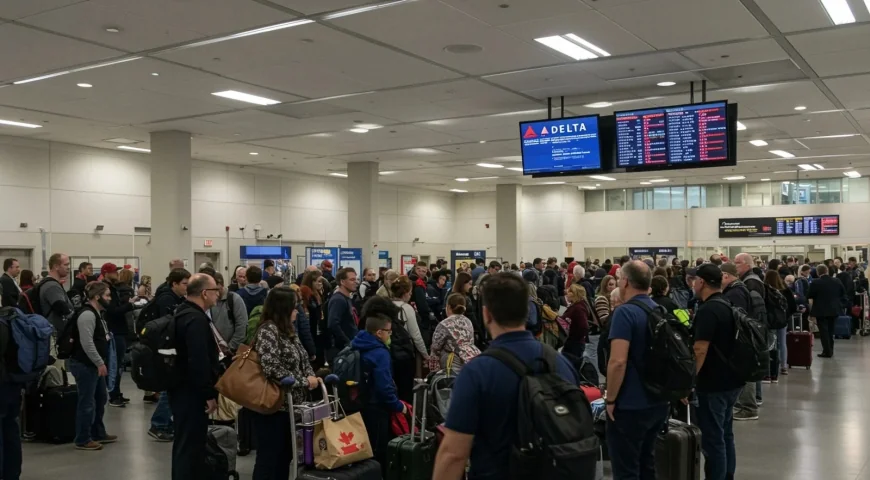
The passenger impact was immediate. Travelers reported long waits, missed connections and limited information at gates. At Los Angeles International Airport, one frustrated passenger reportedly used a gate intercom to ask whether any Delta staff were available, a moment that spread widely online and reflected the mood of customers who felt left without answers.
Hartsfield-Jackson Atlanta International Airport, Delta’s largest hub, appeared to absorb some of the heaviest pressure, with nearly 300 cancellations across Friday and Saturday. LAX also saw widespread delays over the same period, adding to passenger frustration at one of Delta’s most important coastal gateways.
The disruption arrives at an uncomfortable time for Delta. The airline has spent years building a premium image around operational consistency, strong customer service and better recovery during travel problems. But recent performance concerns have placed that image under scrutiny. Reports have pointed to a decline in Delta’s on-time performance from around 86% in March 2025 to about 79% in March 2026, while its reliability ranking among U.S. airlines has reportedly slipped from first place to sixth.
For an airline that often attracts higher-paying business travelers and loyal SkyMiles members, reliability is not a small issue. Passengers may forgive isolated disruption during storms or air traffic control problems, but they are less forgiving when cancellations appear tied to staffing, systems or internal planning.
There was one confirmed localized travel alert on Delta’s advisory page involving Pellston Regional Airport, where flooding forced runway closures and affected service to Detroit. The airport said it was working on water removal and runway repairs, with reopening targeted for May 5. While that issue affected Delta’s regional operation in Michigan, it did not account for the broader weekend cancellation surge.
For passengers caught in the disruption, the most important step is understanding refund and rebooking rights. Under U.S. rules, travelers are entitled to a refund when an airline cancels a flight or makes a significant schedule change and the passenger chooses not to accept the alternative offered. The U.S. Department of Transportation outlines those protections on its official aviation consumer page: U.S. Department of Transportation passenger rights.
Meal vouchers, hotels and ground transport are handled differently. Airlines are more likely to provide support when the disruption is considered controllable, such as staffing or maintenance issues. Passengers should ask directly for assistance, keep receipts and save screenshots of cancellation notices, boarding passes and rebooking offers.
Anyone flying Delta in the near term should check flight status frequently through the airline’s app and airport monitors. Rebooking early can matter, especially when cancellations begin stacking up across hubs. Travelers with tight connections may also want to review alternate routing through nearby airports or later same-day flights before airport agents are overwhelmed.
The weekend disruption also fits into a wider year of pressure for U.S. air travel. Security delays, weather shocks, fuel-cost concerns and route changes have already tested airlines and passengers in 2026. Swikblog has been tracking those travel disruptions closely, including recent coverage of U.S. travel chaos and airline delays.
Delta may still recover quickly if crews and aircraft return to position, but the reputational issue may last longer. A carrier known for dependable operations now has to show passengers that this was a temporary breakdown rather than a sign of deeper strain inside its network.
For now, the numbers tell the story clearly: more than 400 Delta flights cancelled, more than 1,000 delays recorded, and staffing issues at the center of growing concern. The next test is whether Delta can stabilize operations before passenger frustration turns into a broader confidence problem.

Make Swikblog your go-to source on Google for reliable updates, smart insights, and daily trends.