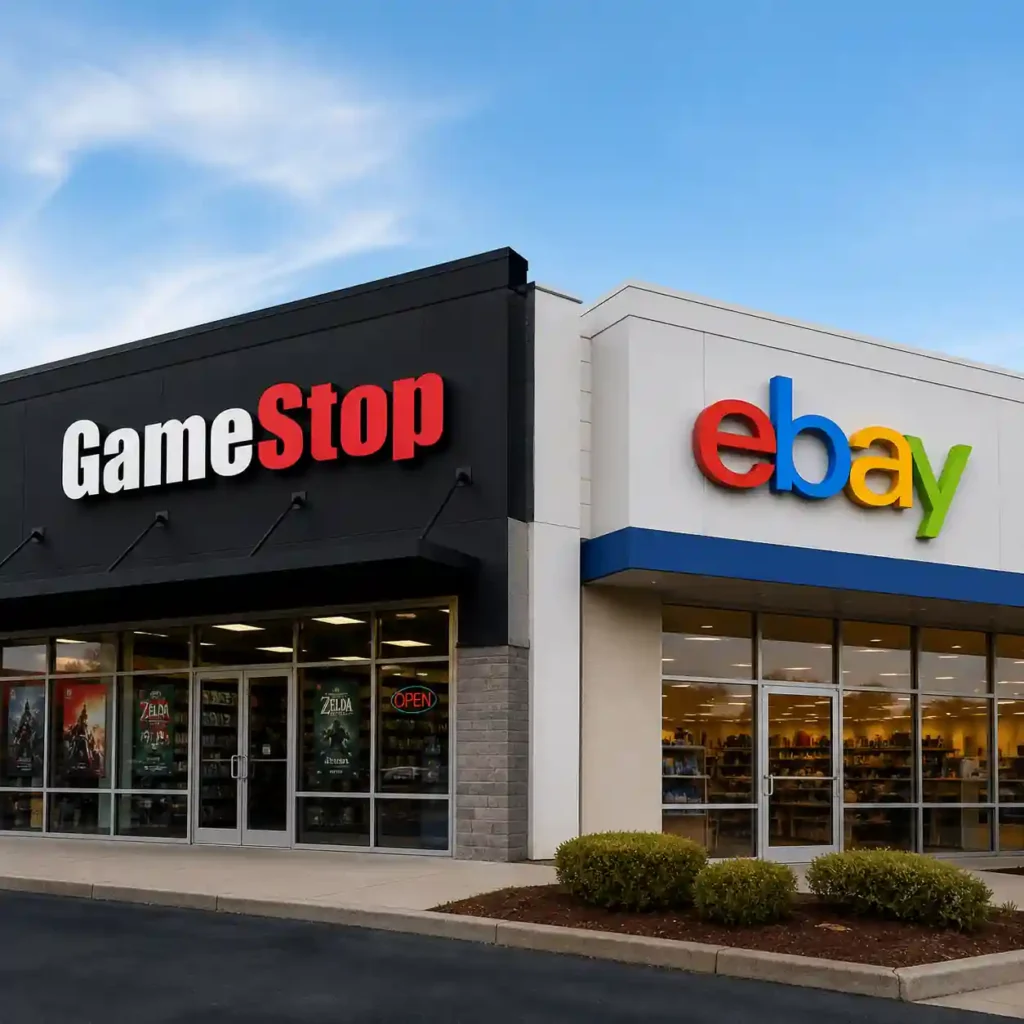

GameStop has made an unexpectedly aggressive move toward reshaping its future, putting forward a $55.5 billion proposal to buy eBay in a deal that could redefine both companies and reignite investor interest in one of the market’s most talked-about names.
The unsolicited offer values eBay at $125 per share, marking a clear premium over its recent trading price. The reaction was swift — eBay shares jumped roughly 14% after the news surfaced, while GameStop stock also climbed as investors weighed the potential of a high-stakes transformation strategy.
The scale of the move stands out immediately. GameStop, with a market value of around $11–12 billion, is attempting to acquire eBay, which is valued near $46 billion. Such a gap makes this one of the more unusual takeover attempts in recent years, raising questions about execution, financing, and long-term viability.
According to The Wall Street Journal, GameStop has already built a roughly 5% stake in eBay and is prepared to push forward even if the board resists. That could lead to a proxy battle, where shareholders ultimately decide whether to support the deal.
GameStop plans to finance the acquisition through a mix of cash, stock and debt. The company currently holds more than $9 billion in cash and has secured around $20 billion in debt financing from TD Securities. Even so, the size of the deal means additional structuring will likely be required, keeping investors cautious about how the transaction would be completed.
Ryan Cohen’s strategy is centered on efficiency and scale. He believes the combined entity could unlock about $2 billion in cost savings within a year. A significant portion — roughly $1.2 billion — is expected to come from trimming eBay’s sales and marketing expenses, which GameStop argues have not translated into sufficient user growth.
However, that approach carries risk. eBay remains a profitable and established platform with strength in categories like collectibles, luxury resale and auto parts. Reducing marketing spend too aggressively could slow growth or weaken its competitive position in an already crowded e-commerce landscape.
The deal is also about repositioning GameStop itself. Once heavily dependent on physical game sales, the company has struggled to adapt to digital distribution. While it has closed many stores, it still operates about 1,600 outlets across the United States. Cohen appears to see these locations as potential assets for eBay — enabling services like live commerce, product authentication and localized fulfillment.
If executed effectively, the combination could create a hybrid retail and marketplace model — something that sits between traditional e-commerce and physical retail. That could help the combined company compete more effectively in niche categories rather than directly challenging giants like Amazon across all segments.
Cohen has also taken an unconventional approach to compensation. He has said he would lead the merged company without a salary or bonus, with rewards tied entirely to performance. Supporters see this as alignment with shareholders, while critics view it as another high-risk bet tied to ambitious growth targets.
This move is the latest in GameStop’s ongoing effort to reinvent itself. The company gained global attention during the 2021 meme-stock rally, driven largely by retail investors. Since then, it has experimented with new strategies, including ventures into NFTs and bitcoin, but has yet to establish a stable long-term growth engine.
Read More
- Visit Swikblog Homepage
- Etihad A380 Toronto Flight Diverts to Munich After Medical Emergency
- Delta Cancels 400 Flights and Delays 1,000 Amid Staffing Issues
- Foxconn Satellite Launches on SpaceX Falcon 9
- Pokémon x Target Collection With 100 Items Set for June 6 Release
- Pittsburgh Marathon 2026 Results: Will Loevner and Jane Bareikis Win
For readers tracking such market shifts, platforms like Swikblog have increasingly focused on decoding these complex corporate strategies and investor reactions, especially as retail-driven narratives continue to influence stock movements.
For eBay shareholders, the decision is far from straightforward. The offer provides an immediate premium, but it also requires confidence in GameStop’s ability to manage a significantly larger business. eBay’s current strategy has delivered steady performance, and some investors may prefer stability over a high-risk transformation.
There are also broader concerns around integration. GameStop and eBay operate very different business models — one rooted in physical retail, the other in digital marketplaces. Combining these operations would require careful execution, strong leadership and a clear long-term strategy beyond cost-cutting.
Market reaction reflects both optimism and uncertainty. eBay’s share surge signals investor interest in the takeover premium, while GameStop’s rise suggests belief in Cohen’s vision. Still, unsolicited deals often face resistance, particularly when the buyer is smaller than the target.
The next phase will depend on eBay’s response. If the board rejects the offer, a shareholder battle could follow. If discussions begin, attention will shift to financing details, governance structure and the feasibility of the proposed cost savings.
For now, GameStop’s $55.5 billion bid has already reshaped the narrative. It has repositioned the company from a struggling retailer into a bold dealmaker willing to take significant risks. Whether this gamble pays off or not, it has firmly placed GameStop back at the center of market attention.
Related reading: GameStop stock updates and eBay stock analysis.

Make Swikblog your go-to source on Google for reliable updates, smart insights, and daily trends.