
By Swikriti Dandotia
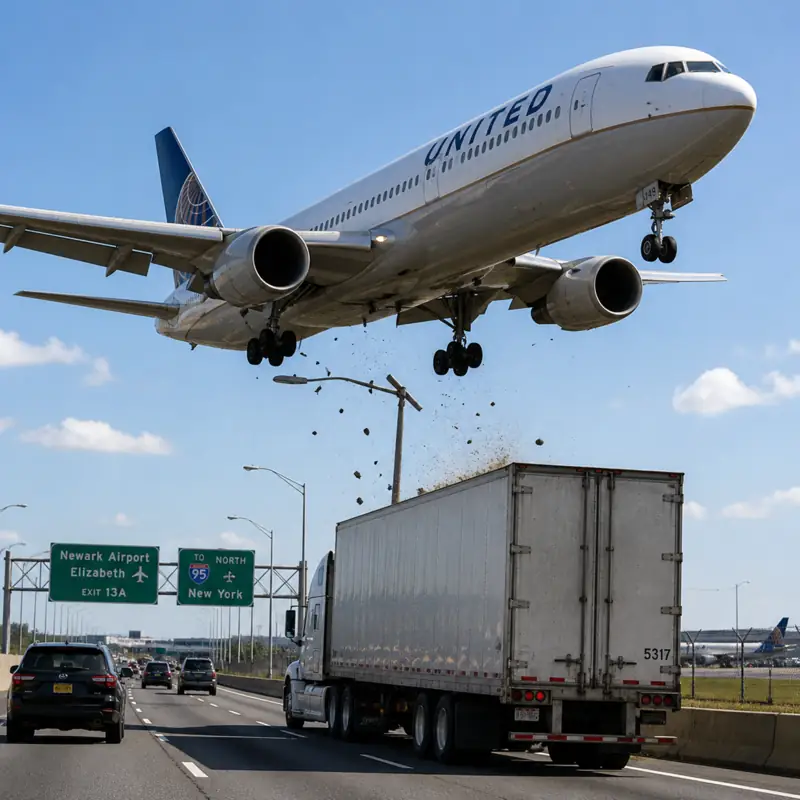
A United Airlines Boeing 767 arriving from Venice made an unusually dramatic landing at Newark Liberty International Airport on Sunday after the aircraft struck roadside infrastructure and a tractor-trailer near the New Jersey Turnpike, injuring the truck driver and triggering investigations by federal and state authorities.
The aircraft, operating as United Flight 169, was carrying 221 passengers and 10 crew members when it approached Runway 29 at Newark. The plane landed safely and continued to the gate, but the moments just before touchdown have drawn major attention after video showed the jet passing extremely low over highway traffic.
No passengers or crew members were injured, according to United Airlines. The driver of the tractor-trailer suffered cuts from broken glass and was taken to hospital with non-life-threatening injuries.
How the Newark landing incident unfolded
The incident happened as the Boeing 767-400 was completing its final approach to Newark after a transatlantic flight from Venice, Italy. As the jet crossed near the New Jersey Turnpike, part of its landing gear and underside came into contact with a light pole and a tractor-trailer below, according to preliminary information from authorities.
The truck involved was reportedly carrying bakery products and was headed toward a depot near Newark Airport. The driver, identified in reports as Warren Boardley of Baltimore, was able to keep control of the vehicle after the impact and pull over safely.
Dashcam footage from the truck captured the sound of the aircraft getting louder seconds before the impact. Glass then shattered inside the cab as debris struck the vehicle. The trailer and its cargo were not seriously damaged, but the driver suffered cuts to his arm and forearm.
Witnesses traveling near the airport described seeing the United jet crossing the highway at a height that appeared much lower than usual. Some said they felt a sudden gust of air as the aircraft passed overhead before smoke and debris appeared near the roadway.
The aircraft continued its landing and touched down on Runway 29. United later said the plane taxied to the gate normally and that maintenance crews were checking the aircraft for damage.
Runway 29 at Newark is located close to the New Jersey Turnpike, making low aircraft approaches visible to drivers when that runway is in use. The runway begins less than 400 feet from the edge of the highway, a layout that can look alarming from the ground even during normal operations.
FAA and NTSB investigation now underway
The Federal Aviation Administration and the National Transportation Safety Board are investigating how the aircraft came into contact with the pole and truck. The NTSB is expected to review the cockpit voice recorder, flight data recorder, aircraft performance, weather conditions, runway approach path and air traffic control communications.
United Airlines said the flight crew has been removed from service while the safety review takes place. That step is standard after serious operational incidents and does not by itself indicate blame.
One key question for investigators will be whether the aircraft was lower than expected during final approach or whether another factor contributed to the collision. Investigators may also examine the placement of roadside structures near the approach path and whether additional safeguards are needed around the runway area.
Air traffic control recordings reportedly suggest that controllers and pilots did not immediately appear to realize the aircraft had struck something before landing. The jet was later given normal taxi instructions, while other aircraft continued using the airport after inspections were completed.
Airport officials said runway checks were carried out soon after the incident and normal operations resumed. The safe landing meant there was no large-scale disruption at Newark, though the event quickly became a major aviation story because of how close the plane came to traffic on one of New Jersey’s busiest roadways.
For readers looking to understand how U.S. aviation incidents are reviewed, the National Transportation Safety Board explains its investigation process and safety recommendations on its official website: NTSB investigation process.
The aircraft involved, a Boeing 767-400, is a widebody jet commonly used on long-haul international routes. United operates the aircraft on major transatlantic services, including flights between Europe and the New York area.
While the incident was frightening, aviation safety experts often caution that a safe landing after an abnormal event is exactly why post-incident inspections, flight data reviews and crew interviews are so important. The purpose of the investigation is not only to identify what happened, but also to reduce the chance of a similar event in the future.
The close call has also renewed attention on airports built near dense roads, rail lines and urban infrastructure. Newark is one of the busiest airports in the New York metropolitan region, and its runway layout places some approaches close to surrounding highways.
For the truck driver, passengers and crew, the outcome could have been far worse. The aircraft reached the gate, the people onboard were unharmed, and the driver’s injuries were not life-threatening. But the investigation will now focus on the narrow margin between a safe landing and a potentially serious accident.
As videos continue to spread online, the Newark incident is likely to remain under public scrutiny until federal investigators release more details about the aircraft’s final approach, the exact point of contact and whether changes are needed around Runway 29.
You may like: Jellyfish Cloud Lights Up Florida Sky After SpaceX Falcon 9 Starlink Launch

Make Swikblog your go-to source on Google for reliable updates, smart insights, and daily trends.