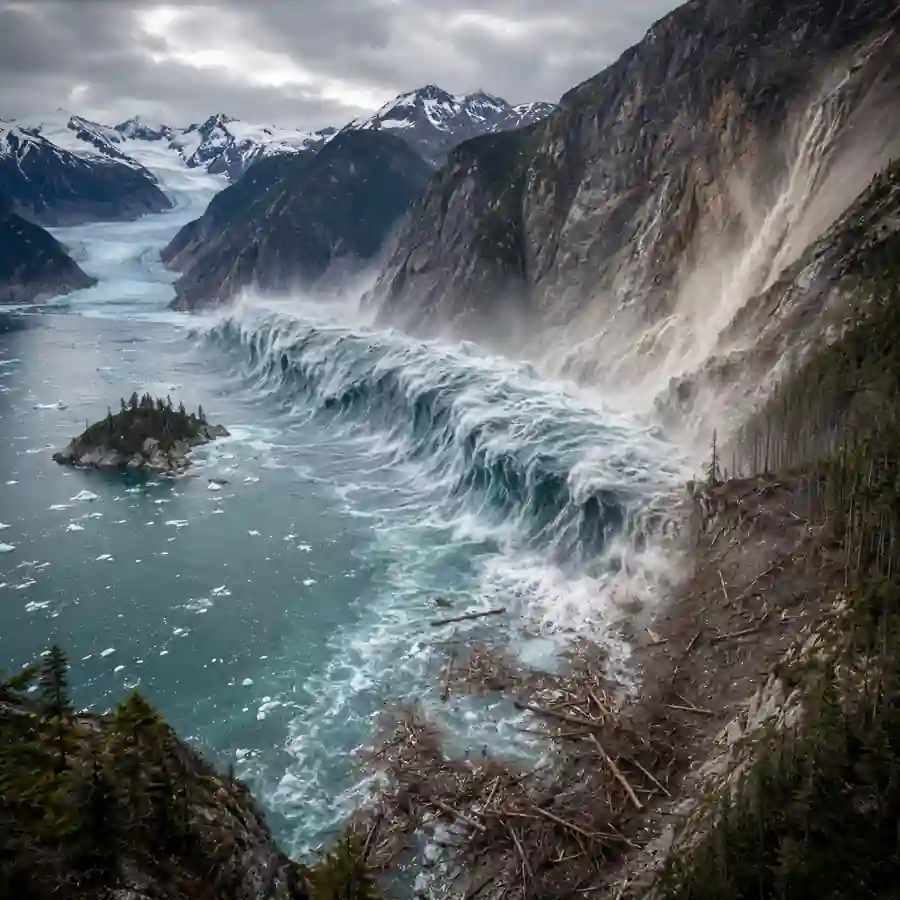

A remote fjord in southeast Alaska has become the center of a major climate and safety warning after scientists confirmed that a landslide near South Sawyer Glacier triggered a megatsunami almost 500 meters high.
The wave, generated inside Tracy Arm Fjord in August 2025, is now considered the second-tallest megatsunami ever recorded. While the disaster happened far from major towns, researchers say its timing may have prevented a tragedy involving cruise ships, tour boats and kayakers who regularly visit the area during Alaska’s summer travel season.
The event was not widely reported when it happened. But new scientific analysis has revealed the extraordinary scale of the collapse: about 64 million cubic meters of rock broke loose from a steep mountainside and plunged nearly one kilometer into the fjord below.
That sudden impact displaced the water with such force that it sent a wall of water racing up the surrounding slopes. The highest run-up reached about 481 meters, a height greater than the Eiffel Tower and close to some of the world’s tallest man-made landmarks.
Why This Alaska Megatsunami Was So Powerful
Unlike the ocean-wide tsunamis caused by major earthquakes, this Alaska megatsunami was created by a landslide inside a narrow fjord. That difference matters.
In open water, tsunami energy can spread across long distances. In Tracy Arm, the water was trapped between steep rock walls. When millions of tonnes of rock crashed into the fjord, the energy had nowhere to go quickly. Instead, the water surged upward and outward with extreme force.
The wave stripped trees, soil and vegetation from the fjord walls. Field teams later found damaged shorelines, uprooted forests, scarred rock and debris scattered across areas that had previously been covered in green slopes.
Scientists used satellite images, seismic data, field observations and computer modeling to reconstruct the event. Their findings show that the water did not simply rise once and disappear. The impact triggered repeated sloshing inside the fjord, a phenomenon known as a seiche, which continued for many hours after the landslide.
The U.S. Geological Survey has documented the landslide and tsunami damage in Tracy Arm and noted that areas affected by large landslides can remain unstable after the first collapse. Read the USGS summary on the Tracy Arm landslide and tsunami.
The only known megatsunami larger than this event was the 1958 Lituya Bay tsunami in Alaska, which remains the highest recorded tsunami in history. That comparison has made the Tracy Arm event especially important for researchers studying fast-changing glacier regions.
The Cruise Ship Risk That Makes This Event Alarming
One reason this disaster is attracting global attention is not only the size of the wave, but where it happened.
Tracy Arm is a well-known destination for cruise ships and expedition vessels. Visitors travel through the fjord to see glaciers, cliffs, waterfalls, floating ice and wildlife. In the summer, the wider Tracy Arm and Endicott Arm area can see heavy marine traffic.
The landslide happened early in the morning, around 5:26 a.m. local time. That timing likely reduced the number of vessels close to the danger zone.
Researchers have said that a cruise ship near the head of the fjord would have faced an unsurvivable situation. A vessel caught directly in the path of a wave hundreds of meters high would have had almost no chance to escape.
Reports from nearby boats described unusual surges, strong currents and sudden changes in water level after the event. Some people in surrounding waterways noticed the effects even though they were far from the landslide itself.
This is why scientists are calling the Alaska megatsunami a warning, not just a natural curiosity. The wave happened in a remote place, but not an unused place. It struck a landscape that tourism companies actively promote as wild, beautiful and dramatic.
Some cruise operators have since moved to avoid Tracy Arm because of safety concerns. That response shows how quickly a scientific finding can become a real-world issue for travel companies, insurers, regulators and local communities that depend on tourism.
How Melting Glaciers May Have Set the Stage
The Tracy Arm landslide also raises a deeper concern about climate change and unstable mountain slopes.
Glaciers do more than carve valleys. In many fjords, they also help support steep rock walls. When a glacier retreats, it can remove pressure from the base of a slope and expose rock that was previously held in place by ice.
Researchers believe that retreat of South Sawyer Glacier played an important role in this collapse. As the glacier pulled back, the mountainside became more exposed and vulnerable. Eventually, the weakened rock mass failed and dropped into the fjord.
This type of hazard is expected to become more important in glacier-covered regions as warming continues. Alaska, Greenland, parts of Canada and other high-latitude fjord landscapes all contain steep slopes, retreating ice and waterways used by ships or coastal communities.
Megatsunamis are usually local events. They do not travel across entire oceans like earthquake-triggered tsunamis. But that does not make them less dangerous for people nearby. In the impact zone, they can be far taller than conventional tsunamis and can destroy everything along the shoreline within minutes.
The Tracy Arm event shows how quickly a quiet glacier landscape can turn into a disaster zone. A mountainside can fail in seconds, a wave can climb hundreds of meters, and people on boats or shorelines may have little or no warning.
Scientists are now calling for better monitoring of unstable slopes in high-risk fjords. That could include satellite tracking, seismic sensors, slope movement detection and emergency alert systems for vessels operating in remote glacier regions.
The Alaska megatsunami did not cause a mass-casualty disaster. But researchers say that outcome should not be mistaken for safety. It was a rare case where timing, location and luck prevented a much worse result.
For Alaska’s tourism industry and other glacier regions around the world, the message is clear: melting ice is not only changing the view. In some places, it is changing the risk beneath the mountains.
You may like: BBC Breakfast’s Carol Kirkwood Reveals Final Show Date After 25 Years on Air

Make Swikblog your go-to source on Google for reliable updates, smart insights, and daily trends.