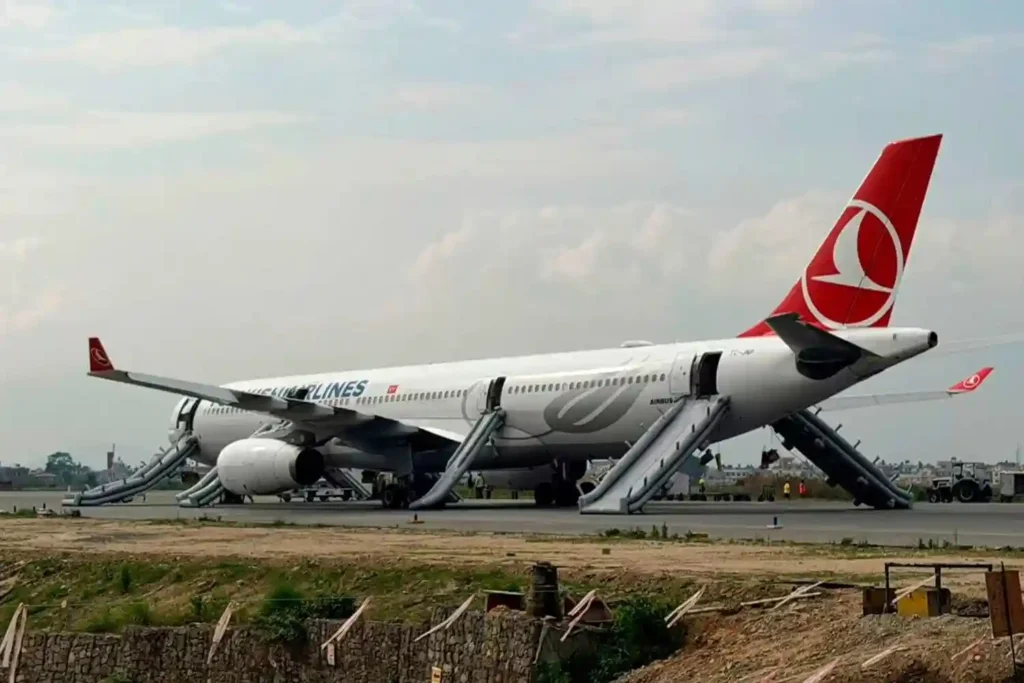

A Turkish Airlines flight carrying 288 people was evacuated at Nepal’s Tribhuvan International Airport on Monday after smoke and fire were reported around the aircraft’s landing gear shortly after it arrived in Kathmandu from Istanbul.
The Airbus A330, operating as Turkish Airlines Flight TK726, had 277 passengers and 11 crew members on board when the incident unfolded at Nepal’s main international airport on May 11. Officials said everyone on the aircraft was safely evacuated and no injuries were reported.
The emergency began after the aircraft completed its landing and was taxiing at Kathmandu airport. Turkish Airlines said smoke was noticed coming from the landing gear area after what it described as a normal landing. Air traffic control then instructed the crew to evacuate passengers as a precaution.
Passengers left the aircraft through emergency slides while airport fire crews moved in to control the situation. Images from the scene showed emergency teams around the wide-body jet after the evacuation, with ground staff later collecting evacuation equipment near the aircraft.
Turkish Airlines Senior Vice President of Communications Yahya Üstün said the evacuation was completed successfully and that the airline had started technical checks on the aircraft. The airline’s early assessment pointed to a technical malfunction in a hydraulic pipe as the likely reason smoke appeared near the landing gear.
Nepal’s Civil Aviation Authority said the fire was reported in the aircraft’s right rear tire area. Emergency crews extinguished the fire before the aircraft was towed away from the runway. The incident forced Tribhuvan International Airport to close temporarily, disrupting flights at a key gateway used by international travelers, trekkers and passengers connecting through Nepal.
According to The Associated Press, the airport was shut after the Turkish Airlines jet caught fire while landing, and all passengers were reported safe. The closure caused delays because Kathmandu’s main airport operates with a single runway, meaning even a short emergency can affect both arriving and departing flights.
Civil Aviation Authority of Nepal spokesperson Gyanendra Bhul said the immediate rescue operation had ended safely and that officials had opened an investigation into the incident. The aircraft remained under technical inspection as teams examined the landing gear, tire, brake and hydraulic systems.
The safe outcome is significant because fires near landing gear can become dangerous quickly. Tires, brakes and hydraulic lines are exposed to intense pressure and heat during landing, especially on long-haul flights. Even when a plane lands normally, a leak or mechanical fault near the gear area can produce smoke, sparks or fire while the aircraft is still moving on the runway.
In this case, the crew’s decision to evacuate passengers by slides appears to have prevented panic from turning into injury. Emergency evacuations are risky even when the aircraft is stationary because passengers must leave quickly, often without luggage, while cabin crew manage movement through exits under pressure.
The Kathmandu incident has also drawn attention because Nepal’s aviation sector has faced repeated safety scrutiny over the years. The country’s mountainous terrain, fast-changing weather and difficult airport approaches make aviation operations more demanding than in many other regions.
Read More
- Visit Swikblog Homepage
- CSL Hit by $7 Billion Blow After Cutting Earnings Forecasts
- Spring & Mulberry Chocolate Bars Recall Over Salmonella Risk
- Victoria Offers Free Meningococcal B Vaccines for Year 10 Students
- Stephen Perofeta Set for Japan Move
- Food Allergy Awareness Week 2026 Highlights Rising Cases
Tribhuvan International Airport is especially important because it serves as Nepal’s primary international air link. When its runway closes, there are limited alternatives for international traffic, making any disruption more serious for travelers and airlines.
Turkish Airlines has faced trouble at the same airport before. In 2015, a Turkish Airlines Airbus A330 skidded off the runway while landing in dense fog at Kathmandu. No one was killed in that incident, but the aircraft blocked the runway and forced the airport to close for days.
Nepal’s aviation history also includes more severe disasters. In January 2023, a Yeti Airlines domestic flight crashed near Pokhara, killing 68 people. That crash renewed international concern about aviation safety in the country and led to fresh focus on pilot training, infrastructure and weather-related risks.
Monday’s incident was far less severe, but it still underlines how quickly a routine landing can become an airport emergency. The aircraft had already reached the ground, but smoke from the landing gear triggered a full safety response, runway closure and evacuation of nearly 300 people.
Turkish Airlines said an additional flight was being arranged for affected passengers while inspections continued. The airline has not yet confirmed when the aircraft involved in the incident will return to service.
The investigation is expected to determine whether the fire was caused by a hydraulic pipe failure, tire issue, brake overheating or another mechanical problem. Until that review is complete, the aircraft is likely to remain grounded in Kathmandu.
The incident follows several recent travel disruptions involving smoke, fire alarms and emergency airport responses, including a Newark Airport flight halt after a burning smell triggered a tower evacuation. Such events show how quickly aviation systems can be disrupted when safety teams detect possible fire risks.
For passengers on Flight TK726, the most important fact is that the emergency ended without injuries. A wide-body aircraft carrying 288 people landed in Kathmandu, smoke appeared near the landing gear, passengers evacuated by slides, firefighters extinguished the fire, and everyone survived safely.
The final cause will depend on the technical investigation, but the response at Kathmandu airport may be remembered as a close call that was handled before it became a tragedy.

Make Swikblog your go-to source on Google for reliable updates, smart insights, and daily trends.