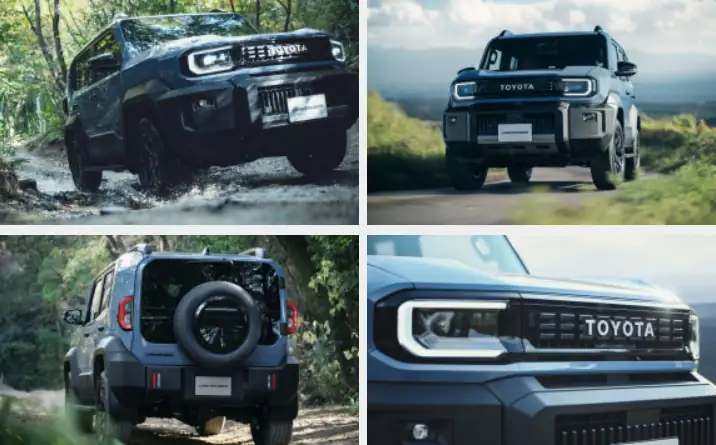

Toyota has added a new and important member to the Land Cruiser family with the launch of the Land Cruiser FJ in Japan. Priced from 4,500,100 yen, the new SUV is now the most affordable model in the current Land Cruiser range, sitting below the 70, 250 and 300 series. But the bigger story is not just the lower price. Toyota has used the FJ to create a smaller, easier-to-drive Land Cruiser without cutting away the engineering that gives the badge its credibility.
The Land Cruiser name carries a very specific expectation. Buyers do not look at it only as another SUV brand. For decades, it has stood for durability, rough-road strength and long-distance dependability. That is why Toyota’s decision to launch a compact Land Cruiser with a proper ladder-frame platform is notable. The FJ is aimed at customers who want the toughness of a traditional Land Cruiser but in a size that is easier to live with in cities, narrow roads and everyday parking spaces.
According to Toyota’s official newsroom, the new FJ was developed around the idea of “Freedom & Joy.” Toyota says the goal is to let more customers enjoy the Land Cruiser experience while keeping the brand’s core values of reliability, durability and off-road performance. That positioning makes the FJ more than a budget version of a bigger SUV. It is a different type of Land Cruiser, designed for buyers who want capability in a more manageable package.
What Makes the Land Cruiser FJ Different
The Land Cruiser FJ is offered in Japan in a single VX grade. It uses a naturally aspirated 2.7-liter inline four-cylinder gasoline engine, producing 120 kW, or 163 PS, and 246 Nm of torque. The engine is paired with a 6-speed automatic transmission known as 6 Super ECT and a part-time four-wheel-drive system. Toyota says the setup improves smoothness from start-off to low-speed driving, which matters in daily use, while also supporting better control on downhill sections.
Fuel economy is rated at 8.7 km/L under the WLTC cycle. That figure makes it clear that the FJ is not being marketed as a fuel-saving crossover. Instead, Toyota is focusing on mechanical simplicity, predictable power delivery and strength on poor surfaces. For customers who use their vehicles for camping, rural travel, mountain roads or outdoor work, that approach may be more important than headline acceleration figures.
The SUV is based on a ladder-frame structure, a key detail that separates it from most compact SUVs. Toyota says the platform was trained through the IMV series, which has a strong reputation in tough markets, and then revised to match the FJ’s body size. The wheelbase has been shortened, while additional braces have been added to improve frame rigidity and handling stability.
The suspension setup also supports the FJ’s off-road character. Toyota has used a high-mount double-wishbone front suspension and a rear rigid axle with a four-link layout and lateral rod. This type of hardware is not chosen only for comfort on smooth highways. It is designed to help the vehicle remain stable and capable when the road surface becomes uneven.
Toyota has also included important off-road support systems. The FJ gets Downhill Assist Control to help maintain stability on steep descents, Hill-start Assist Control to reduce rollback when starting on slopes, and an electric rear differential lock to improve traction when grip is limited. These features make the vehicle more approachable for less experienced off-road drivers while still giving serious users hardware they can rely on.
In size, the FJ is noticeably more compact than the Land Cruiser 250. It measures 4,575 mm in length and 1,855 mm in width, making it 350 mm shorter and 125 mm narrower than the 250 series. Its wheelbase is 2,580 mm, which is 270 mm shorter than the Land Cruiser 250. Toyota also says the vehicle has a minimum turning radius of 5.5 meters, which should make it easier to maneuver in urban traffic, tight parking areas and narrow trails.
Despite being smaller, Toyota has worked to keep the vehicle useful inside. The FJ is a two-row, five-seat SUV with a 60:40 split-folding rear seat. The rear seat can slide and recline, and it also comes with backboard support. With the rear seats in use, Toyota lists the luggage space at 795 liters, with a minimum luggage length of 735 mm and a luggage height of 1,030 mm. When the rear seats are folded, the luggage length increases to 1,480 mm and capacity rises to 1,607 liters.
This practicality is important because the FJ is not only being built for image. Toyota appears to be targeting people who want to carry outdoor equipment, travel luggage, tools or camping gear without buying a larger and more expensive Land Cruiser. The boxy body shape is not just for nostalgia either. It helps deliver usable cabin and cargo space while giving the driver a better sense of the vehicle’s corners.
Design, Safety and Toyota’s Bigger SUV Strategy
The design follows the traditional Land Cruiser formula but gives it a more playful character. Toyota describes the body as being inspired by a dice motif, with a strong rectangular shape and chamfered edges. The SUV carries a square cabin, wide-looking bumpers, pronounced fenders, the classic TOYOTA logo and a rear-mounted spare tire. These details make it look more like a true off-roader than a family crossover wearing rugged styling.
Read More
The front and rear corner bumpers use a split removable design, so damaged sections can be replaced more easily. That detail matters for an SUV expected to see rougher use, because repairability is part of real-world durability. Standard exterior equipment includes roof rails for outdoor gear, side steps for easier entry and a skid plate to help protect the engine and transmission during rough-road driving.
Toyota has also given attention to visibility and driving confidence. The cabin uses a horizontal instrument panel so the driver can better understand the vehicle’s posture. The low cowl and dashboard top are designed to improve forward visibility, while controls and switches are grouped for easier operation. The FJ also comes with Toyota Safety Sense, including pre-collision safety and lane departure alert. A panoramic view monitor, blind spot monitor and 12.3-inch display audio system with connected navigation support are also listed as standard equipment.
Body color options include Smoky Blue, Oxide Bronze Metallic, Ash, Attitude Black Mica and Platinum White Pearl Mica. Toyota is also offering exterior accessories and customization options, which could help the FJ appeal to lifestyle buyers as well as off-road enthusiasts.
The pricing gives the launch extra weight. At 4,500,100 yen, the Land Cruiser FJ is around 300,000 yen cheaper than the Land Cruiser 70 in Japan. That makes it the new entry point to the Land Cruiser range and could bring younger buyers or first-time Land Cruiser customers into the brand. Toyota’s wider SUV strength has already been visible in global markets, including the company’s recent momentum in the U.S. discussed in this Swikblog report on Toyota’s gains as Ford EV sales declined sharply.
Production will take place at Toyota Motor Thailand’s Ban Pho plant, with Toyota setting a monthly sales target of 1,300 units. The Thailand production base also reflects Toyota’s long experience building durable utility vehicles for demanding markets.
Alongside the FJ, Toyota has announced the LAND HOPPER, a single-seat electric personal mobility vehicle planned for release in spring 2027 or later. It uses a two-wheel front structure for stable off-road movement and is designed to be carried in a vehicle’s luggage area. The idea is simple: drive the Land Cruiser to the edge of a trail, then continue exploring beyond where the SUV can go.
The Land Cruiser FJ may be the cheapest model in the range, but Toyota has not treated it like a stripped-down badge exercise. Its ladder-frame construction, compact wheelbase, real 4WD hardware, off-road assist systems, practical cargo space and repair-friendly exterior details show a focused product strategy. For buyers who want a smaller SUV with genuine Land Cruiser DNA, the FJ could become one of Toyota’s most interesting launches of 2026.

Make Swikblog your go-to source on Google for reliable updates, smart insights, and daily trends.