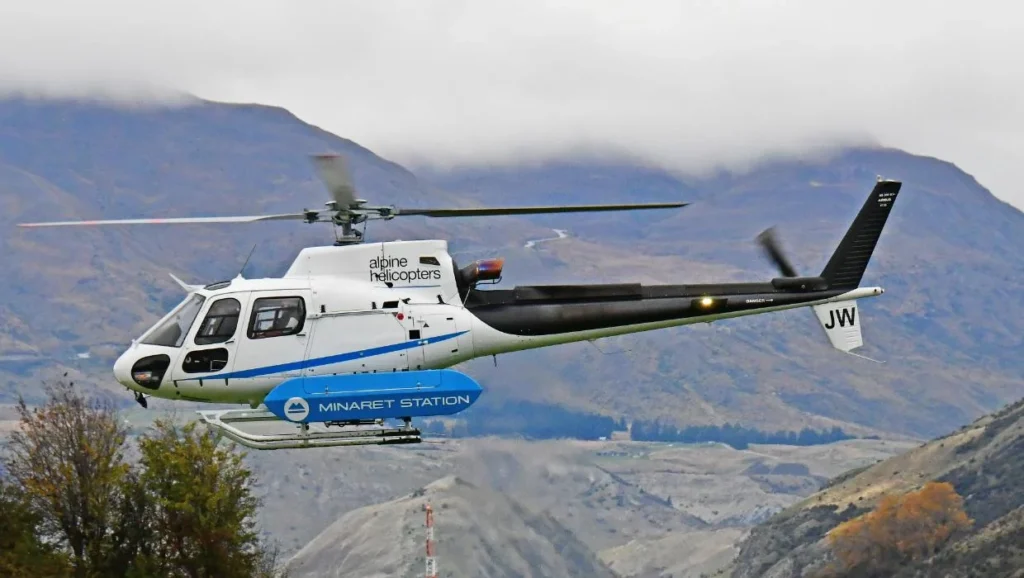

A fatal helicopter crash in New Zealand’s South Island has placed Alpine Helicopters back under national attention after chief pilot Tim Brown and his friend Sean Roach were killed during a guided hunting operation in Mt Aspiring National Park.
The crash happened on Sunday morning in remote alpine terrain west of Makarora. Brown and Roach were travelling in an Airbus AS350B3, commonly known as a Squirrel helicopter, when the aircraft came down in the upper Te Naihi River area of South Westland. Both men were the only occupants on board and died in the accident.
Police said they received the first report of the incident at about 9.50am. The Transport Accident Investigation Commission later confirmed the helicopter had crashed into a mountainside roughly 24km west of Makarora, an area known for steep backcountry terrain and limited access.
Flight tracking information showed the aircraft had departed Wanaka Airport at 7.39am. It climbed above 5500 feet while heading north before later descending. Its last mapped position was recorded around 8.11am, when the helicopter was slightly above 3000 feet.
Three other members of the hunting party were not inside the helicopter when it crashed. They were found on the ground and taken to safety with minor injuries, according to officials.
Alpine Helicopters said the aircraft was carrying out a guided hunting operation in clear and calm conditions at the time of the accident. The company said it was devastated by the loss and described Brown and Roach as highly experienced and valued members of a close-knit team.
“Both were highly experienced and valued members of a close-knit team,” the company said in its statement, adding that its thoughts were with the families and loved ones of both men.
The company also thanked emergency teams involved in the response, including New Zealand Police, the Rescue Coordination Centre, Otago Southland Rescue Helicopter Trust and Queenstown Alpine Cliff Rescue.
The crash is now being investigated by the Transport Accident Investigation Commission and the Civil Aviation Authority. The deaths have also been referred to the coroner. Investigators are expected to examine the wreckage, flight path, weather, aircraft condition and operational factors before releasing formal findings.
Brown was widely respected in New Zealand aviation circles. He was educated at Mount Aspiring College in Wanaka and built his career through several aviation operators, including Paton Air, Roncato Helicopters and Elite Aviation Services, before joining Alpine Helicopters.
His role as chief pilot placed him at the centre of the company’s flying operations. Friends and colleagues have described him as a skilled pilot with deep connections across the agricultural, farming and aviation sectors.
A Givealittle page set up to support Brown’s family said his death had left an immense void for those who knew him. It also noted that he had recently invested heavily in a new business venture, adding financial pressure to the emotional shock now facing his family.
Sean Roach was also well known in Otago and Southland communities. Educated at Wakatipu High School, he was an accomplished golfer and had once captained the Otago men’s amateur golf team.
Roach had survived another dramatic hunting incident years earlier. In 2008, when he was 20, he was seriously injured after being speared by a stampeding stag during a deer hunting trip near Naseby. He suffered deep puncture wounds but survived the attack.
The deaths of Brown and Roach have drawn fresh attention to Alpine Helicopters’ difficult history. The company was founded in the early 1960s by Sir Tim Wallis, one of New Zealand’s best-known aviators. Wallis helped pioneer helicopter deer recovery and later expanded the business into tourism and commercial flying.
Sir Tim Wallis survived several major crashes during his lifetime, including a 1968 helicopter accident involving overhead power lines that left him with serious injuries. In 1996, he crashed a Spitfire at high speed at Wanaka Airport and was unable to fly again. He died in 2023.
Read More
- Visit Swikblog Homepage
- Two Fighter Jets Collide at Idaho Air Show
- Italian Men Who Won Rome Before Jannik Sinner
- Timmy the Humpback Whale Found Dead After Rescue Attempt Failed
- Trump’s Rededicate 250 Rally Sparks Church-State Debate
- Iyo Sky Officially Announces Marriage to WWE Star Naraku
- Q-Day Threat: Google’s Quantum Cybersecurity Warning
The Wallis family also suffered two major aviation losses in 2018. Alpine Helicopters pilot Nick Wallis died with two Department of Conservation workers when their helicopter crashed soon after takeoff from Wanaka Airport during a tahr control mission near Haast. Just three months earlier, Matt Wallis died when his helicopter crashed into Lake Wanaka while he was flying alone toward Mt Aspiring National Park.
That history makes the latest crash especially painful for the company and the wider aviation community. Mountain helicopter flying in New Zealand is highly demanding, particularly in remote valleys where weather, terrain, altitude and visibility can change quickly. Even experienced pilots face narrow margins in rugged alpine environments.
At this stage, there is no official cause for the crash. Authorities have not suggested whether mechanical failure, terrain, weather, visibility or another factor contributed to the accident. Until the TAIC and CAA complete their work, any conclusion would be premature.
The incident also adds to broader concerns around helicopter safety in remote tourist, conservation and hunting operations. Swikblog previously reported on another fatal aviation case involving a helicopter crash near Kauai in Hawaii, where difficult terrain also complicated the investigation and recovery effort.
For now, the focus remains on the families of Tim Brown and Sean Roach, the emergency crews who responded, and the investigators working to establish how a flight in calm conditions ended in tragedy.

Make Swikblog your go-to source on Google for reliable updates, smart insights, and daily trends.