
The Trump-backed Rededicate 250 prayer rally on the National Mall has opened a new front in America’s long-running fight over religion, politics and constitutional limits. What was promoted as a national moment of prayer before America’s 250th anniversary has quickly become a test case for how far a presidential administration can go in placing religious identity at the center of public celebration.
The event, officially titled “Rededicate 250: A National Jubilee of Prayer, Praise & Thanksgiving,” was organized as part of the wider America 250 commemorations. It brought together public officials, conservative Christian figures, musicians and faith leaders for a day centered on worship and national reflection. Supporters described it as a patriotic gathering rooted in gratitude, faith and the country’s spiritual heritage.
But the political reaction has been far from united. Critics say the rally went beyond ordinary public prayer and moved toward government endorsement of a particular religious worldview. The concern is not that Americans gathered to pray. The concern is that a major anniversary event connected to federal celebration efforts appeared to frame the United States through one dominant religious lens.
That distinction matters because the U.S. Constitution protects both religious exercise and religious independence from government control. The First Amendment bars the government from establishing a religion, while also protecting the right of individuals and communities to worship freely. In practice, that balance has allowed Christianity, Judaism, Islam, Hinduism, Sikhism, Buddhism, atheism and many other beliefs to exist without the state formally choosing one as the national faith.
Rededicate 250 has become controversial because of its language. The idea of “rededicating” America as “One Nation Under God” sounds inspirational to many religious conservatives, but it raises a deeper historical question: was the United States ever officially dedicated to one faith in the first place?
The Constitution does not describe America as a Christian nation. Its original text mentions religion mainly by rejecting religious tests for public office. The First Amendment later made clear that Congress must not establish a religion. That framework was designed not to remove faith from American life, but to prevent government from controlling or privileging it.
Some of the phrases now treated as ancient American identity markers are also more recent than many people realize. “One Nation Under God” was added to the Pledge of Allegiance in 1954 during the Cold War. “In God We Trust” became the national motto in 1956. Before that, the older national motto E pluribus unum — “Out of many, one” — better captured the civic idea of unity across difference.
This is why the National Mall event has drawn scrutiny from legal experts and religious liberty advocates. According to The Washington Post’s coverage of Rededicate 250, the rally became a focal point in the growing national debate over religion, constitutional limits and political power ahead of America’s 250th anniversary celebrations.
The speaker lineup added to the criticism. Reports said the event was expected to include messages or appearances from President Donald Trump, House Speaker Mike Johnson, Secretary of State Marco Rubio and Defense Secretary Pete Hegseth, along with prominent figures from the religious right. Organizers said Americans of all backgrounds were welcome, but critics noted that the faith leadership appeared heavily weighted toward conservative Christianity.
That imbalance has fueled accusations of Christian nationalism — a political ideology that presents the United States as fundamentally Christian and argues that public life should reflect that identity. Supporters of the rally reject that criticism, saying faith has always shaped American public life and that religious citizens should not be pushed out of civic events.
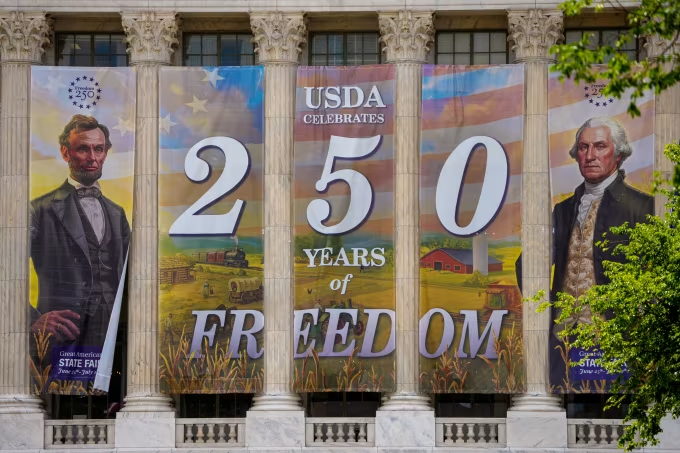
The funding questions have made the debate sharper. Freedom 250, connected to the National Park Foundation structure around America 250 events, helped organize the gathering. Reports said America 250 activities involve a mixture of private support and public resources, although the exact amount connected to this particular rally was not immediately clear. For critics, even indirect government involvement in a worship-focused event raises serious concerns.
Read More
- Visit Swikblog Homepage
- Canadian Cruise Passenger Tests Positive for Andes Hantavirus
- United Airlines Pacific WiFi Outage Hits 17-Hour Flights
- Timothy Spall’s Death Valley Returns Tonight on BBC One
- WA Shuts Down 6 Tobacco Stores Over Illegal Tobacco Laws
- Qantas Flight Diverted to Tahiti After Passenger Bites Flight Attendant
The controversy also arrives during a broader faith push inside Trump’s second administration. Federal agencies have faced scrutiny over Christian-themed messaging, Bible readings, prayer events and public religious language from senior officials. To supporters, these gestures reflect respect for faith. To opponents, they suggest a government culture increasingly comfortable favoring one religious tradition.
Religious minority leaders have also objected to repeated references to America as a “Judeo-Christian” nation. Some argue that the phrase is often used to make the language sound inclusive while still leaving out Muslims, Hindus, Sikhs, Buddhists, atheists and others who are part of the American public.
The political impact could be significant. For Trump’s base, Rededicate 250 may reinforce the message that his administration is defending Christian values and restoring faith to public life. For critics, it may become a warning sign that America’s 250th anniversary is being shaped less as a celebration of constitutional democracy and more as a culture-war stage.
Swikblog has already covered the broader political branding around the anniversary in Trump’s America 250 strategy coverage. Rededicate 250 now adds a more sensitive layer to that story: the role of religion in defining national identity during a deeply divided election-era America.
The central question after the rally is not whether faith belongs in American life. It clearly does. The more urgent question is whether government-backed national events should make any citizen feel that full belonging depends on sharing the religion of those in power.
As America approaches its 250th birthday, Rededicate 250 shows that the anniversary will not only be about fireworks, flags and patriotic speeches. It will also test how the country understands freedom, pluralism and the constitutional promise that government should protect religion without becoming an instrument of it.

Make Swikblog your go-to source on Google for reliable updates, smart insights, and daily trends.