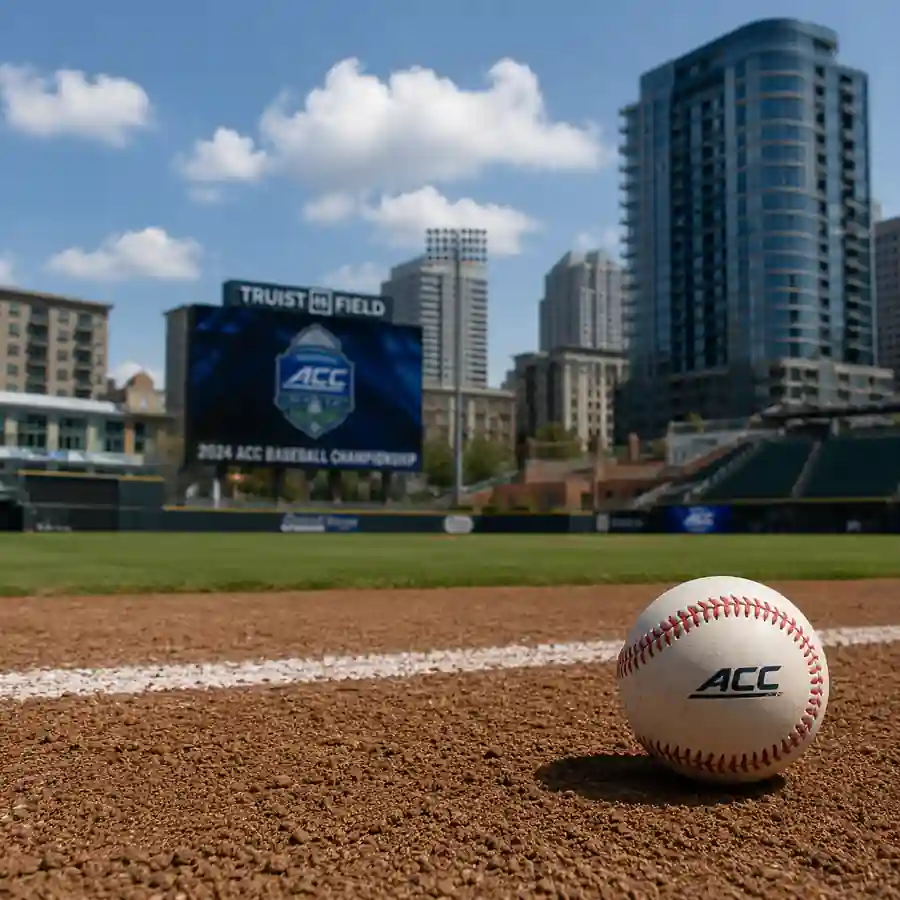

The 2026 ACC Baseball Tournament arrives in Charlotte with a bracket built for drama, a clear No. 1 seed in Georgia Tech and several NCAA tournament storylines running through every round. The six-day championship will be played from Tuesday, May 19, through Sunday, May 24, at Truist Field, giving all 16 ACC teams a final chance to strengthen their postseason case before the national bracket is finalized.
This year’s tournament is not just about crowning a conference champion. It is also a pressure test for teams chasing NCAA regional hosting spots, bubble programs trying to stay alive and ranked contenders looking to prove they can handle postseason baseball. Georgia Tech, North Carolina, Florida State and Boston College earned the top four seeds and double-byes, but the path through Charlotte still looks demanding.
Georgia Tech enters as the No. 1 seed after finishing 45-9 overall and 25-5 in ACC play. The Yellow Jackets won the ACC regular-season championship outright and earned the tournament’s top seed for the second straight year. The official ACC release also noted that all 16 teams will compete in a single-elimination championship at Truist Field from May 19-24, with the bracket announced after regular-season play concluded on May 16. Read the official ACC bracket announcement.
North Carolina is the No. 2 seed after going 43-10-1 overall and 22-8 in league play. The Tar Heels are also the defending ACC tournament champions after beating Clemson in the 2025 title game. A repeat would carry extra historical weight because North Carolina has not won back-to-back ACC tournament titles since its three-year championship run from 1982 through 1984.
Florida State takes the No. 3 seed at 38-16 overall and 19-11 in the ACC, while Boston College is No. 4 after a 36-20 season and 17-13 conference record. Those four teams avoid the first two rounds, a major advantage in a tournament where pitching depth usually decides how far a team can go.
ACC Baseball Tournament 2026 bracket and TV schedule
All times are Eastern. Games from Tuesday through Saturday are scheduled for ACC Network. The championship game will air Sunday on ESPN2.
Tuesday, May 19 — First Round
- Game 1: No. 9 NC State vs. No. 16 Duke — 9 a.m. — ACC Network
- Game 2: No. 12 Stanford vs. No. 13 California — 1 p.m. — ACC Network
- Game 3: No. 10 Notre Dame vs. No. 15 Clemson — 5 p.m. — ACC Network
- Game 4: No. 11 Louisville vs. No. 14 Pitt — 9 p.m. — ACC Network
Wednesday, May 20 — Second Round
- Game 5: No. 8 Virginia vs. NC State/Duke winner — 9 a.m. — ACC Network
- Game 6: No. 5 Miami vs. Stanford/California winner — 1 p.m. — ACC Network
- Game 7: No. 7 Virginia Tech vs. Notre Dame/Clemson winner — 5 p.m. — ACC Network
- Game 8: No. 6 Wake Forest vs. Louisville/Pitt winner — 9 p.m. — ACC Network
Thursday, May 21 — Quarterfinals
- Game 9: No. 1 Georgia Tech vs. Game 5 winner — 3 p.m. — ACC Network
- Game 10: No. 4 Boston College vs. Game 6 winner — 7 p.m. — ACC Network
Friday, May 22 — Quarterfinals
- Game 11: No. 2 North Carolina vs. Game 7 winner — 3 p.m. — ACC Network
- Game 12: No. 3 Florida State vs. Game 8 winner — 7 p.m. — ACC Network
Saturday, May 23 — Semifinals
- Game 13: Game 9 winner vs. Game 10 winner — 1 p.m. — ACC Network
- Game 14: Game 11 winner vs. Game 12 winner — 5 p.m. — ACC Network
Sunday, May 24 — Championship
- Game 15: ACC Championship Game — Noon — ESPN2
Fans can watch the tournament on ACC Network through the semifinals and ESPN2 for the final. Streaming options include ESPN platforms with a participating TV provider login, while live TV streaming services carrying ACC Network and ESPN2 may also provide access.
Complete ACC tournament seeding
The bracket reflects a wide gap at the top and a crowded middle tier behind the double-bye teams. Georgia Tech and North Carolina finished with the two best conference records, while Florida State and Boston College did enough to avoid the early-round grind.
- No. 1 Georgia Tech: 45-9 overall, 25-5 ACC
- No. 2 North Carolina: 43-10-1 overall, 22-8 ACC
- No. 3 Florida State: 38-16 overall, 19-11 ACC
- No. 4 Boston College: 36-20 overall, 17-13 ACC
- No. 5 Miami: 36-17 overall, 16-14 ACC
- No. 6 Wake Forest: 38-18 overall, 16-14 ACC
- No. 7 Virginia Tech: 29-22 overall, 15-14 ACC
- No. 8 Virginia: 35-20 overall, 14-16 ACC
- No. 9 NC State: 32-21 overall, 14-16 ACC
- No. 10 Notre Dame: 30-21 overall, 13-17 ACC
- No. 11 Louisville: 30-26 overall, 13-17 ACC
- No. 12 Stanford: 27-25 overall, 13-17 ACC
- No. 13 California: 29-25 overall, 12-18 ACC
- No. 14 Pitt: 30-23 overall, 11-19 ACC
- No. 15 Clemson: 30-25 overall, 9-20 ACC
- No. 16 Duke: 25-30 overall, 10-20 ACC
The records also show why this tournament is difficult to predict. Clemson, despite being the No. 15 seed, still enters with 30 overall wins. Pitt, Louisville, Stanford and Notre Dame also have enough quality to make early games uncomfortable for higher seeds. In a single-elimination setup, one strong start or one big inning can erase the difference between a top-eight seed and a lower seed.
Read More
- Visit Swikblog Homepage
- Canadian Cruise Passenger Tests Positive for Andes Hantavirus
- United Airlines Pacific WiFi Outage Hits 17-Hour Flights
- Timothy Spall’s Death Valley Returns Tonight on BBC One
- WA Shuts Down 6 Tobacco Stores Over Illegal Tobacco Laws
- Qantas Flight Diverted to Tahiti After Passenger Bites Flight Attendant
Georgia Tech’s biggest advantage is timing. The Yellow Jackets do not play until Thursday, which allows their pitching staff extra rest while early-round opponents must use arms just to reach them. North Carolina, Florida State and Boston College receive the same benefit, and that is often the hidden value of a double-bye in college baseball.
The middle of the bracket is where the tournament could turn. Miami and Wake Forest both finished 16-14 in ACC play and enter as dangerous single-bye teams. Virginia Tech, Virginia and NC State are close enough in quality that Wednesday’s games may feel more like NCAA regional matchups than standard conference tournament openers.
For North Carolina, the storyline is different. The Tar Heels are not only chasing another trophy; they are defending one. Their 2025 championship win over Clemson gave the program its first ACC tournament title since 2022, and another run this week would make them one of the defining teams of the conference’s current baseball cycle.
Florida State also enters with legitimate championship expectations. The Seminoles have the national profile, the record and the rest advantage to make a run, but their side of the bracket could include a difficult matchup against Wake Forest or Louisville/Pitt survivor depending on how the early rounds unfold.
Boston College may be the most interesting top-four seed. The Eagles are ranked nationally and avoided the first two rounds, but they sit on the same half of the bracket as Georgia Tech. That creates the possibility of a semifinal between the No. 1 and No. 4 seeds if both handle their quarterfinal matchups.
Beyond the title race, the NCAA tournament implications are hard to ignore. Strong performances in Charlotte can improve regional hosting arguments, protect at-large resumes or create late movement near the bubble. That is why lower-seeded teams such as Clemson, Pitt, Louisville and Stanford will treat the opening round like more than just a conference tournament game.
Readers following broader conference championship races can also read Swikblog’s guide to ACC championship scenarios and title paths, which explains how postseason pressure builds across major college sports.
The 2026 ACC Baseball Tournament has the ingredients for a strong championship week: a dominant No. 1 seed, a defending champion, four nationally ranked teams and several bubble programs fighting for survival. Georgia Tech may enter Charlotte as the favorite, but the bracket leaves little room for comfort once the first pitch is thrown.

Make Swikblog your go-to source on Google for reliable updates, smart insights, and daily trends.