
America’s 250th birthday is still more than a year away, but the shape of the celebration is already drawing intense attention. This week, former president Donald Trump unveiled a sweeping vision for the United States’ semiquincentennial in 2026 — a plan that blends traditional patriotism with spectacle on a scale rarely seen in modern American history.
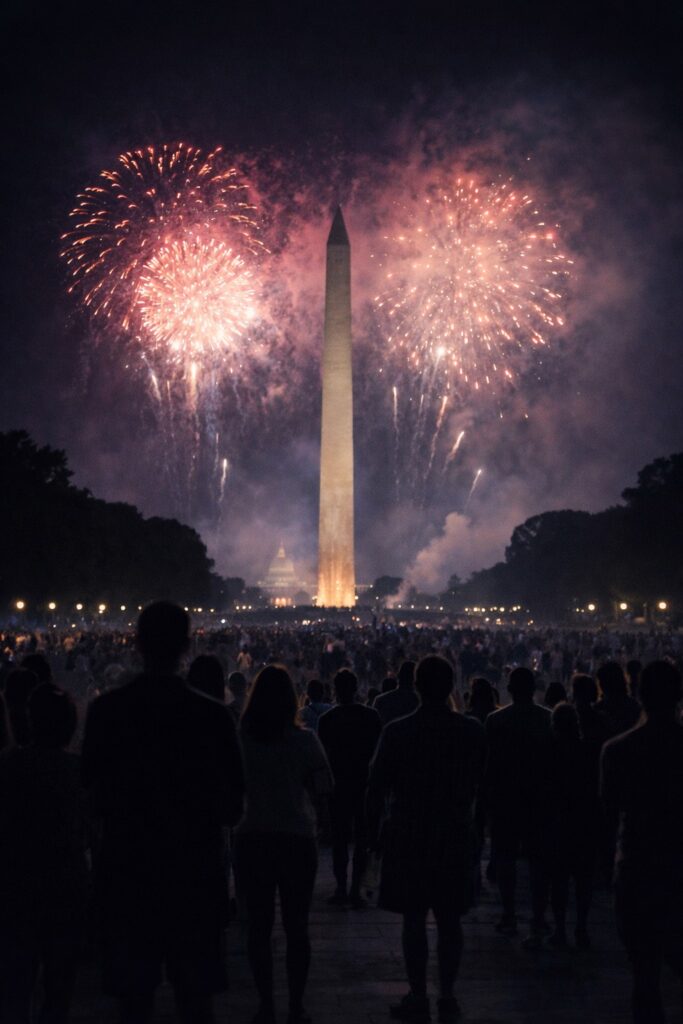
At the centre of the proposal is a national programme branded as “America 250”, sometimes referred to as “Freedom 250”, featuring fireworks, concerts, historical reenactments, and a large state-fair-style gathering on the National Mall in Washington. But it is one element in particular — dubbed the “Patriot Games” — that has prompted curiosity, confusion, and a growing wave of commentary.
The scale of the proposal has quickly pushed it into the national spotlight. Early reporting suggests the America 250 programme could become one of the most expansive public celebrations ever attempted by the federal government, blending civic ceremony with large-scale entertainment and political symbolism. As outlined in Reuters coverage of the emerging plans, questions around funding, logistics, and public space are likely to intensify as the 2026 anniversary approaches.
The idea, according to early outlines, is a nationwide competition designed to showcase athleticism, skill, and civic pride, culminating in high-profile events tied to Independence Day celebrations. Supporters describe it as a unifying exercise that draws Americans together through sport and friendly rivalry. Critics, however, say the branding and tone feel unusually theatrical — and in some cases unsettling.
Comparisons to pop culture have been swift. Online, commentators have likened the concept to dystopian fiction, questioning whether the framing risks overshadowing the historical meaning of the anniversary itself. Others argue that the criticism is overblown, pointing out that national competitions and mass celebrations have long been part of American civic life.
The broader goal, according to the plan’s backers, is to mark 250 years since the nation’s founding with a renewed sense of shared identity. The celebrations are expected to highlight American innovation, military history, cultural diversity, and democratic values, while also drawing millions of visitors to the capital.
Still, major questions remain unanswered. Details around funding, organisation, and oversight have yet to be fully outlined. Civil liberties advocates have raised concerns about how public spaces may be used, while historians warn that large-scale spectacle can sometimes crowd out reflection — particularly at a moment when the country remains deeply divided.
The last time the United States marked a milestone on this scale was the 1976 Bicentennial, remembered for its parades, tall ships, and sense of national consensus. America 250 arrives in a very different era — one shaped by polarised politics, instant online reaction, and heightened scrutiny of symbolism.
For now, the Patriot Games remain more concept than concrete schedule. Whether they become a unifying centrepiece of the 250th anniversary or a lightning rod for controversy may depend less on the events themselves and more on how they are framed — as celebration, competition, or political theatre.
What is certain is that the countdown to 2026 has begun, and with it, a broader debate over how a nation chooses to mark its history at a pivotal moment.
The announcement fits into a broader moment where culture, politics, and spectacle are increasingly overlapping in public life. Recent debates over how institutions shape national identity — from awards ceremonies to historic venues — have highlighted how symbolism now carries as much weight as policy. A similar shift can be seen in how cultural power is evolving, as explored in this Swikblog analysis on the Oscars’ move to YouTube, where tradition collided with modern audience realities.

Make Swikblog your go-to source on Google for reliable updates, smart insights, and daily trends.