
Every year on May 13, the Catholic world turns its attention to Fatima, the small Portuguese town where three shepherd children said the Virgin Mary appeared to them in 1917. But in 2026, the devotion is drawing fresh attention for a reason that feels deeply modern: its message speaks directly to a world still searching for peace.
For millions of Catholics, Fatima is not only a story from the past. It is a spiritual roadmap. Its message asks believers to pray the Rosary, make sacrifices, return to God, seek conversion and place their trust in the Eucharistic presence of Christ. That combination of Marian devotion, personal repentance and prayer for peace is often described by Catholics as Fatima’s “peace plan.”
The first apparition took place on May 13, 1917, when Lucia dos Santos and her cousins Francisco and Jacinta Marto were tending sheep near Fatima. Europe was still trapped in the violence of World War I. Families were grieving, nations were collapsing, and fear had become part of daily life. Against that background, the message reported by the children was not political. It was spiritual: pray, repent and ask God for peace.
According to the Church’s account of the apparitions, Mary asked the children to pray the Rosary every day and offer sacrifices for sinners. The request was simple enough for children to understand, yet demanding enough to challenge adults more than a century later. That may explain why Fatima continues to attract people during moments of crisis.
The Vatican’s official explanation of the Message of Fatima presents the devotion as a call to conversion, prayer and hope. It does not frame Fatima as curiosity or superstition, but as a serious spiritual appeal rooted in the Gospel.
In 2026, that appeal feels urgent again. Wars, public division, anxiety inside families and a growing sense of spiritual exhaustion have made many Catholics look again at older devotions that offer structure and meaning. Fatima does not offer an easy answer to suffering. It offers a way to carry suffering through prayer.
Why Fatima’s message is being heard again
One reason Fatima keeps returning to Catholic life is that its message is practical. It does not require power, wealth or public influence. It asks for daily prayer, small sacrifices and a change of heart. A person can live Fatima’s message in a church, at home, in a hospital room, during work or in the middle of family struggle.
The Rosary remains at the center of that devotion. At Fatima, Mary’s repeated call to pray the Rosary for peace became one of the most recognizable parts of the apparition story. For many Catholics, each decade of the Rosary becomes a quiet act of resistance against despair. It is a way of placing fear, grief and uncertainty into the hands of God through Mary.
Fatima also places strong emphasis on sacrifice. This does not mean dramatic gestures only. In Catholic spirituality, it can mean offering daily difficulties with love: illness, tiredness, family responsibilities, disappointment or hidden acts of patience. The children of Fatima understood this deeply. Francisco, Jacinta and Lucia were not influential figures, yet their small acts of prayer and sacrifice became part of a global devotion.
The Eucharistic side of Fatima is equally important. Before the Marian apparitions, Catholic tradition says the children were prepared by the Angel of Peace, who taught them prayers of adoration and reparation. In one powerful scene associated with Fatima, the Angel appeared with a Host and chalice, directing the children toward worship of Christ in the Eucharist.
This is why Fatima is more than a Marian devotion alone. It leads toward the Eucharist. Mary’s role in the story is not to draw attention away from Christ, but to guide souls closer to him. That point matters at a time when Eucharistic adoration, Holy Hours and renewed devotion to the Blessed Sacrament are gaining attention in many Catholic communities.
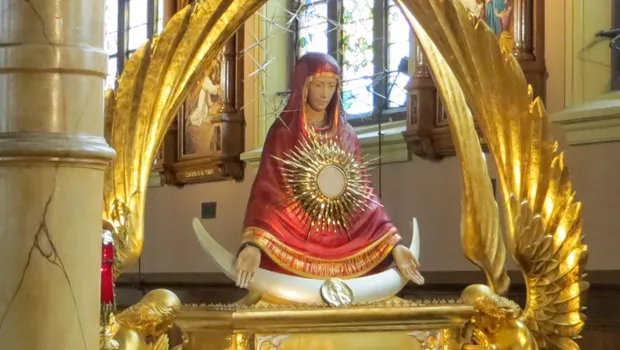
May 13 also carries another meaning that many Catholics overlook. It is connected with devotion to Our Lady of the Blessed Sacrament, a title promoted by St. Peter Julian Eymard, the founder of the Congregation of the Blessed Sacrament. The title highlights Mary as the woman who carried Christ in her womb and points believers toward the real presence of Jesus in the Eucharist.
That connection gives May 13 a deeper spiritual weight. On the same day Catholics remember Fatima’s call to the Rosary, they are also invited to rediscover Mary’s relationship to the Eucharist. Together, the two devotions form a powerful Catholic response to unrest: prayer with Mary and worship of Christ.
Fatima’s modern relevance is also tied to St. John Paul II. The Polish pope was shot on May 13, 1981, the anniversary of the first Fatima apparition. He later credited Our Lady of Fatima with saving his life. The bullet from the assassination attempt was eventually placed in the crown of the statue of Our Lady of Fatima, becoming one of the most striking symbols of the devotion’s place in modern Church history.
Read More
John Paul II helped bring Fatima into the contemporary Catholic imagination. His survival, his devotion to Mary and his public gratitude gave new visibility to a message that had already shaped millions of believers. The later canonization of Francisco and Jacinta by Pope Francis in 2017 further strengthened Fatima’s place in the life of the Church.
A peace plan built on prayer, not politics
What makes Fatima unusual is that its “peace plan” does not begin with governments or institutions. It begins with the soul. The message suggests that peace in the world is connected to conversion in human hearts. That idea may sound old-fashioned, but it remains one of the reasons Fatima continues to resonate.
Modern people often look for peace through policy, diplomacy or social change. Those efforts matter. But Fatima speaks to a deeper Catholic conviction: lasting peace cannot be separated from repentance, forgiveness and the healing of sin. Without conversion, conflict simply changes form.
The official Shrine of Fatima continues to receive pilgrims from around the world, showing that the devotion has not faded into memory. Pilgrims come with prayers for families, nations, the sick, the dead and the future. Many arrive carrying burdens that are intensely personal, yet they join a much larger global act of prayer.
Poland’s Marian tradition also adds another layer to the story. The nightly “Call of Jasna Gora,” associated with Our Lady of Czestochowa, invites believers to pause at 9 p.m. and remember Mary with watchful love. Some Catholics have connected that spirit of watchfulness with Fatima, using evening prayer, Rosary devotion and Eucharistic adoration as ways to remain spiritually awake in troubled times.
For Catholic families, Fatima’s message can be lived in ordinary ways: praying one decade of the Rosary together, visiting the Blessed Sacrament, offering a difficult day for someone in need, or teaching children that peace begins with prayer. These practices are small, but Fatima has always shown that small acts of faith can carry lasting power.
Faith stories across the world continue to show why prayer for peace remains urgent. Swikblog has reported on painful events affecting Christian communities, including the Nigeria mass school kidnapping involving Catholic students. Such tragedies remind believers that calls for protection, conversion and peace are not abstract religious language. They are tied to real human suffering.
That is why millions are returning to Fatima’s peace plan in 2026. Not because the world has become simpler, but because it has become more anxious. Fatima offers Catholics a way to respond without panic: pray the Rosary, seek conversion, adore Christ in the Eucharist, make sacrifices with love and ask Mary’s help.
More than a century after the first apparition, Fatima still refuses to disappear from Catholic life. Its message remains direct, demanding and hopeful. In a restless world, that may be exactly why people keep coming back.

Make Swikblog your go-to source on Google for reliable updates, smart insights, and daily trends.