
Anglo American has found a new buyer for its Australian steelmaking coal business, agreeing to sell a package of central Queensland mines to UK-registered Dhilmar Limited in a transaction worth up to US$3.875 billion, or about A$5.43 billion.
The deal gives Anglo American a second chance to complete its exit from Australian metallurgical coal after its earlier sale agreement with Peabody Energy broke down. It also places a relatively low-profile British mining company in control of some of Queensland’s most important steelmaking coal assets.
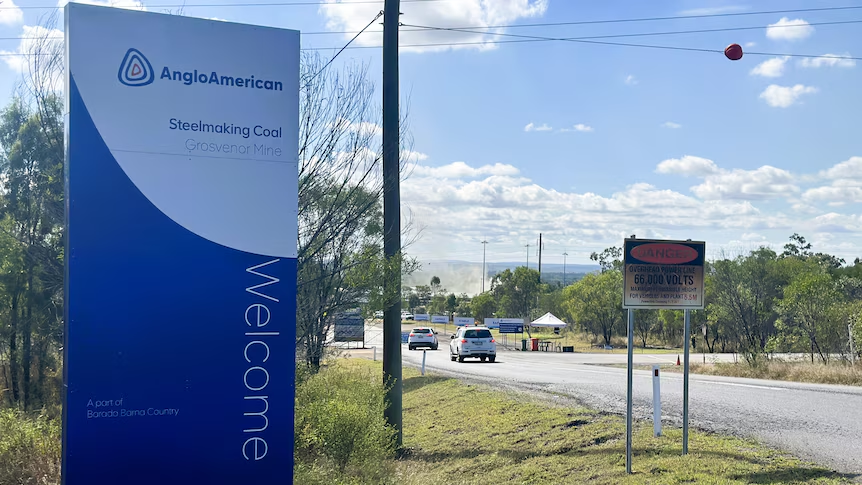
The portfolio being sold is not a small collection of fringe operations. It includes Anglo American’s interests in Moranbah North, Grosvenor, Capcoal, Roper Creek, Dawson South and Theodore South, along with other linked joint venture interests across the Bowen Basin. These mines supply coal used in steel production, making them strategically important for customers in Asia and other industrial markets.
Anglo American said the agreed consideration includes US$2.3 billion in upfront cash payable at completion. Dhilmar may also pay up to US$1.575 billion through a price-linked earnout over five years. That structure gives Anglo American immediate cash while preserving some upside if coal prices perform strongly after the transaction closes.
The sale also includes Middlemount, a mining town closely tied to Anglo American’s operations. The company provides housing, a shopping centre, childcare facilities and a medical centre there, meaning the transaction is likely to draw attention not only from investors but also from workers, families, local businesses and Queensland authorities.
According to Anglo American’s official announcement, the assets covered by the transaction include an 88 per cent interest in the Moranbah North and Grosvenor joint ventures, 70 per cent of Capcoal, 86.36 per cent of Roper Creek, 51 per cent interests in Dawson, Dawson South, Dawson South Exploration and Theodore South, and 50 per cent of Moranbah South.
The agreement follows a difficult period for Anglo American’s coal sale process. Peabody Energy had previously agreed to buy the same steelmaking coal portfolio, but later attempted to terminate that deal after a fire at the Moranbah North mine. Peabody relied on a material adverse change clause, while Anglo American has disputed that argument and continues to pursue arbitration.
For Anglo American, the Dhilmar agreement helps keep its wider restructuring plan on track. Chief executive Duncan Wanblad said the deal represents another major step in simplifying the company’s portfolio before the planned merger with Teck. The group has been working to sharpen its focus around assets such as copper, premium iron ore and crop nutrients while reducing exposure to coal.
The company also expects the proceeds to reduce net debt. When combined with the earlier sale of Anglo American’s interest in the Jellinbah mine for about US$1 billion, the group said its total cash proceeds from exiting steelmaking coal could reach up to US$4.9 billion.
Read More
- Visit Swikblog Homepage
- Two Fighter Jets Collide at Idaho Air Show
- Italian Men Who Won Rome Before Jannik Sinner
- Timmy the Humpback Whale Found Dead After Rescue Attempt Failed
- Trump’s Rededicate 250 Rally Sparks Church-State Debate
- Iyo Sky Officially Announces Marriage to WWE Star Naraku
- Q-Day Threat: Google’s Quantum Cybersecurity Warning
Dhilmar is a privately held UK mining company rather than a household name in global resources markets. However, its leadership has experience across mining operations and investments in established jurisdictions, including surface and underground assets. In 2025, Dhilmar acquired the Éléonore gold mine in Canada from Newmont Corporation, expanding its international mining footprint before moving into this much larger Australian coal transaction.
The acquisition signals Dhilmar’s confidence in long-life mining assets at a time when some listed mining giants are under pressure to lower their carbon exposure. Metallurgical coal remains different from thermal coal because it is used in steelmaking rather than power generation. Even so, the sector faces close scrutiny as governments, investors and manufacturers look for lower-emission steel technologies.
For Queensland, the transaction matters because the Bowen Basin remains one of the world’s key steelmaking coal regions. The future owner’s approach to safety, environmental performance, workforce stability and community services will be watched closely, especially given the operational history of Moranbah North and Grosvenor.
The deal is still subject to competition approvals, regulatory clearances and pre-emption arrangements. Anglo American expects completion by the first quarter of 2027, leaving a transition period in which employees, contractors, customers and local communities will be looking for clarity from both companies.
The agreement adds another major chapter to the global mining sector’s reshuffle, where companies are selling mature or carbon-exposed assets while new private buyers step in. Swikblog has also covered wider international business and investment shifts, including the UK’s growing cross-border investment push.
Anglo American’s latest coal deal is therefore not just a mine sale. It is a balance sheet move, a regional employment story, a coal market signal and a test of whether private mining groups can take on assets that larger listed companies are increasingly willing to leave behind.

Make Swikblog your go-to source on Google for reliable updates, smart insights, and daily trends.