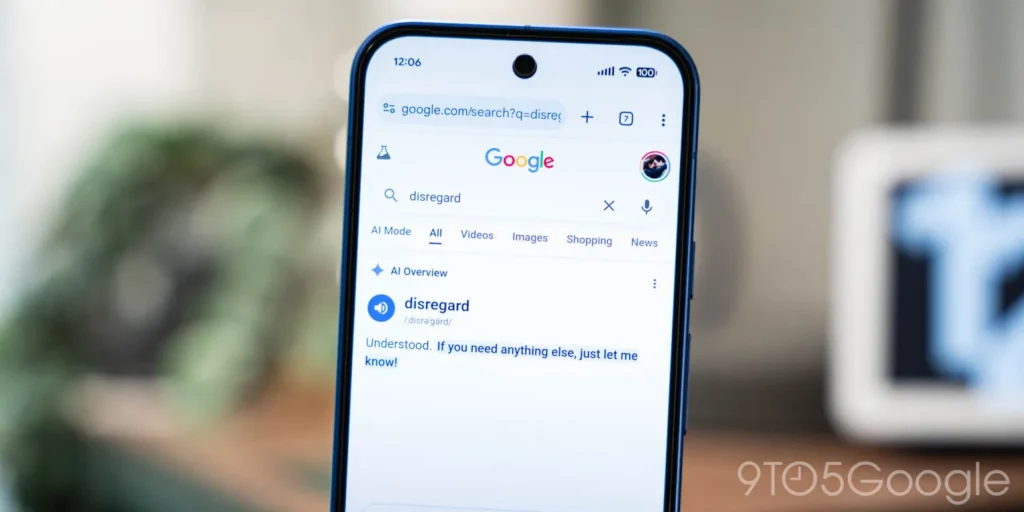

Google Search is facing another uncomfortable AI moment after a strange AI Overview bug turned a basic dictionary search into a viral debate about whether Google’s search engine is becoming less reliable for simple tasks.
The issue gained attention after users searched for words such as “disregard,” “ignore,” “dismiss,” and “skip.” Instead of showing a clean definition, pronunciation, usage example, or a trusted dictionary result, Google’s AI Overview appeared to treat the words as commands given to an AI chatbot. In some examples, the response looked less like a search result and more like an assistant acknowledging an instruction.
That distinction matters. A user typing “disregard” into Google is usually not telling a chatbot to disregard anything. They are most likely looking for the meaning of the word. For years, Google handled that kind of query almost instantly with a dictionary box or a result from established sources such as Merriam-Webster. The latest AI Overview behavior shows how easily an AI-first search system can confuse user intent when a query is short, direct, and context-free.
The bug was highlighted by The Verge, which reported that searches for words including “disregard,” “ignore,” and “skip” produced chatbot-style replies rather than useful search information. TechCrunch also noted that the traditional Merriam-Webster-style result could still appear on the page, but users may need to scroll past a large AI block before reaching anything useful.
This is why the story moved quickly across Google News and social platforms. It is not just another funny AI screenshot. It cuts into the basic promise of Google Search: type something in, get a useful answer quickly. When AI Overviews sit above traditional links but fail to answer the actual query, they do not simply make a mistake. They delay the answer the user came for.
The timing has made the criticism sharper. Google has been pushing deeper into AI-powered Search after its latest I/O announcements, where the company positioned Gemini and AI Mode as central to the future of search. Swikblog recently covered that broader shift in Google Search Will Never Be the Same After Gemini 3.5 Launch, noting how Google is moving from simple link results toward AI-generated summaries and task-based answers.
That strategy may work well for complex questions, travel planning, product comparisons, coding help, or multi-step research. But the “disregard” bug shows a different problem: some searches do not need AI at all. A dictionary query should not become a prompt interpretation test. A search engine should know when to show a definition and when to step back from generating a conversational response.
The backlash grew further because Bing reportedly returned more useful dictionary-style results for the same type of search. That comparison is damaging for Google because Search has long been the product where users expected Google to be clearly ahead. A moment where people say Bing handled a basic query better is exactly the kind of narrative that spreads fast online.
The incident also adds to earlier concerns about AI Overviews. Google’s AI summaries have previously gone viral for inaccurate or absurd responses, including examples involving glue on pizza and fake “blinker fluid” advice. Google has made changes since those early problems, but this new dictionary glitch suggests that AI Overviews can still misread ordinary search behavior in surprising ways.
Read More
Another important detail is that adding the word “definition” did not always solve the issue in reported examples. That makes the bug more than a visual annoyance. It suggests the AI system may still be prioritizing prompt-like interpretation even when the user clearly signals they want a word meaning.
For readers and publishers, there is a second concern. If AI Overviews push authoritative links lower on the page, users may see less of the original sources that actually provide the information. Swikblog has also covered Google’s experiments with AI-generated news summaries in Google Tests AI News “Overviews” and Audio Briefings, a shift that continues to raise questions about visibility, source credit, and trust in AI-curated information.
Google will likely patch this specific issue, especially now that it has attracted public attention. But the larger question will remain: how much of Search should be handed over to AI when many searches still require direct, simple, source-backed answers?
The viral “disregard” bug is small in scale but big in symbolism. It shows that AI Search can look impressive in demos while still stumbling over everyday habits that millions of users take for granted. Google wants Search to become smarter, more conversational, and more capable. But for users, the standard is simpler: when they search for a word, Google should still know they want the meaning.

Make Swikblog your go-to source on Google for reliable updates, smart insights, and daily trends.