
Written by Jordan Mitchell
Google is piloting AI-generated article snapshots on Google News pages and experimenting with short audio briefings, as it expands Gemini’s role in how people discover and consume journalism.
Google has launched a new pilot program that experiments with AI-powered article overviews inside its news experience — a move that could reshape how audiences decide what to read next. The test is designed to give people “just enough” context before clicking, while still showing attribution and a direct path to the full story.
The company outlined the initiative as part of a broader set of product updates focused on supporting the web and helping users connect with sources they trust. Google says the pilot explores how AI can drive more engaged readership on news surfaces, including within its Gemini ecosystem. Google’s announcement post provides the clearest overview of the new features and publisher-related experiments.
What’s in the AI pilot
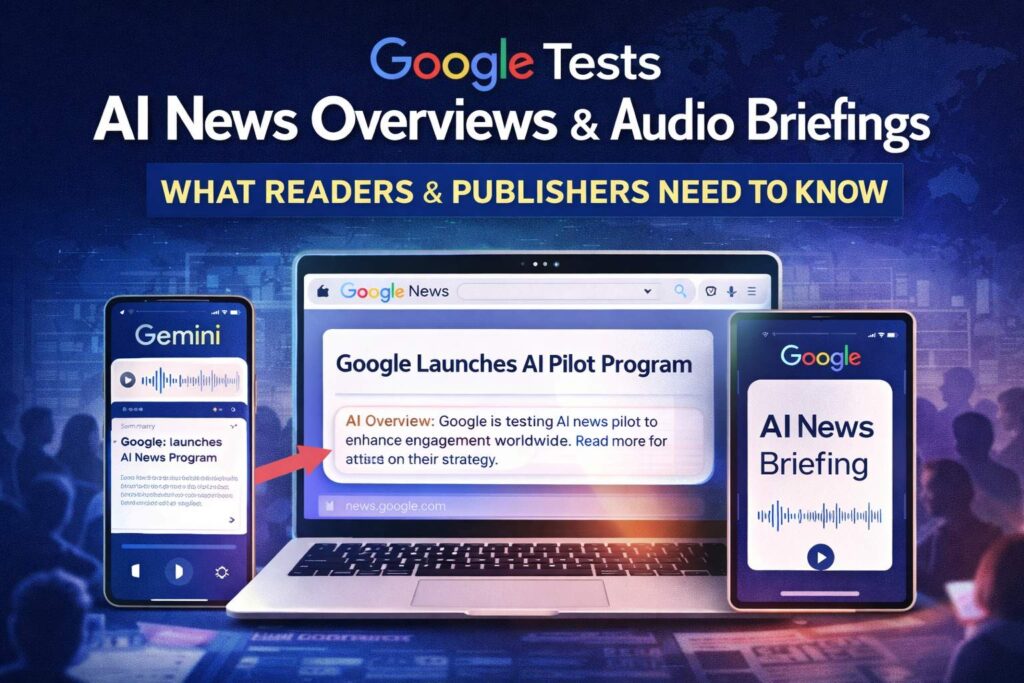
1) AI article overviews on Google News pages. In this test, Google uses AI to generate a short, informational summary that appears alongside an article on certain Google News pages. The intent is to help readers understand what they’re about to open — especially when multiple stories compete for attention.
2) Audio briefings for quick catch-up. Google is also piloting audio-based summaries so users can listen to a short briefing instead of reading a full story immediately. This format is aimed at people who want updates while commuting, working, or multitasking.
3) Partnerships with major publishers. The pilot involves a group of global news organizations, including names such as The Washington Post, The Guardian, and El País, reflecting Google’s focus on incorporating publisher content into evolving news experiences.
Why this matters to readers
For audiences, AI overviews are meant to reduce “guesswork” — the moment when a headline looks important, but the reader isn’t sure whether it’s relevant. A well-made preview could help people choose better, faster: what to read now, what to save, and what to skip.
Audio briefings target a different habit: people who want the gist first and may return to the full article later. If adopted widely, this could change the rhythm of daily news consumption — moving from “read everything” to “preview, then commit.”
What it could mean for publishers
The biggest question is how AI summaries affect click-through behavior. If readers feel fully satisfied by a preview, fewer people may open the full story. On the other hand, clearer context can also increase trust and lead to higher-quality clicks — users who arrive with stronger intent and are more likely to stay, scroll, and subscribe.
Industry observers have noted the tension: AI-generated summaries can be helpful, but they also risk shifting attention away from original reporting. One report on the pilot points out that AI overviews may reduce clicks in some cases, which is why the program is being closely watched across the news ecosystem. TechCrunch’s coverage details how the overviews appear and why publishers are paying attention.
The bigger shift: “preview-first” news
Whether the experiment expands or stays limited, the direction is clear: platforms increasingly want to help users decide before they click. That means the packaging of journalism — clarity, structure, and immediate usefulness — becomes even more important in how stories travel.
For readers, that could mean a smoother way to keep up with breaking events. For publishers, it raises new stakes around attribution, traffic, and how original reporting is recognized in AI-assisted environments.
Sources: Google product announcement and reporting on the pilot program linked above.

Make Swikblog your go-to source on Google for reliable updates, smart insights, and daily trends.