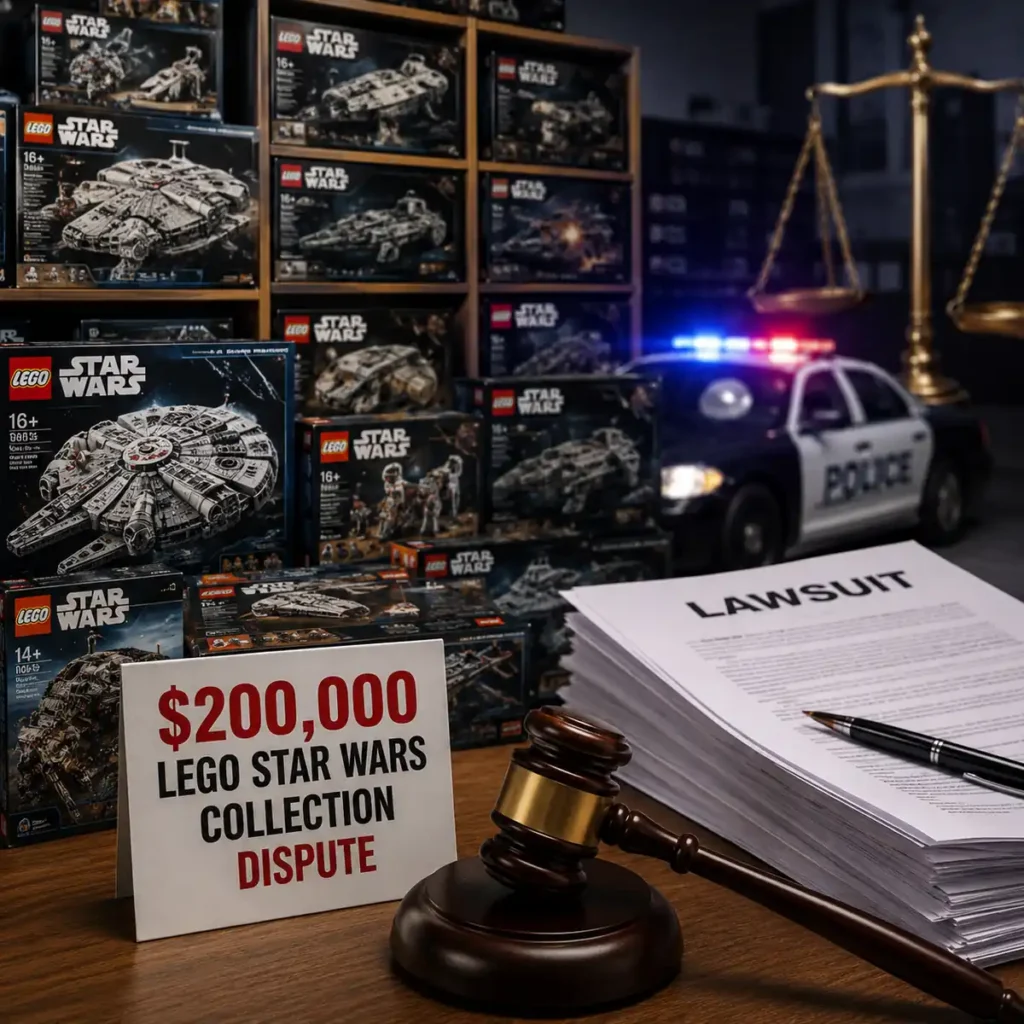

A dispute over a rare Lego Star Wars collection reportedly valued at more than $200,000 has moved far beyond a disagreement between a collector and a local store. What began as a consignment arrangement in Oregon has now triggered lawsuits, a police investigation, viral YouTube coverage, Reddit backlash and a reported temporary store shutdown.
The case centers on Bryan Mansell and his father’s long-held Lego Star Wars collection, which was placed with a Bricks & Minifigs store in Salem-Keizer, Oregon, in late 2023. According to reports, the arrangement allowed the store to sell individual sets while ownership remained with the Mansell family. The store would take a 35% commission, while the family would receive the remaining proceeds. Any unsold items were expected to be returned if the agreement ended.
The collection was not a small hobby lot. It was reportedly built over many years and included hundreds of sealed Star Wars sets and rare minifigures. The store itself previously promoted the inventory online as being worth “well over $200,000,” a figure that has since become central to the public reaction around the dispute. For Lego collectors, that valuation places the collection in the same serious category as major display builds and rare sets, far beyond an ordinary resale lot. Interest in large-scale Lego releases has also grown around builds such as the Lego Minas Tirith Lord of the Rings set, showing how valuable and emotionally important these collections can become.
The conflict appears to have escalated after a reported ownership transition at the store in November 2024. Former franchise operators Chrystal and Robert Gorman have claimed they were removed during the transition involving corporate representatives and incoming management. They also said corporate was made aware that the Lego Star Wars inventory belonged to the Mansell family under a consignment agreement.
Bricks & Minifigs corporate has pushed back on that position. The company has said the arrangement was an “unauthorized” consignment agreement and that corporate was not a party to it. It has also emphasized that franchise locations operate independently, a point that has become one of the main dividing lines in the dispute.
For Mansell, however, the question is simpler: if the unsold sets still belonged to his family, they should either be returned or fairly paid for. He later terminated the agreement in November 2024, citing alleged missed payments and restricted access to inspect the remaining inventory. In a public statement, Mansell said he wanted “either a fair payout for the collection, the collection back, or the store itself run out of town if they don’t want to do what is right.”
The case gained wider attention after YouTuber Reckless Ben released investigative videos about the dispute. The videos brought national attention to the Oregon store, the corporate response and the conduct of people involved in the case. Some claims raised in the videos, including allegations around corruption or improper connections, remain unproven and should be treated carefully until legal proceedings or investigators establish the facts.
Still, the online reaction has been intense. On Reddit, users focused heavily on the ownership question. One commenter wrote that “regardless of any dispute between the old owner and BAM, the assets of the third party must be returned to the third party.” Another user summarized the situation by saying the collection was “worth around $200,000” and was meant to help pay for college funds, while claiming corporate refused to recognize the agreement after taking over the store.
Several Reddit users also questioned the corporate argument around consignments. One commenter asked why, if consignments were not allowed, the remaining Lego sets were not simply returned to the owner. Another argued that even if internal franchise rules barred consignments, “franchise rules don’t supersede the law.” Those comments do not prove the allegations, but they show why the case has resonated so strongly with collectors watching from outside Oregon.
The Reddit thread also shows how quickly the dispute has become a reputation issue for Bricks & Minifigs. Some users claimed discussions were being removed or restricted in Lego-related communities, while others said they would no longer shop at the chain until the matter is resolved. One commenter wrote: “I’ll never shop at Bricks & Minifigs after seeing all of this unfold.”
That public anger does not settle the legal dispute, but it does show why the story has grown so quickly. For collectors, the case touches a sensitive issue: trust. High-value collectibles often depend on documentation, store reputation and a clear chain of custody. Similar concerns have appeared in other Lego-related cases, including the recent California Lego theft and pasta swap case, where the value of boxed sets again showed how seriously authorities and collectors now treat Lego inventory.
Keizer police have confirmed that the matter remains under investigation, while civil litigation is also ongoing. The reported temporary closure of the store added another layer of uncertainty, though it has not resolved the central question of what happened to the remaining inventory and who is legally responsible for returning or paying for it.
For now, the safest reading is that the case remains disputed. Mansell and supporters say the family’s property was not properly returned or paid for. Former operators say corporate knew about the consignment. Corporate says the agreement was unauthorized and not its responsibility. Police and courts will have to determine where civil liability ends and whether any criminal wrongdoing occurred.
What is already clear is that a niche Lego dispute has become a much bigger story about franchise accountability, collector trust and the power of online pressure. The legal outcome may take time, but the reputational damage is already unfolding in public.

Make Swikblog your go-to source on Google for reliable updates, smart insights, and daily trends.