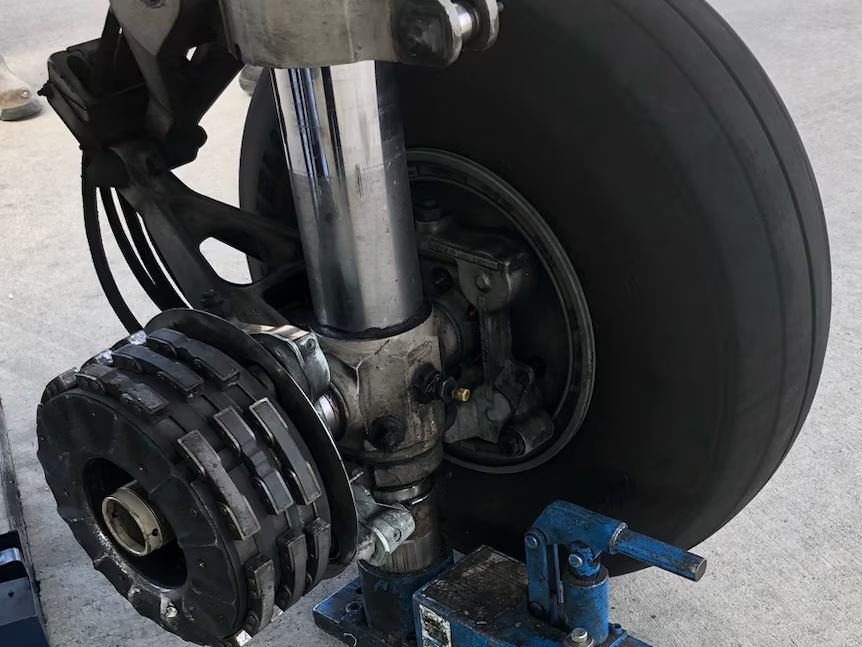

A Link Airways flight from Canberra to Newcastle became the focus of a transport safety investigation after one of its landing gear wheels separated during take-off from Canberra Airport, leaving investigators unable to confirm the exact reason the failure occurred.
The incident involved a Saab 340 aircraft, registered VH-VEZ, operating flight FC201 on January 29, 2026. The aircraft had 19 passengers and three crew members on board when the left inboard main landing gear wheel detached as the plane was departing runway 35.
According to the Australian Transport Safety Bureau, the aircraft taxied from the apron at about 3:48pm local time before taking off from Canberra Airport. During the initial climb, air traffic control noticed the wheel had separated from the aircraft and immediately informed the pilots.
The crew stopped the climb and held the aircraft at a minimum safe altitude while assessing the situation. They also reviewed the aircraft’s operating handbook, but investigators said there was no checklist specifically written for a landing gear wheel separating after take-off.
That left the flight crew to manage a rare and unusual technical failure through coordination with air traffic control. As the aircraft approached the edge of Canberra’s control area, the pilots chose to return to Canberra rather than continue toward Newcastle.
The captain declared an urgency condition, which is used when the safety of an aircraft or people on board is affected but the situation has not escalated into a distress call. Emergency services were placed on standby before the aircraft returned to the runway.
Airport emergency crews reported no fire, smoke or fluid leaks from the landing gear. The Saab 340 landed safely back at Canberra Airport, and there were no injuries among passengers or crew. After the landing, both engines were shut down, the aircraft was towed from the runway and passengers were able to leave the aircraft normally.
The missing wheel was later found by Canberra Airport safety staff against an internal airport fence on the eastern side of the runway.
The ATSB found that the wheel separated because of a bearing failure. However, the investigation could not establish what caused the bearing to fail because the components were too badly damaged by the time they were examined.
Investigators said a failure of this type can be linked to several possible factors, including a material defect, manufacturing issue, improper installation, insufficient lubrication or operational wear. In this case, the evidence was not strong enough to confirm one cause over another.
The bureau also reviewed the aircraft’s maintenance records and found the wheel had been installed and maintained in line with relevant maintenance instructions. Records showed a history of bearing component replacement, but investigators did not identify a clear maintenance error that explained the wheel separation.
ATSB Director of Transport Safety Stuart Macleod said the event showed the value of calm decision-making and clear communication during an unexpected aircraft malfunction. He said the actions of air traffic control and the flight crew helped maintain safety margins and led to a safe landing.
After the incident, Link Airways inspected wheels across its full fleet and found no faults. The airline also changed its wheel-bearing maintenance schedule as an added precaution following the investigation.
The aircraft manufacturer, Saab, provided data on similar events involving Saab 340B operators worldwide. Since 1997, there have been 14 reported incidents involving a main landing gear wheel departing a Saab 340 aircraft. Saab told investigators it had not identified a trend or pattern connected to wheel loss or main wheel bearing failures.
Read More
The Canberra Airport case is another reminder of how aviation safety investigations often focus not only on what failed, but also on how crews respond when a rare failure happens without a dedicated checklist. Swikblog has also reported on other recent aviation safety incidents, including a Southwest Airlines emergency landing after a cockpit windshield crack.
For passengers, the most important outcome was that the aircraft returned safely. For investigators, the unresolved question remains why the wheel bearing failed severely enough for the landing gear wheel to separate during take-off.

Make Swikblog your go-to source on Google for reliable updates, smart insights, and daily trends.