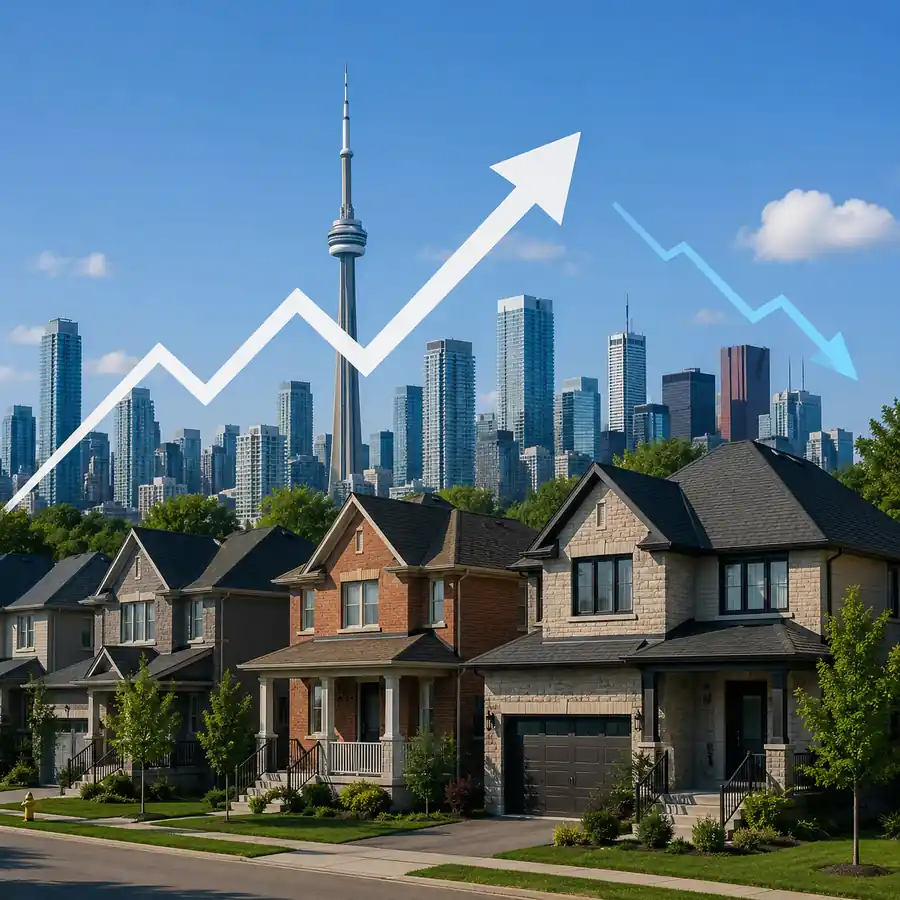

Greater Toronto’s housing market is showing a sharper spring rebound, but the recovery is not coming with higher prices yet. Home sales across the Greater Toronto Area rose again in May, giving the region its third straight month of stronger year-over-year activity, while prices continued to fall from last year’s levels.
The latest figures from the Toronto Regional Real Estate Board show 6,583 homes changed hands across the GTA in May, up 6.3% from May 2025. Sales also increased 10% from April on a seasonally adjusted basis, suggesting buyers are slowly returning after months of caution driven by affordability pressure, mortgage costs and economic uncertainty.
For households watching the market closely, the key detail is not just that sales improved. It is that the improvement came while prices remained lower. The average selling price in the GTA fell 4.6% year over year to $1,069,700, while the composite benchmark price, which is designed to represent a typical home, dropped 6.7%.
That combination creates a more complicated market than a simple rebound headline suggests. Buyers are more active than they were a year ago, but they are still negotiating in a market where affordability has not fully recovered. Lower selling prices and borrowing costs have helped bring some demand back, but many households are still weighing monthly payments, job security and the risk of buying before prices clearly stabilize.
TRREB president Daniel Steinfeld said spring sales have been stronger than last year, helped by improved affordability from lower prices and borrowing costs. The board also suggested sales could improve further in the second half of the year if trade conditions and broader geopolitical uncertainty ease. The official Toronto Regional Real Estate Board remains the key source for monthly GTA housing market data.
GTA Listings Fall as the Market Starts to Tighten
The biggest shift in May came from supply. New listings fell to 17,698, down 18.9% from a year earlier. Total active listings also declined 13.3% to 26,927. That means buyers still have choice, but less fresh inventory is entering the market than last year.
A market can still feel soft at the price level while tightening underneath. If sales keep improving and fewer homes come to market, the negotiating advantage buyers have enjoyed may start to fade in specific neighbourhoods before the broader price data fully reflects it.
TRREB chief information officer Jason Mercer said buyers still have substantial negotiating power for now, but selling prices could begin to grow in the back half of the year if sales continue to strengthen relative to listings. That is the turning point many buyers are watching: not whether prices have already jumped, but whether the balance of power is quietly shifting before the headline numbers catch up.
The City of Toronto recorded 2,377 sales in May, up 3.2% from May 2025. Across the rest of the GTA, sales rose more sharply, climbing 8.1% to 4,206. The stronger growth outside the city suggests buyers are still looking beyond Toronto’s core for better value, more space or lower total ownership costs.
Detached homes led the market with a 9% year-over-year increase in sales. Townhouse sales rose 4.8%, while condo activity gained 4.2%. Semi-detached homes were the only major category to edge lower, slipping 0.8% from a year earlier.
For buyers, this means the GTA market is not moving evenly. Detached homes may be drawing renewed interest from households that delayed purchases, while condos and townhouses remain important affordability options. Semi-detached homes, often positioned between those segments, showed slightly weaker activity, underlining how local pricing and property type still matter more than broad market averages.
The latest numbers also add a new layer to the broader Toronto housing story. Earlier in 2026, buyers were already watching softer pricing, higher inventory and affordability pressure across the region, making the latest shift in Toronto real estate prices and market mood especially relevant as May sales show renewed activity.
Still, this is not a full seller’s market. A lower average price near $1.07 million remains a major affordability hurdle, particularly for first-time buyers facing down payments, stress tests and monthly mortgage payments. Even with softer prices, many households need a meaningful income cushion to buy in the GTA.
For sellers, the message is equally clear. Rising sales do not automatically mean every home can command last year’s price. Buyers are active, but they remain selective. Homes that are priced realistically, presented well and located in neighbourhoods with limited competing inventory are more likely to attract interest. Overpriced listings may still sit, especially if buyers believe more supply could appear later in the year.
The May report points to a market in transition rather than a market that has fully recovered. Sales are rising, listings are falling, and price declines are still visible. That mix gives buyers a window of opportunity, but it may not stay open in the same way if inventory continues to tighten through the summer.
For anyone trying to make a decision, the most useful signal is the balance between sales and listings. If more buyers return while fewer sellers list, competition can build quickly in desirable pockets of the GTA. If affordability pressure remains heavy, price growth may stay limited even as sales improve. May’s numbers show both forces at work, making this a market where timing, neighbourhood choice and realistic pricing matter more than ever.

Make Swikblog your go-to source on Google for reliable updates, smart insights, and daily trends.