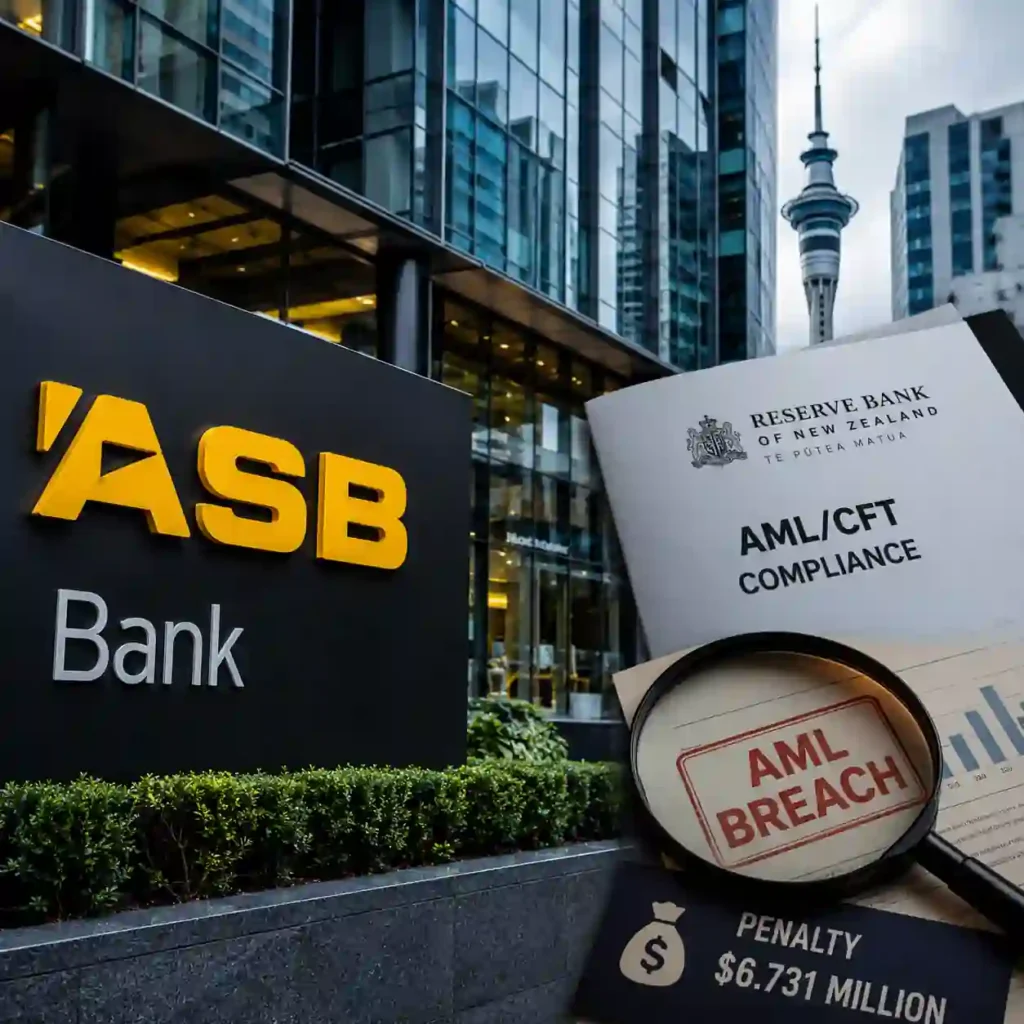

ASB Bank has been ordered to pay a record NZ$6.731 million penalty after admitting seven breaches of New Zealand’s anti-money laundering and countering financing of terrorism (AML/CFT) laws, marking the largest penalty ever imposed under the country’s AML/CFT Act.
The High Court ruling follows proceedings launched by the Reserve Bank of New Zealand (RBNZ) in December 2025 after an investigation found significant shortcomings in ASB’s compliance systems. According to the regulator, the bank’s transaction monitoring system and AML/CFT programme were inadequate for approximately six years, raising concerns about its ability to identify and respond to potentially suspicious financial activity.
The penalty reflects what regulators described as serious and prolonged non-compliance. While ASB was not accused of laundering money itself, the case focused on whether the bank had appropriate systems, controls and reporting processes in place to meet its legal obligations.
Seven breaches admitted by ASB
ASB cooperated with the Reserve Bank’s investigation and admitted liability for seven separate breaches of the AML/CFT Act.
The admitted failures included not properly establishing, implementing or maintaining parts of its AML/CFT programme relating to customer due diligence requirements, risk management procedures and compliance monitoring. The bank also failed to adequately conduct ongoing customer due diligence for certain foreign trust customers and did not always meet reporting obligations for suspicious activities within the required timeframes.
Additional breaches involved failures to conduct enhanced customer due diligence in higher-risk situations and failures to terminate business relationships when required under AML/CFT regulations.
According to the Reserve Bank, transaction monitoring is one of the most important tools available to financial institutions for detecting money laundering and terrorism financing risks. Acting Assistant Governor for Financial Stability Angus McGregor said banks have a responsibility to ensure their systems are robust enough to identify and mitigate those threats. Readers can review the regulator’s findings in the official Reserve Bank of New Zealand announcement.
Read More
ASB apologises and outlines changes
ASB Chief Executive Vittoria Shortt accepted the Court’s findings and issued a public apology, acknowledging shortcomings in the bank’s transaction monitoring and customer due diligence systems.
“We accept we didn’t act fast enough to resolve the issue and I apologise for that,” Shortt said following the ruling.
The bank said it had cleared all monitoring alert backlogs by February 2024 and has had none since. It also stated that significant investments have been made in AML/CFT compliance, including enhanced technology, additional financial crime specialists and expanded staff training programmes.
The ruling comes at a time when regulatory scrutiny of financial institutions is increasing across New Zealand. Similar compliance and governance concerns have surfaced in other major banking cases, including the ANZ $125M CCCFA ruling affecting thousands of borrowers, highlighting the growing expectations regulators place on large financial institutions.
For New Zealand’s banking sector, the ASB case serves as a reminder that anti-money laundering compliance is not simply an administrative requirement. Regulators argue that failures in transaction monitoring and reporting can delay critical intelligence needed by law enforcement agencies to detect and prevent financial crime. The record-setting penalty sends a strong signal that prolonged compliance failures will attract significant enforcement action, regardless of whether criminal activity is ultimately identified.

Make Swikblog your go-to source on Google for reliable updates, smart insights, and daily trends.