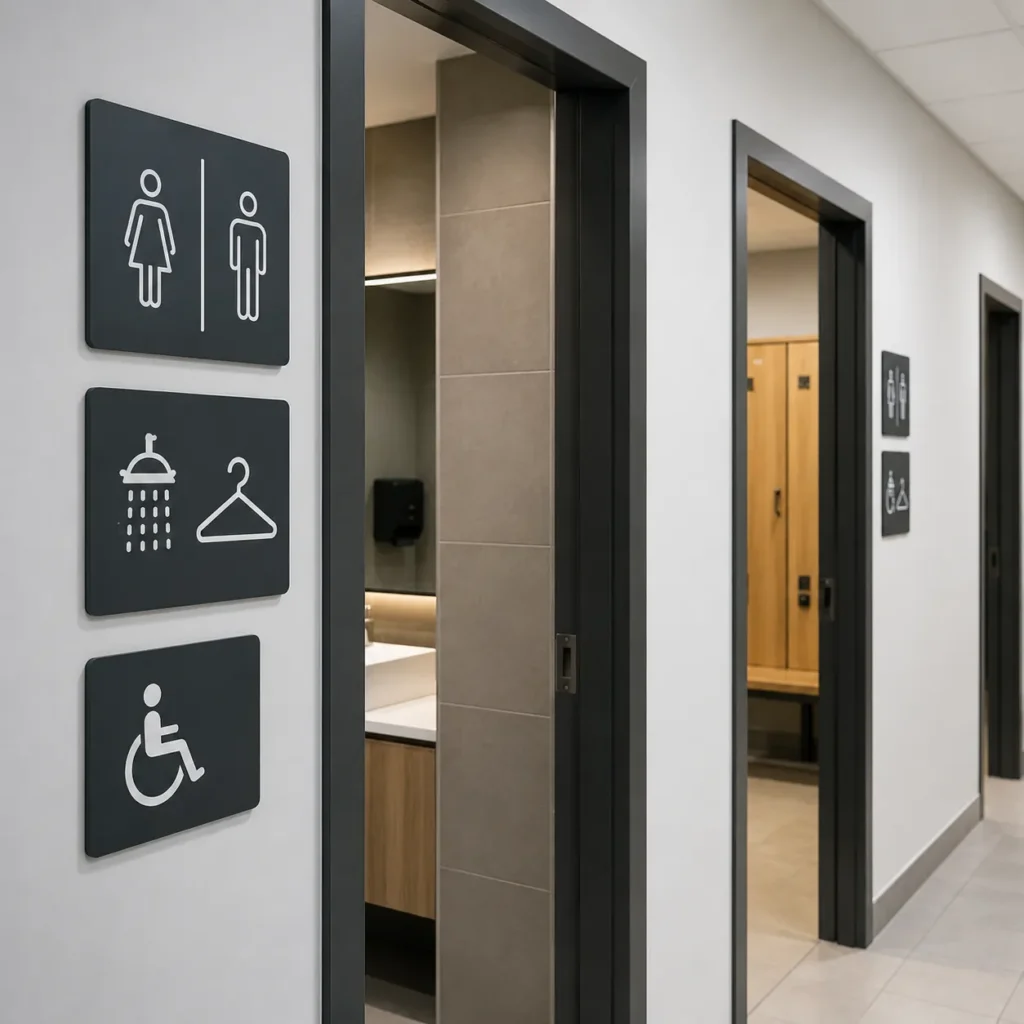

Thousands of organisations across Britain are preparing for a practical facilities review after new single-sex spaces guidance moved closer to implementation. Estimates linked to the updated Equality and Human Rights Commission code suggest nearly 13,000 toilets, more than 5,500 changing rooms and over 18,000 signs could be affected across gyms, hospitals, leisure centres, council services, restaurants, hairdressers and sports clubs.
The issue is not only about who can use which space. For businesses, councils and voluntary organisations, the bigger question is how to provide clear, lawful and workable facilities without leaving people without access. That is why the figures matter: they turn a legal ruling into a real-world planning challenge for thousands of everyday public spaces.
The updated code applies in England, Scotland and Wales. It follows the UK Supreme Court’s April 2025 judgment that “sex” in the Equality Act 2010 means biological sex. The draft code was published in May 2026, after being handed to the Government by the EHRC, and July 9 marks the end of the 40-day parliamentary scrutiny period. It may still take several weeks before the code formally comes into force.
The UK Government’s draft code of practice says providers must consider their Equality Act duties when offering single-sex and separate-sex services.
What the code changes in practice
The updated guidance says a service must operate on the basis of biological sex if it is to be treated as a single-sex service under the Equality Act. That affects spaces such as toilets, changing rooms, hospital wards, refuges and other facilities where privacy, safety or dignity is part of the reason for providing a single-sex service.
That does not mean every toilet block or changing area will be rebuilt. The likely impact will vary sharply depending on the provider. A small venue with one self-contained unisex toilet may have little to alter. A large leisure centre, hospital or sports facility with multiple shared spaces may need a more detailed review.
For many operators, the first step is likely to be an audit: checking signs, layouts, staff guidance, written policies and whether alternative facilities are available. In some cases, changing a sign may be enough. In others, providers may consider self-contained lockable unisex facilities so that nobody is left without a practical option.
This is one of the most important details for readers to understand. The code is not presented as a new Act of Parliament. It is statutory guidance explaining how existing Equality Act duties should be applied after the Supreme Court ruling. Once in force, courts and tribunals may take it into account when deciding whether a provider acted lawfully.
Where the biggest facility impact may fall
Data obtained by the Press Association from the EHRC gives a clearer picture of the likely scale. The estimates point to 12,895 toilets potentially affected across Britain.
The private sector accounts for the largest share, with an estimated 10,563 toilets. Public-sector bodies account for 1,154 toilets, while voluntary organisations account for 1,178.
Changing rooms are also expected to be reviewed. The estimate covers 5,526 changing rooms, including 4,527 in privately run facilities, 494 in public-sector spaces and 505 in the voluntary sector.
Signs may be the most visible change for the public. Around 18,422 signs could need updating, with 15,091 in the private sector, 1,648 in the public sector and 1,683 in voluntary organisations.
The sectors likely to be watching closely include gyms, leisure centres, local authority buildings, healthcare settings, domestic abuse services, restaurants, salons and sports clubs with at least 25 members. For readers tracking wider compliance and consumer issues, the way businesses respond to regulatory costs has also been seen in cases such as the JB Hi-Fi refund case involving misleading discount claims.
Why the cost estimate is so high
The central 10-year implementation cost is estimated at £703.1 million. That figure is not limited to building work. It also includes cleaning costs, staff training and policy updates.
The unadjusted total was originally estimated at £547.7 million. It rose after an “optimism bias” adjustment, a standard approach used in public-sector assessments to reflect the risk that projects may cost more or take longer than first expected.
Construction costs are estimated at £162.3 million before adjustment. That includes £133.2 million for private-sector providers, £14.2 million for the public sector and £14.9 million for voluntary organisations. After adjustment, construction costs rise to £211 million.
Cleaning is expected to account for an even larger share. Unadjusted cleaning costs total £230.2 million, with £188.6 million in the private sector, £20.6 million in the public sector and £21 million in the voluntary sector. After adjustment, cleaning costs rise to £299.2 million.
The remaining costs relate to staff training and internal policy changes. Those may be less visible than new doors or signs, but they could be critical for front-line workers who have to explain rules, handle complaints and keep services running smoothly.
Government and EHRC say many providers may already comply
The Government has argued that the code gives organisations guidance rather than changing the law or creating new rules. It says many businesses may already be largely compliant and may face no cost at all.
For providers that do need changes, ministers have suggested the work may often be limited, such as updating signs on existing facilities. The draft code also makes clear that a provider’s size and available facilities are relevant when deciding how the law should be followed.
EHRC chairwoman Mary-Ann Stephenson has also indicated that not every venue will face large costs. She has pointed out that many service providers already have male and female toilets as well as a unisex accessible toilet. For smaller providers, that may be enough.
The uncertainty is likely to sit with larger or more complex sites. A leisure centre with multiple changing areas, a hospital ward, a sports club with shared facilities or a council building used by many different groups may need more detailed planning than a small shop or community venue.
Read More:
- Halifax Jazz Festival cancels Saturday night show after Broken Social Scene pulls out
- Obama Presidential Center museum tickets: Prices, dates and how to book
- Visit the Swikblog homepage for more latest news
Campaigners remain sharply divided
For Women Scotland, which brought the case that led to the Supreme Court ruling, has welcomed the guidance as a milestone for protecting women’s rights. The group has said the code does not change the law, but helps organisations understand how to apply it.
On the other side, NION Women and other campaigners have raised concerns about the impact on transgender people. Their argument is that women’s safety and transgender dignity should not be framed as competing priorities, and that practical, inclusive services should be prioritised.
That disagreement is likely to continue as the code moves from Parliament into everyday use. The legal wording may be settled, but the implementation questions are still sensitive: what counts as proportionate, what facilities are available, how staff are trained and how providers avoid leaving anyone without access.
What readers should expect next
The code has cleared the 40-day scrutiny window, but it is not yet formally in force. A commencement date is still required, meaning organisations have a short window to review facilities before the guidance carries statutory weight.
For the public, changes are likely to appear unevenly. Some places may update signs quickly. Others may take longer while they assess layouts, budgets and legal advice. The most noticeable changes may come first in high-use facilities such as leisure centres, hospitals, gyms and council buildings.
The key point is that the code’s impact will not be identical everywhere. Some providers may need no major change, while others may face new costs and operational decisions. The figures suggest the guidance could touch a large number of public-facing spaces, but the scale of change will depend on what each organisation already provides.

Make Swikblog your go-to source on Google for reliable updates, smart insights, and daily trends.