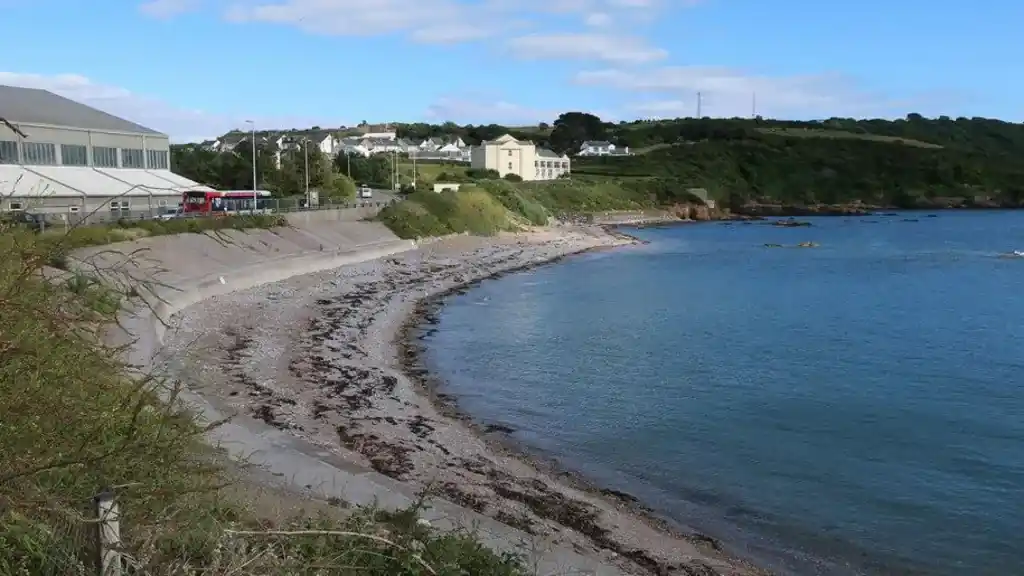

Mount Batten Beach in Plymouth has been closed until further notice after new environmental testing found asbestos fibres in 14 of 16 sand samples, prompting officials to restrict access while a detailed health investigation gets underway. The decision follows a review of monitoring carried out over several years and marks the most significant change in the beach’s safety status since asbestos-containing material was first identified there in 2019.
Plymouth City Council announced the closure on Friday, July 10, after the Director of Public Health consulted with the UK Health Security Agency (UKHSA). According to the council, two different asbestos types were detected, with concentrations classified by the testing contractor as hazardous waste.
The beach will remain closed until further notice while specialists carry out additional sand sampling, air-disturbance testing and further investigations to determine where the material is coming from. Residents, visitors and tourists have been urged to stay outside fenced areas and follow all warning signs.
By Chetan Sharma
- Beach closed from July 10, 2026 until further notice.
- Asbestos fibres found in 14 of 16 recent sand samples.
- Two asbestos types identified.
- Testing contractor classified the contamination as hazardous waste.
- About 500kg of asbestos-containing material has been collected since 2019.
- Air testing and further environmental surveys are now planned.
- No immediate health risk has been identified for recent visitors.
Years of monitoring led to a precautionary closure
Although Friday’s announcement may appear sudden, it follows years of monitoring at Mount Batten Beach.
Asbestos-containing material was first discovered in April 2019 after one of 16 sand samples showed a very low level of asbestos fibres. At that stage, specialists concluded that the overall risk remained low, allowing the beach to stay open provided warning signs remained in place and regular inspections continued.
Since then, Plymouth City Council has operated an ongoing clean-up programme. Teams have visited the beach roughly every two months to remove suspicious material washed onto the shoreline.
Around 500 kilograms of asbestos-containing debris has been collected since the initial discovery. Much of the material consists of small rocks and pebbles containing asbestos that appear to have been carried ashore by tidal movement.
However, officials recently reviewed the long-term monitoring programme and found that the amount of asbestos being recovered had not declined over time. That prompted a fresh round of laboratory testing across the beach.
The latest investigation revealed asbestos fibres in 14 of the 16 sand samples collected. Unlike the isolated findings recorded in 2019, the fibres were detected across much of the sampled area, leading public health officials to conclude that further precautions were necessary.
Investigators are still trying to establish where the contamination originates. A previous underwater dive survey failed to identify a definitive source, meaning additional environmental surveys will now be carried out.
Why asbestos in beach sand raises concern
Asbestos was widely used in construction materials throughout much of the twentieth century because it was durable, heat resistant and inexpensive. Problems arise when asbestos-containing material breaks down and microscopic fibres become airborne.
Those fibres cannot usually be seen with the naked eye, yet they can remain suspended in the air if contaminated material is disturbed by digging, construction work, strong winds or repeated movement across the surface.
The UK Health Security Agency states that all asbestos fibre types are hazardous if inhaled because exposure can increase the risk of serious diseases after many years. Health experts also note that asbestos exposure does not normally produce immediate symptoms following a brief visit to an affected area.
Plymouth City Council has emphasised there is currently no evidence suggesting an immediate health risk for people who recently visited Mount Batten Beach. Even so, authorities are taking a precautionary approach while they establish whether ordinary activity on the beach could release fibres into the surrounding air.
Anyone concerned about previous visits should seek advice from their GP or contact NHS 111 rather than attempting to collect or disturb any suspicious material themselves.
The closure reflects a wider focus on protecting people using shared public spaces when potential health risks are identified. Similar changes affecting public facilities can also be seen in the new single-sex spaces code affecting more than 13,000 toilets and 5,500 changing rooms, which introduces updated guidance for managing public spaces across the UK.
Further information about asbestos health risks is available through the UK Health Security Agency.
Read More:
- Galaxy Global Education denies land grab claims
- England KS2 SATs results delayed until July 16 after Pearson issue
- Visit the Swikblog homepage for more latest news
What happens before the beach can reopen
Officials say several stages of work must now be completed before any decision can be made about reopening Mount Batten Beach.
- Additional sand sampling across the shoreline.
- Air-disturbance testing to assess airborne fibre levels.
- Further investigations to identify the contamination source.
- A revised public health risk assessment based on the latest evidence.
Professor Steve Maddern, Plymouth’s Director of Public Health, acknowledged that closing one of the city’s most popular beaches would disappoint many local residents and visitors. However, he said protecting public health had to take priority while specialists assessed the latest findings.
He urged everyone to respect warning signs and fencing and avoid entering the restricted area from either land or the sea until further notice.
Although the beach itself is closed, other parts of the Mount Batten peninsula remain open, including the Mount Batten Watersports and Activities Centre and nearby public facilities where access has not been restricted.
There is currently no confirmed reopening date. Plymouth City Council says updates will be issued as further testing is completed and investigators gain a clearer understanding of the contamination, the source of the asbestos and the work needed to make the beach safe for public use again.

Make Swikblog your go-to source on Google for reliable updates, smart insights, and daily trends.