
A 2,100-year-old Roman shipwreck carrying hundreds of ancient amphorae has been discovered off Sicily, offering archaeologists a rare look at the wine trade and shipping networks that connected the Mediterranean during the late Roman Republic.
The vessel lies about three miles off Mazara del Vallo on Sicily’s western coast, around 46 metres (150 feet) below the surface. Italian authorities believe it dates from between the second and first centuries BC, while local reports estimate the wreck at roughly 21 metres long and six metres wide.
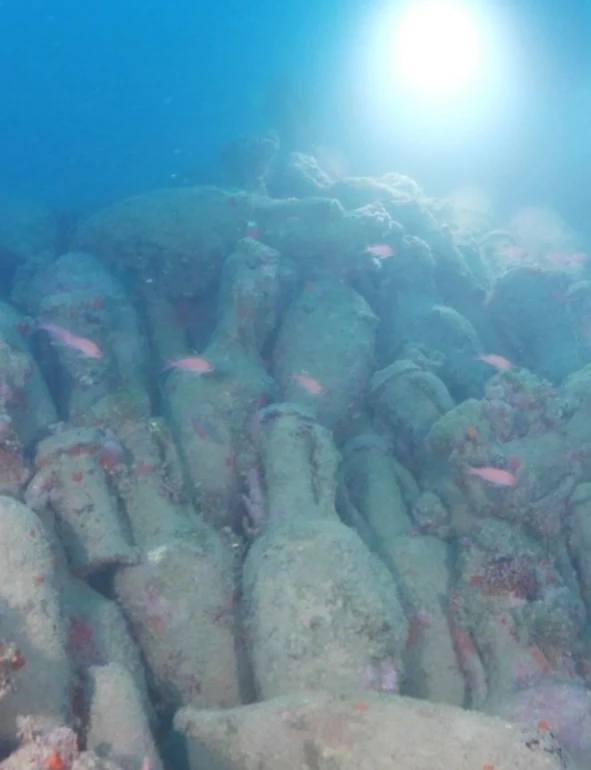
Much of the cargo consists of well-preserved Dressel 1A amphorae, tall ceramic containers widely associated with transporting wine. Investigators have also identified two lead anchor stocks and another lead structure at the site.
Italian Culture Minister Alessandro Giuli has described the discovery as one of the most important underwater archaeological finds of recent years.
Fishermen helped uncover a seabed covered with amphorae
The discovery followed information from underwater fishermen Giacomo De Mola and Igor Bisulli. De Mola said he noticed something on underwater scanning equipment that initially appeared to be a large rock and decided to dive down for a closer inspection despite limited visibility.
Instead, he found an extensive concentration of ancient jars. De Mola later said he reported the site to Sicily’s Superintendent of the Sea. Footage from the area showed fish, eels and other marine life moving among the containers after centuries on the seabed.
Specialist teams, including the Carabinieri Cultural Heritage Protection Unit in Palermo and Carabinieri divers, were subsequently involved in examining the wreck. Authorities are now focusing on documenting and protecting the site while researchers study its archaeological context.
The amphorae are especially important because their shape, clay composition, manufacturing methods and any surviving residue can help experts trace production areas and trade routes. Dressel 1A containers circulated widely during the late Roman Republic and are closely linked with wine transportation.
The Sicily wreck adds to a broader record of ancient vessels preserved beneath Mediterranean waters. A 2,000-year-old luxury Egyptian boat discovered beneath Alexandria’s coast offered a very different glimpse of Roman-era maritime life, revealing an elite pleasure craft rather than a commercial vessel carrying cargo.
A separate 1864 wreck is revealing clues about historic Guinness
The Sicily discovery comes as another shipwreck is attracting attention for a very different connection to what people once drank. Divers examining the Mindora, a vessel that set sail on November 27, 1864 and was lost after colliding with another ship, discovered bottles bearing the Guinness name.
Expedition diver and underwater photographer Stefan Panis and research diver and historical researcher Paweł Truszynski have been involved in the project. Panis said divers encountered numerous bottles and brought one to the surface, where rinsing revealed the Guinness inscription.
Based on the size of the case, Panis estimated that it may originally have held around 24 bottles, with the possibility that additional cases remain at the wreck.
The bottles spent more than 160 years in unusually stable conditions of around 4°C, darkness and constant underwater pressure. Researchers are interested in whether material associated with the historic yeast could still contain useful genetic information.
If sufficiently intact material can be recovered, scientists could potentially attempt a small experimental re-brew reflecting characteristics of Guinness produced in the 1860s. The idea has been described as “liquid time travel,” although no successful recreation has yet been confirmed.
The historical timing matters because brewing methods changed during the 19th century as taxation rules, ingredients and production practices evolved. Diageo Ireland has said the Guinness Archive team has been in contact with the divers as the discovery is assessed.
The Roman vessel and the Mindora are unrelated wrecks separated by roughly two millennia, but both show how submerged sites can preserve evidence of goods once transported and consumed.
Modern underwater searches can uncover much more recent history too. The wreckage of Pan Am Flight 526A identified after a 74-year search demonstrated how archival research, sonar and deep-sea imaging can help investigators locate sites hidden far beneath the ocean.
Why the Sicily cargo could reveal more about Roman trade
The archaeological value of the Sicily wreck goes beyond the number of wine jars. Because hundreds of containers remain associated with one vessel and one voyage, researchers can study the cargo as a connected commercial record rather than a collection of isolated artifacts.
The position of the amphorae, pottery origins, surviving residues and remaining parts of the ship could eventually help specialists determine where the wine was produced and where the vessel may have been heading. Protecting that context is crucial because disturbing objects before they are properly documented can permanently erase evidence about how the cargo was arranged and transported.
Italy’s cultural authorities continue to study and protect underwater heritage around Sicily. The Italian Ministry of Culture’s Museo del Satiro in Mazara del Vallo documents archaeological finds recovered from the waters of the Sicily Channel, including transport amphorae from Roman and earlier periods.