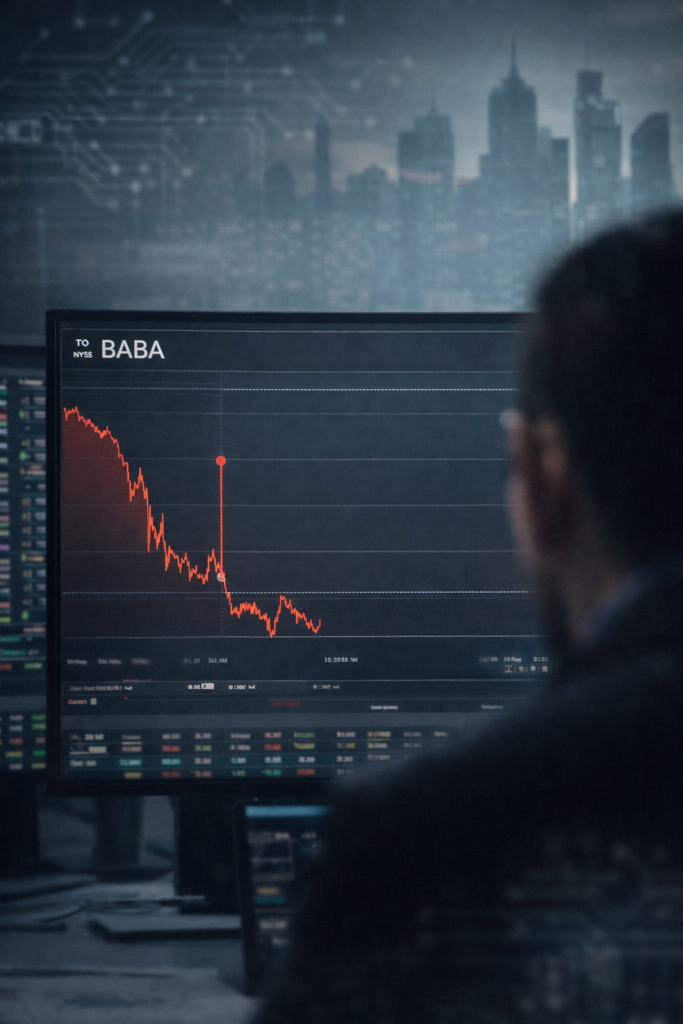

Alibaba Group Holding Ltd. is facing renewed investor pressure after its latest earnings report revealed a sharp deterioration in profitability, sending its US-listed stock down 4.58% to around $128 in pre-market trading. The decline came after the company posted a staggering 67% drop in net income, even as it accelerates one of the most aggressive artificial intelligence investment strategies in the global tech sector.
The results highlight a growing tension inside Alibaba’s business model: while the company is positioning itself as a leader in AI and cloud computing, the financial cost of that transition is weighing heavily on earnings. At the same time, its core e-commerce segment is under intense pressure from domestic rivals, forcing Alibaba to spend aggressively just to maintain its position.
Profit crashes 67% as revenue growth stalls
For the quarter ended December, Alibaba reported revenue of 284.8 billion yuan ($41.3 billion), marking just a 2% increase year-over-year and slightly missing market expectations. However, the much bigger concern was the collapse in profitability. Net income plunged 67%, marking its worst performance since early 2024 and raising concerns about the company’s ability to balance growth investments with financial stability.
The weak earnings performance was largely driven by rising costs across multiple fronts, including aggressive promotional spending in its e-commerce division and heavy investments in AI infrastructure and development.
Price wars and subsidies continue to hurt margins
Alibaba remains deeply engaged in a prolonged price war with major competitors including JD.com and Meituan. The company has been offering significant subsidies to retain users and defend market share, with spending reaching as much as 50 billion yuan in recent periods. While these efforts have helped sustain user engagement, they have also significantly eroded margins.
During key shopping periods and campaigns such as the Lunar New Year, Alibaba and its rivals distributed billions of yuan in coupons to attract users to their platforms. This aggressive spending environment has made profitability increasingly difficult to maintain, even for a company of Alibaba’s scale.
AI investment surges, but monetization becomes urgent
At the same time, Alibaba is doubling down on artificial intelligence as its next major growth engine. The company has committed more than $53 billion toward AI investments over several years, making it one of the most aggressive spenders in China’s AI race. While this figure is still smaller than the projected $650 billion spending by US hyperscalers in 2026, it represents a massive capital commitment within the Chinese tech landscape.
Alibaba’s cloud division has emerged as its fastest-growing segment, with triple-digit growth in AI-related revenue for 10 consecutive quarters. However, despite this strong demand, the company is now under pressure to convert that growth into sustainable profits.
In a move signaling a shift toward monetization, Alibaba has raised prices for its cloud computing and storage services by as much as 34%. The company is also focusing more heavily on enterprise clients, launching new AI-driven products such as its agentic AI service “Wukong,” aimed at business users.
More details about Alibaba’s evolving AI and cloud strategy can be found on its official investor relations page here.
Major restructuring and creation of “Token Hub”
To streamline its AI operations and accelerate commercialization, Alibaba has introduced a major restructuring initiative. A new business unit called “Alibaba Token Hub” has been created, bringing nearly all AI-related operations under one umbrella led by CEO Eddie Wu.
The concept of “tokens” refers to units of computing power used in AI systems and also serves as a pricing mechanism for customers. This shift indicates Alibaba’s intention to directly link AI usage with revenue generation, marking a significant step toward turning its AI investments into a viable business model.
Analysts see this move as a critical development. According to research commentary, the surge in token usage reflects strong demand for AI services, and the restructuring could play a key role in improving commercialization efforts.
Competitive pressure in AI intensifies
Alibaba’s AI ambitions are unfolding in an increasingly competitive environment. Tencent, in particular, is seen as having a strategic advantage due to its control over the WeChat ecosystem, which provides access to a vast user base and valuable data for building AI-driven applications.
Meanwhile, companies like Baidu and ByteDance are also accelerating their AI efforts. Baidu has already raised prices for its AI cloud products by up to 30%, signaling a broader industry shift from price competition to monetization.
This competitive landscape means Alibaba must not only innovate but also execute quickly to maintain its leadership position in China’s AI sector.
Leadership uncertainty adds to concerns
Adding to the uncertainty, Alibaba recently saw the departure of Junyang Lin, a key developer behind its Qwen AI models and a central figure in the company’s AI transition. His exit has raised questions about internal stability and the future direction of Alibaba’s AI research efforts.
While the exact reasons for his departure remain unclear, the move has sparked concern among industry observers and investors about potential disruptions in Alibaba’s AI development pipeline.
Balancing transformation with profitability remains the key challenge
Alibaba’s current situation reflects a broader strategic transition. The company is attempting to evolve from a traditional e-commerce giant into a full-stack AI and cloud computing powerhouse. However, this transformation comes with significant costs and risks.
Its legacy e-commerce business is facing slowing growth and shrinking margins, while its new AI-driven initiatives require heavy upfront investment with uncertain short-term returns. This dual pressure is creating a challenging environment for management and investors alike.
What the 4.58% stock drop really means
The sharp decline in Alibaba’s stock is not just a reaction to one weak quarter. It reflects deeper concerns about the company’s ability to navigate this transition successfully. Investors are increasingly focused on whether Alibaba can demonstrate clear progress in monetizing its AI investments while stabilizing its core business.
Until the company can show consistent revenue growth and improved profitability, market sentiment is likely to remain cautious. Broader market analysis on global tech trends and AI competition can be explored further on Bloomberg.
For now, Alibaba remains at a critical crossroads. Its aggressive push into AI could define its future, but the path forward will require careful execution, disciplined spending, and a clear ability to turn innovation into earnings. Until then, volatility in the stock may continue as investors wait for stronger signs of a sustainable turnaround.
You may also like: Shell share price today falls after Qatar attack raises LNG market concerns

Make Swikblog your go-to source on Google for reliable updates, smart insights, and daily trends.