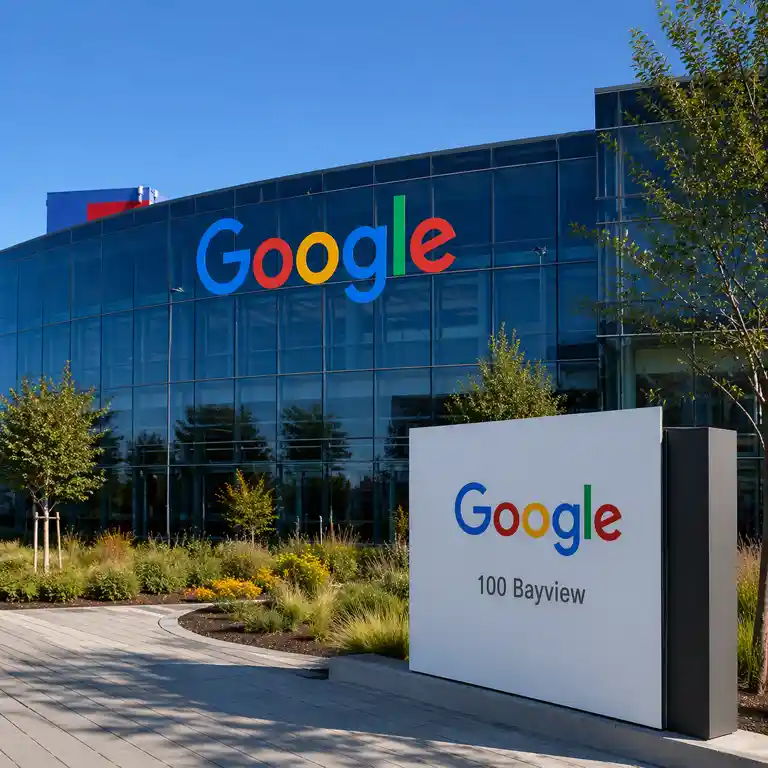

Alphabet Inc. (NASDAQ: GOOG) moved higher in Wednesday trading, with the stock rising 1.7% to about $336, after Google landed a cloud infrastructure agreement with Thinking Machines Lab, the artificial intelligence startup founded by former OpenAI CTO Mira Murati. On the surface, the market reaction looked measured. Underneath, though, the message was more important: investors are starting to treat Google Cloud’s AI business as a growth engine with real commercial traction, not just a supporting act inside a much larger advertising company.
The agreement is reportedly worth around $3 billion, placing it among the more meaningful AI infrastructure deals tied to a young frontier lab. That matters because the startup is not simply renting generic cloud capacity. It is signing up for high-performance systems built around Nvidia’s newest GB300 chips, along with the surrounding software and cloud services needed to train and deploy advanced models at scale. In practical terms, this is the kind of customer win that says more about future positioning than one quarter of revenue ever could.
Key numbers investors are watching
- Stock: Alphabet Inc. (GOOG)
- Share price reaction: +1.7%
- Recent trading level: about $336
- Estimated deal size: roughly $3 billion
- Startup founder: Mira Murati, former OpenAI CTO
- Thinking Machines valuation: $12 billion
- Seed funding raised: $2 billion
- Chip platform in focus: Nvidia GB300 systems
- Claimed performance improvement: up to 2x faster training and serving versus prior-generation GPUs
- Workload emphasis: reinforcement learning for model training and deployment
What makes this win especially notable is that Thinking Machines is still early in its life as a company, yet it is already committing to infrastructure on a scale that points to serious model-building ambitions. The startup launched in February 2025 after Murati left OpenAI, later raised a $2 billion seed round at a $12 billion valuation, and introduced its first product, Tinker, in October. Tinker is designed to automate the creation of custom frontier AI models, which gives the deal a more interesting angle than a plain cloud contract. Google is not just adding another customer. It is attaching itself to a lab trying to build tools for the next generation of AI development.
That distinction matters because the economics of frontier AI are increasingly being shaped by compute intensity. Thinking Machines’ architecture reportedly leans on reinforcement learning, a training method that can consume huge amounts of processing power. Reinforcement learning has already helped drive major leaps across the industry, but it is expensive, iterative, and infrastructure-heavy. For Google, signing a customer with those needs creates a showcase opportunity. It can point to a demanding AI lab and say its cloud stack, databases, orchestration tools, and GPU-backed systems are ready for serious production work.
The strategic read-through is just as important as the immediate revenue potential. Google has spent years trying to narrow the perception gap with Amazon Web Services and Microsoft Azure. It has strong technology, but investor narratives around cloud leadership have not always worked in its favor. This deal helps change the conversation. It suggests that top AI startups are willing to trust Google Cloud not only for storage or basic compute, but for the most advanced and expensive part of the stack. That kind of endorsement carries weight in a market where every major cloud vendor is trying to prove it can power the AI boom.
Another point worth noting is that the agreement is non-exclusive. On one hand, that means Thinking Machines can still work with multiple providers over time, so Google has not locked up the entire relationship. On the other hand, non-exclusive deals are normal in this part of the market, where labs often diversify compute sources to manage cost, supply, and resilience. What matters more is that Google got in early. In a race where the biggest long-term winners may be the infrastructure providers embedded with top AI developers from the start, early placement counts.
There is also a broader industry context. Google has been bundling AI infrastructure with surrounding services like Kubernetes, data tools, storage, and Spanner, trying to make its cloud offering more compelling as a full operating environment for AI companies. Rivals are moving just as aggressively. Anthropic has signed separate large-scale capacity agreements with both Google-related infrastructure and Amazon, underscoring how intense the competition has become. For investors, this is the real story: cloud providers are no longer just selling generic computing. They are battling to become the default backbone for the most ambitious AI labs.
From a stock perspective, GOOG’s 1.7% move makes sense. It is enough to show the market sees the deal as meaningful, but not so large that investors are assuming the upside is fully captured in one headline. Alphabet remains a giant company, so individual deals need to be very large or highly strategic to materially shift sentiment. This one checks the strategic box. It supports the view that Google can translate AI leadership into customer relationships, usage growth, and eventually stronger cloud economics.
For longer-term investors, the most important takeaway may be what this says about Google’s role in the AI value chain. The company is often discussed through the lens of Gemini, search, and digital advertising. Yet infrastructure may become just as important to the bull case. If Google can serve as the platform on which emerging AI leaders build and scale, then its cloud unit becomes more than a diversification story. It becomes a core monetization layer of the AI cycle.
That is why this development deserves more attention than a standard deal announcement. It offers a glimpse of where value may be created over the next several years: not only in the models that attract headlines, but in the compute platforms, databases, and deployment systems that make those models possible. Google appears determined to be part of that foundation. And when a high-profile startup led by one of AI’s best-known executives chooses its infrastructure, the market notices.
Investors looking at Alphabet today are no longer just asking whether search can hold up or whether advertising growth can stay healthy. They are also asking whether Google can win enough of the AI infrastructure buildout to create a second engine of durable expansion. This deal does not answer that question on its own. But it does move the story in Google’s favor.
For more coverage on cloud competition and AI infrastructure, read our Vodafone Stock Drop After Google AI Deal: Buying Opportunity?
. Readers who want a technical view of how advanced training methods are shaping modern AI systems can also explore Google DeepMind’s research updates.
Make Swikblog your go-to source on Google for reliable updates, smart insights, and daily trends.