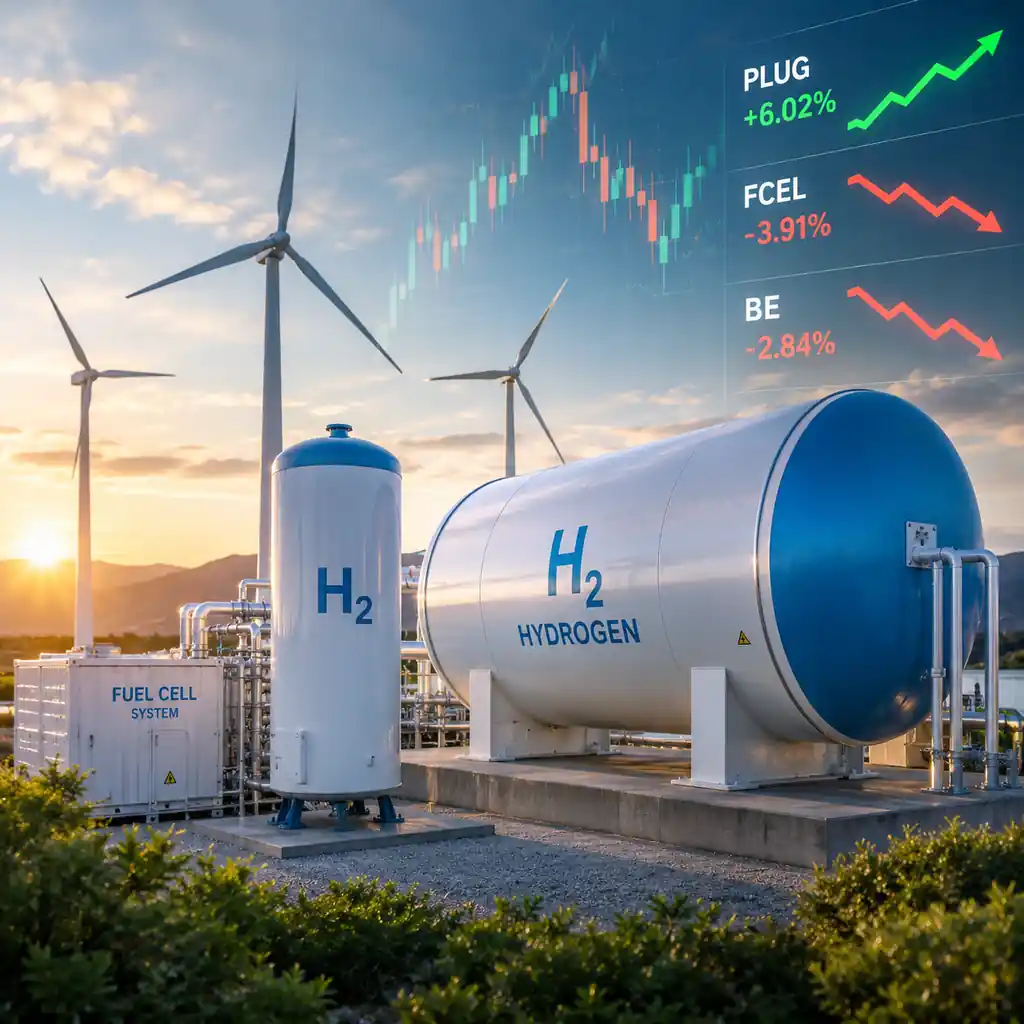

Plug Power shares climbed about 6% to $4.07 in Wednesday trading, breaking away from a broader fuel-cell pullback as investors reconsidered the company’s turnaround prospects. FuelCell Energy fell approximately 4% to $23.32, while Bloom Energy declined around 3% to $294.64.
The split suggests investors are no longer treating hydrogen and fuel-cell companies as a single clean-energy trade. Plug Power attracted buyers after signs of improving revenue and potential cash generation, while traders took profits in FuelCell Energy and Bloom Energy following their substantial 2026 rallies.
Plug Power benefited from renewed turnaround hopes. FuelCell Energy and Bloom Energy appeared to face profit-taking after sharp year-to-date gains, despite both companies retaining exposure to growing electricity demand from artificial intelligence data centers.
Why Plug Power stock moved higher
Plug Power’s first-quarter fiscal 2026 revenue reached $163.51 million, representing growth of approximately 22% from the previous year and coming in roughly 17% above consensus expectations. The better-than-expected sales result offered investors evidence that demand was improving, even though the company continued to report substantial losses.
Management has identified positive EBITDAS in the fourth quarter of 2026 as an important operating target. EBITDAS is a company-defined, non-GAAP measure, so investors should not treat the goal as equivalent to achieving net profitability or positive free cash flow.
The company has also outlined plans to generate approximately $275 million by monetizing hydrogen assets. That total includes a $142 million transaction involving Stream Data Centers, giving the market another possible source of liquidity as Plug Power works to reduce costs and strengthen its balance sheet.
These developments help explain the fresh buying interest. The stock has already shown how quickly sentiment can change when a new catalyst appears, including during a recent Plug Power rally driven by hydrogen deal momentum. However, completing the planned transactions and improving operating performance will matter more than a single day’s share-price gain.
Bloom Energy slips despite powerful growth
Bloom Energy’s decline came after an extraordinary run rather than a weak quarterly report. According to the company According to the company’s first-quarter financial results, revenue rose 130% year over year to $751.1 million.
Bloom also raised its fiscal 2026 revenue forecast to between $3.4 billion and $3.8 billion. Its solid-oxide fuel-cell systems have attracted attention as data center operators search for dependable on-site electricity that can be deployed faster than some traditional grid projects.
With Bloom shares having gained about 242% during 2026 at the time of the trading snapshot, the modest decline may reflect investors locking in profits after a rapid valuation increase. That surge followed growing interest in Bloom Energy’s role in powering AI data centers, where reliable on-site electricity has become an increasingly important investment theme.
FuelCell Energy faces a similar test
FuelCell Energy was also coming off a major rally, with its shares up approximately 225% for the year at that point. The company ended fiscal 2025 with $55.02 million in quarterly revenue, $278.1 million in cash and investments, and a backlog of about $1.24 billion, according to its year-end business update.
That backlog provides potential long-term revenue visibility, but it does not guarantee when projects will be completed or when their value will be recognized as revenue. Investors are also watching whether FuelCell Energy can turn interest from data center customers into profitable commercial deployments.
Is this a hydrogen turnaround signal?
Wednesday’s divergence is better viewed as rotation within the fuel-cell sector than proof of a broad hydrogen turnaround. Plug Power is trading as a recovery candidate, Bloom Energy as an established AI-power winner, and FuelCell Energy as a more speculative play on distributed electricity and data center demand.
The long-term opportunity remains significant. The U.S. Department of Energy continues to support research and development involving hydrogen production, storage and fuel-cell applications. Commercial success, however, will depend on cost, reliability, financing and the ability to compete with other power technologies.
Holding above $4 could support Plug Power’s short-term momentum, but the more important tests are cash use, asset-sale completion and progress toward its operating targets. Fuel-cell stocks remain highly volatile, and strong revenue growth does not remove financing, execution or valuation risk.
This article is for informational purposes only and does not constitute financial or investment advice. Stock prices and analyst expectations can change rapidly.

Make Swikblog your go-to source on Google for reliable updates, smart insights, and daily trends.