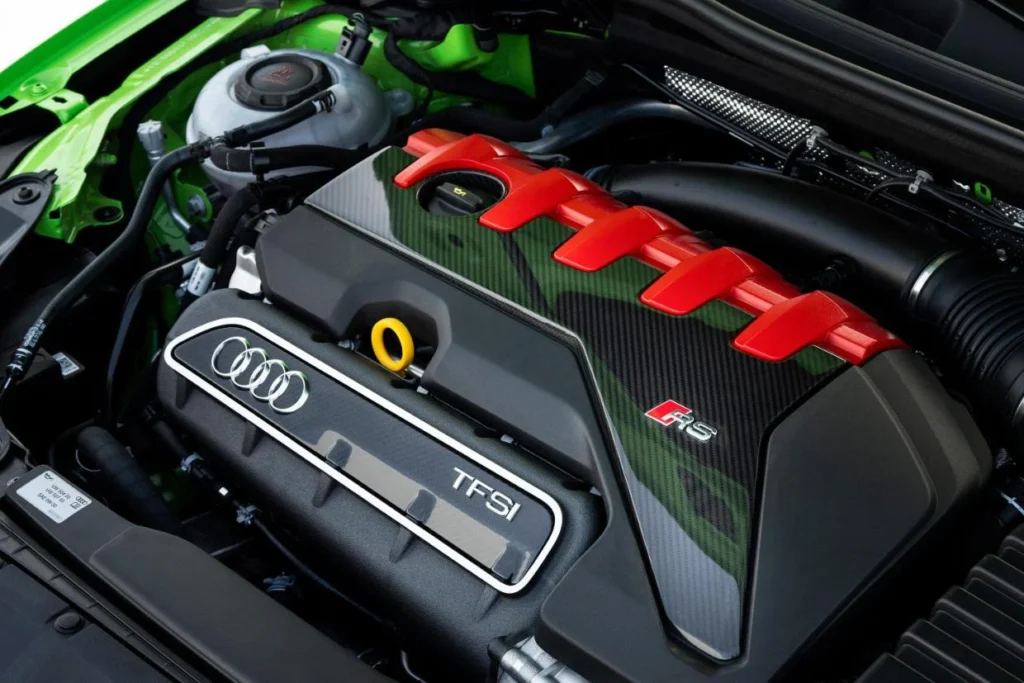

Audi has confirmed it will discontinue its iconic turbocharged 2.5-litre five-cylinder engine from its European lineup by mid-2027, marking the end of a 50-year legacy as stricter Euro 7 emissions regulations begin to take effect from late 2026. The move places one of the brand’s most recognisable performance engines on a clear countdown, with the current-generation RS3 expected to be its final major application.
The decision is being driven by compliance challenges rather than lack of demand. Audi’s long-running ‘EA855’ engine — a 2480cc unit producing up to 294kW and 500Nm in the RS3 — does not meet the incoming emissions standards without significant redevelopment. With production of the RS3 set to end around mid-2027, the five-cylinder will quietly exit alongside it, closing a chapter that began in 1976.
That timeline, however, may not be uniform globally. Markets such as Australia and New Zealand, where emissions rules lag behind Europe, could continue receiving the RS3 and its distinctive engine into 2028, depending on supply. Local regulations are still aligned with Euro 6d standards, delaying the immediate impact of Euro 7.
A defining engine for Audi’s performance identity
The five-cylinder engine has long been more than just a technical configuration for Audi. It became synonymous with the brand’s identity following the launch of the original Quattro in 1980, where turbocharged five-cylinder power and all-wheel drive combined to dominate rallying and reshape performance engineering.
In modern form, the engine powered not only the RS3 hatch and sedan but also the now-discontinued TT RS and RS Q3. It is also set to appear in limited numbers in the upcoming Cupra Formentor VZ5, underlining how widely respected the unit remains across performance-focused brands within the Volkswagen Group.
Its appeal has never been purely about output figures. The engine’s distinctive firing order and sound — unlike conventional four- or six-cylinder layouts — gave Audi a unique acoustic signature, helping smaller performance models stand apart in an increasingly standardised market.
Shift toward hybrid performance and regulatory reality
The phase-out reflects a broader shift across the industry, where regulatory pressure is accelerating the move toward electrification and hybridisation. Audi itself has already begun repositioning its high-performance lineup, recently introducing plug-in hybrid systems in newer RS models.
The latest RS5, for example, adopts a 2.9-litre twin-turbo V6 paired with an electric motor, producing a combined 470kW and 870Nm — significantly more than its predecessor while remaining compliant with evolving emissions standards.
This transition mirrors a wider trend among European rivals. BMW is also reworking its performance powertrains to meet Euro 7 rules, including hybridised versions of the M3 and updated plug-in hybrid systems in the M5 lineup.
Audi, however, is not abandoning combustion engines entirely. The company has recently reiterated a “technology-agnostic” approach, stepping back from its earlier all-electric-only timeline and confirming petrol and diesel engines will remain part of its portfolio into the 2030s.
Even so, the economics of compliance are narrowing the space for niche engines. The five-cylinder, despite its heritage and loyal following, represents a specialised solution in an industry increasingly prioritising scalable, regulation-friendly architectures.
There are indications the engine could make a final celebratory appearance, with reports suggesting a possible limited run in a future Volkswagen Golf R tied to the model’s 25th anniversary. If confirmed, it would serve as a symbolic send-off for a powertrain that helped define Audi’s modern performance era.
The regulatory shift underpinning this decision is outlined in the European Union’s Euro 7 framework, which is forcing automakers to reassess even their most iconic technologies.
For enthusiasts, the end of Audi’s five-cylinder engine is less about numbers and more about identity. In an era where electrification is reshaping performance, its departure highlights a broader transformation — one where character-rich engineering solutions are increasingly giving way to efficiency, compliance and future-proof design.
You may also like: Claude AI outage 2026 triggers login errors and chat failures.

Make Swikblog your go-to source on Google for reliable updates, smart insights, and daily trends.