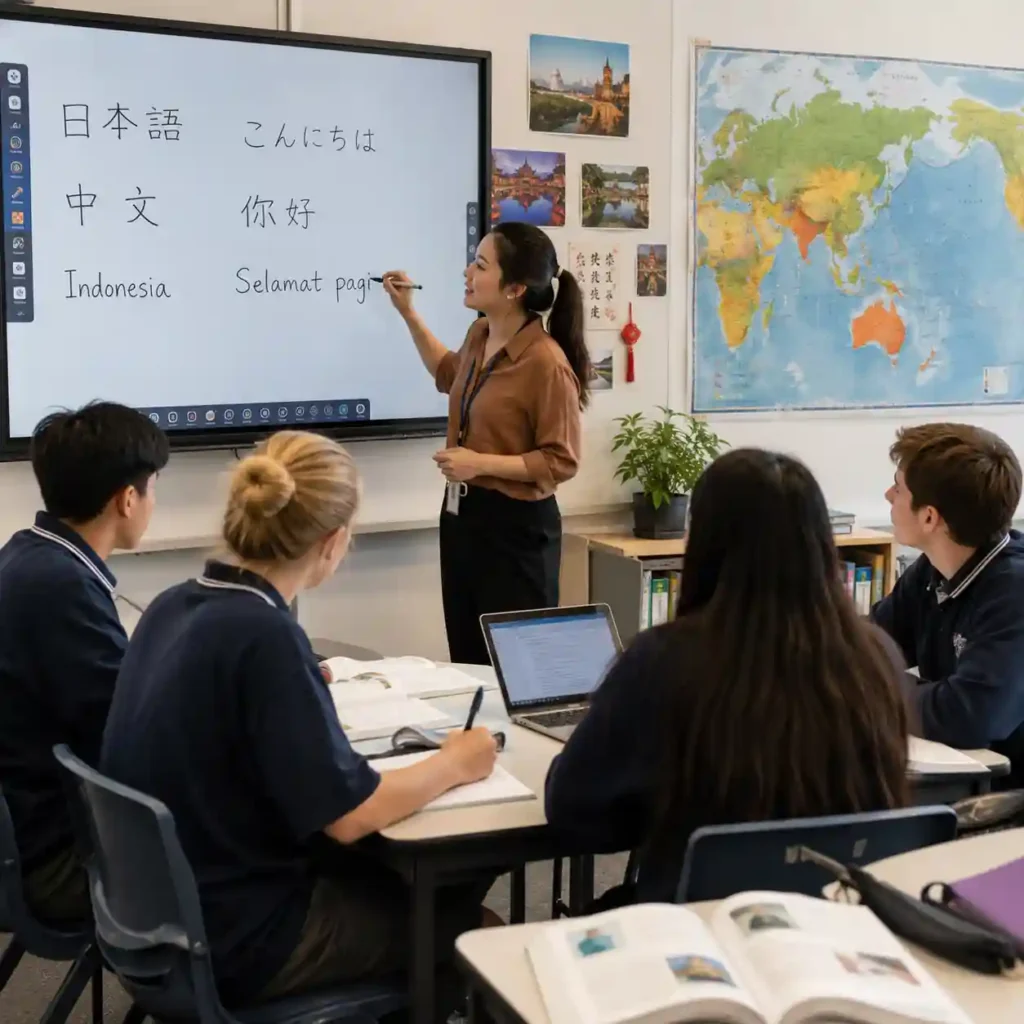

Australia’s Asian language education system is facing an “existential crisis”, with a parliamentary report warning that student enrolments are falling at the same time the country needs stronger ties with Asia for trade, diplomacy, security and future jobs.
The report says Australia is not producing enough students with Asian language skills or regional knowledge, despite Asia’s growing role in the global economy. It found that only 3.3% of Australian Year 12 students studied Chinese, Indonesian or Japanese in 2023, down from 4.7% in 2012.
At university level, the decline is even sharper. Domestic enrolments in South-East Asian languages fell by 75% between 2005 and 2024, raising concerns that Australia’s long-term Asia capability is weakening.
The warning also comes as students and families are watching broader education policy changes, including Australia’s freeze on new CRICOS registrations until 2027, which has added fresh attention to the future of the country’s education sector.
Indonesian language learning faces the biggest warning
The report says Indonesian language teaching could become “functionally extinct” within five years if current trends continue. That is a major concern because Indonesia is Australia’s nearest large neighbour and a key regional partner.
Committee chair Tim Watts, Labor MP and Special Envoy for the Indian Ocean, said Australia’s Asian language capability was close to “falling off a cliff”. He said that out of around 1 million domestic university students, barely 500 are studying Indonesian, fewer than during the era of former prime minister Sir Robert Menzies.
The decline is not limited to Indonesian. The report found that only two Australian universities offer Hindi courses, while the Australian National University is the only university with a dedicated program on South Asia.
Chinese studies are also under pressure. Just 17 students completed honours in Chinese studies with language at Australian universities in the five years to 2021, despite China remaining one of Australia’s most important trading partners.
Read More
Why Australia says Asia capability matters
The report warns that falling Asian language enrolments could weaken Australia’s national prosperity and security. It notes that Asia is expected to account for 53% of the global population and nearly half of global GDP by the end of the decade.
Four of Australia’s five top trading partners are China, Japan, South Korea and India. That makes Asian language learning more than a classroom subject. It is tied to trade, diplomacy, defence, business, research and cultural understanding.
The committee also warned that China invests heavily in understanding Australia, while Australia’s education system is no longer investing seriously enough in understanding China.
Foreign Minister Penny Wong said the figures were worse than she expected, but heading in the direction she had feared. She said Australia’s multicultural population is a national asset and can help the country engage more securely with the region.
The full parliamentary report and official committee material can be viewed through the Parliament of Australia.
Extra ATAR points proposed for Asian languages
One of the report’s 34 recommendations is to give students five extra Australian Tertiary Admission Rank points for studying selected Asian languages in Year 12, including Mandarin, Indonesian and Hindi.
The proposal is designed to encourage students to continue language study into senior school, where subject choices are often shaped by university entry goals. Mr Watts said an “eat your vegetables” approach would not work, and that students need incentives to build their own interest in languages.
Year 8 student Ruby O’Connell, who studies Japanese at St Patrick’s College Townsville, said learning a new language gives students a deeper understanding of the world and builds problem-solving skills that can connect with real life.
Twins Shagun and Shakshi Kaveti, who study Japanese at Mount Gravatt High School in Brisbane, said there are benefits beyond ATAR points. Their family background includes Hindi and Sinhalese, but they did not grow up speaking Hindi, showing how heritage language skills can fade without regular learning.
Parent Claire Paterson, whose twins study Chinese and Italian in Melbourne, supported the incentive but questioned why it should not apply to all languages. Another student, Evelyn, said extra ATAR points could act as a safety net for students who may not perform as strongly in subjects such as maths or science.
Asia Leader Schools and immersion programs recommended
The report recommends more than just ATAR incentives. It calls for overseas immersion programs, stronger partnerships between Australian and Asian schools, and a national network of regional centres of excellence called Asia Leader Schools.
These schools would help improve classroom teaching, support language teachers and create stronger pathways so students do not lose access to Asian languages as they move from primary school to secondary school and then university.
The committee also recommends a new consortium of schools that can work together to reduce the cost and logistical difficulty of overseas trips to Asia for intensive language programs.
Experts welcomed the report but warned that Australia needs deeper reform. University of Melbourne honorary fellow Allan Patience described the current system as a “fruit salad” approach, where students are often exposed to different Asian languages for short periods without developing long-term fluency.
He said language teaching should not rely only on vocabulary and grammar exercises. To keep students engaged, Asian languages need to be taught through culture, history, politics, literature, art, music and real-world communication.
The report’s central message is that Australia’s Asian language decline is no longer a narrow education issue. Without stronger teachers, better university programs, consistent school pathways and meaningful student incentives, the country risks losing the skills needed to understand the region shaping its future.

Make Swikblog your go-to source on Google for reliable updates, smart insights, and daily trends.