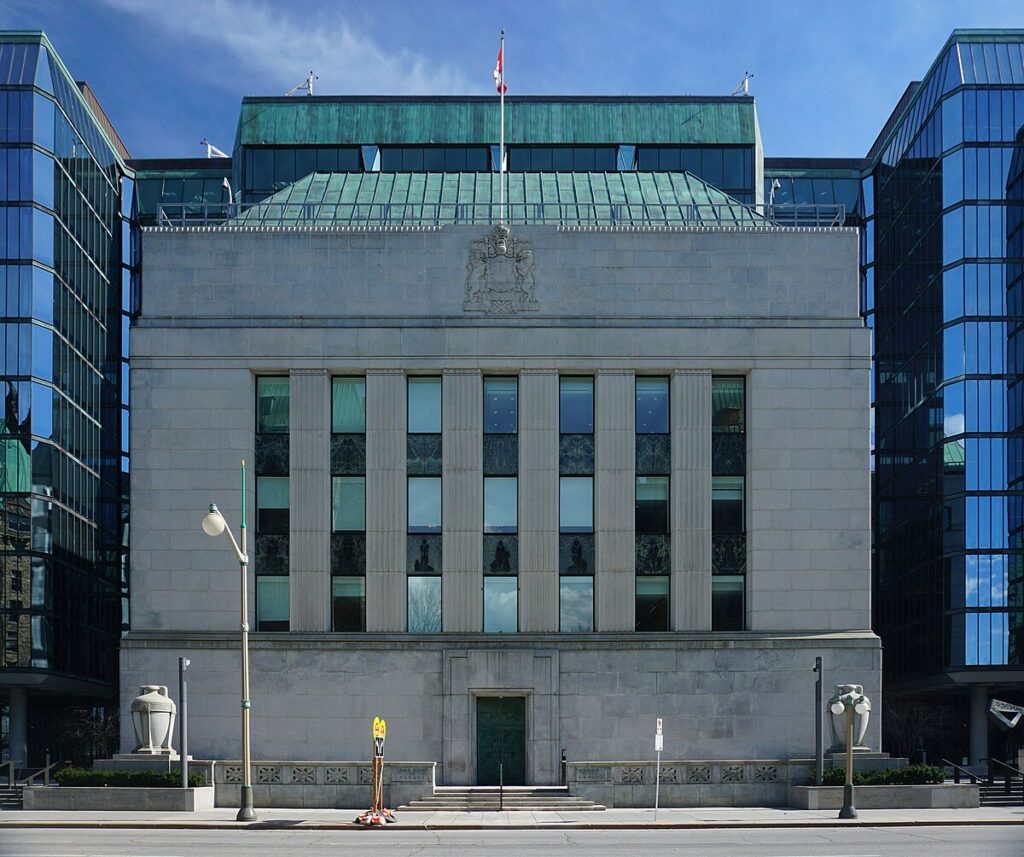

The Bank of Canada is widely expected to leave its benchmark interest rate unchanged at 2.25% when policymakers meet on January 28, 2026, choosing patience as inflation trends improve but uncertainty around Canada-US trade policy continues to cloud the economic outlook.
Markets broadly expect the Bank of Canada to keep its overnight lending rate at 2.25% for a second straight meeting. Governor Tiff Macklem and the central bank’s Governing Council face a difficult balancing act as they weigh moderating inflation against fresh uncertainty created by trade tensions with the United States.
Although price pressures have eased considerably from their post-pandemic highs, policymakers are still looking for stronger evidence that inflation can remain close to the Bank’s 2% target before considering additional interest-rate cuts.
Trade uncertainty is shaping the policy outlook
The biggest variable in the current outlook is trade. Recent tariff proposals and policy comments from US President Donald Trump have increased uncertainty for Canadian exporters, manufacturers and companies that depend on cross-border supply chains.
Businesses typically delay investment decisions when future trade rules are unclear. That uncertainty can slow hiring, reduce expansion plans and weigh on economic growth, making it harder for the central bank to judge the appropriate direction for monetary policy.
Why economists expect no change: Holding rates steady allows policymakers to gather more economic data before making another move. A premature rate cut could fuel inflation, while a rate increase could add pressure to households and businesses already facing slower growth.
Inflation is improving, but the picture remains mixed
Canada’s headline inflation has moved higher in some recent reports, although economists note that temporary factors and year-over-year comparisons have influenced the data. At the same time, the Bank of Canada’s preferred core inflation measures have continued to show gradual improvement.
Food prices remain an important concern for households, while service-sector inflation is easing more slowly than goods inflation. Together, those trends suggest inflation is moving in the right direction but has not fully settled at the Bank’s long-term objective.
Economic growth is showing both strength and caution
Canada’s economy is still expected to expand during 2026, although growth is becoming more uneven. Consumer spending has moderated as higher borrowing costs continue to affect household budgets, while many businesses remain cautious about making major investments.
Population growth has also slowed compared with previous years, changing demand across housing, retail spending and services. These shifts make it more challenging for economists to estimate how quickly the economy can grow without creating new inflation pressures.
For broader coverage of Canada’s economy and financial markets, see the latest business news and market updates.
Global central banks remain closely connected
The Bank of Canada’s decision comes as investors are also watching the US Federal Reserve. Interest-rate decisions in the United States often influence Canadian financial conditions, exchange rates and borrowing costs because the two economies are closely linked.
If the Federal Reserve keeps rates higher for longer, Canada’s central bank may have less flexibility to reduce borrowing costs without putting downward pressure on the Canadian dollar and increasing imported inflation.
What the decision means for households and businesses
If the Bank leaves rates unchanged, mortgage holders, businesses and financial markets will receive another period of policy stability. While borrowing costs would remain elevated compared with recent years, a pause gives households and companies greater certainty as they plan spending, investment and refinancing decisions.
Attention will then shift toward future inflation reports, labour market data and trade developments, which are likely to determine when the Bank of Canada feels confident enough to begin adjusting interest rates again.
Additional policy background and market reporting are available from Bloomberg.

Make Swikblog your go-to source on Google for reliable updates, smart insights, and daily trends.