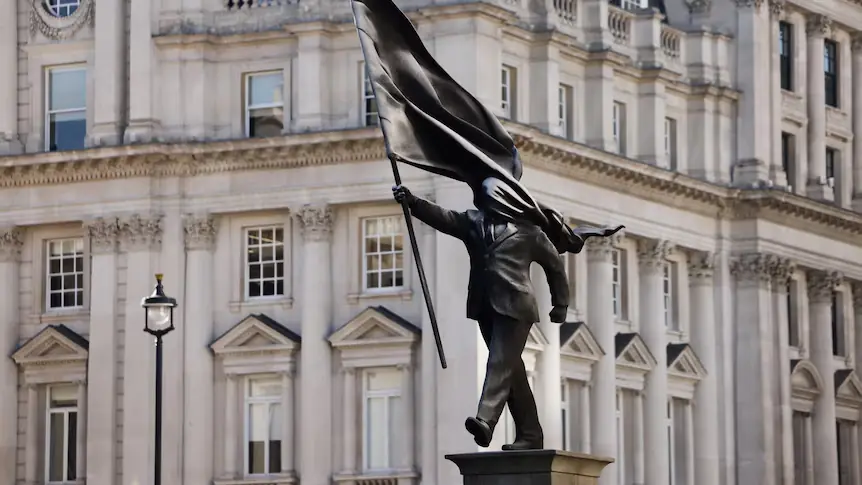

Banksy has returned to London’s streets with a work that feels less like a monument and more like a warning. The artist’s latest piece, a statue of a suited man stepping blindly off a plinth while a flag covers his face, appeared overnight in Waterloo Place near Pall Mall, immediately turning a central London traffic island into a public talking point.
The sculpture shows a man in motion, one foot leaving the platform beneath him. His posture suggests confidence, but his covered face tells another story. The flag he carries has wrapped around his head, blocking his view as he moves forward. It is a simple image, but a sharp one: a figure who appears powerful, polished and certain, yet unable to see the danger directly ahead.
Banksy later confirmed the work through his usual method, posting footage on Instagram that showed the statue being installed under darkness with the help of heavy machinery. The artist’s team described it as an unsolicited monument, placed where Banksy reportedly felt “there was a bit of a gap.” That dry humour is typical of his work, but the message behind the sculpture appears much heavier.
Unlike a traditional statue, this piece does not honour a leader, soldier or historic figure. Instead, it challenges the language of monuments themselves. Waterloo Place is already surrounded by statues connected to British history, including King Edward VII, Florence Nightingale and the Crimean War Memorial. Banksy’s new figure stands among them as an outsider, asking whether every public symbol deserves trust, admiration or obedience.
A Statue About Blind Patriotism, Power and Public Space
The most obvious reading of the sculpture is political. A man blinded by a flag suggests the risk of patriotism turning into tunnel vision. The suit adds another layer, making the figure look less like an ordinary citizen and more like someone in authority. Many visitors have already interpreted the work as a comment on nationalism, leadership and the way political identity can sometimes stop people from seeing what is directly in front of them.
That is where Banksy’s work often succeeds. He rarely explains everything. Instead, he creates an image clear enough to be understood instantly, but open enough to keep people arguing about it. This statue does not name a party, country or leader. It does not need to. The idea of someone walking confidently toward a fall while blinded by a national symbol is broad enough to travel far beyond one London street.
Read More
The response from Westminster City Council has also been notable. Rather than removing the work immediately, the council welcomed it as a striking addition to the city’s public art scene and said early steps had been taken to protect it. That reaction shows how much Banksy’s status has changed over the years. What may once have been treated simply as an act of unauthorised street art is now viewed as a cultural event capable of drawing crowds and global attention.
For readers following global culture, politics and public art, Swikblog often covers stories where a single image or public moment grows into a wider debate. This Banksy statue fits that pattern perfectly: it is visual, controversial, timely and easy to understand without being shallow.
Public reaction has been split, which is exactly what gives the work its energy. Some onlookers have praised it as a brilliant comment on the rise of nationalism. Others have been less impressed, preferring the older statues nearby. That divide is important. Banksy’s art is not designed to sit quietly in the background. It is designed to interrupt, provoke and make passers-by choose a position.
The statue also arrives at a time when Banksy’s identity is again being discussed. Recent reporting has renewed claims about the artist’s real name, though Banksy has never officially confirmed who he is. For many fans, the mystery remains part of the work. His anonymity allows the art to speak first, while the public fills in the rest with speculation.
Why Banksy’s London Statue Is Already a Cultural Moment
This is not Banksy’s first sculptural intervention in London. His earlier work, “The Drinker,” a satirical version of Rodin’s “The Thinker,” appeared in 2004 before being stolen and caught up in years of ownership disputes. That history adds urgency to the new statue. Public Banksy works rarely feel permanent, even when made from heavy materials. They can be protected, removed, damaged or stolen, and that uncertainty is part of the attraction.
There is also a larger question about who controls public space. Official monuments are usually planned, approved and preserved by institutions. Banksy bypasses that process, placing his own commentary directly into the city. Whether people see that as vandalism, art or civic theatre, it forces a conversation that might not happen inside a gallery.
For background on Banksy’s wider influence and place in contemporary art, the Tate’s Banksy profile offers useful context on how his work moved from street walls to global cultural debate.
The strength of this new London statue lies in how quickly it communicates its idea. A man, a flag, a fall. There is no need for a long explanation at the site. Anyone walking past can understand the tension in seconds. Yet the more you look, the more uncomfortable it becomes. Is the figure a politician? A voter? A country? A warning? Banksy leaves the answer unresolved.
That unresolved quality is why the sculpture is likely to continue attracting attention. It is not simply a new object in London; it is a new argument placed in public view. In a city filled with monuments to certainty, Banksy has installed a figure defined by blindness. And in doing so, he has once again turned the street into a stage for one of the most urgent questions of the moment: what happens when symbols become more powerful than sight?

Make Swikblog your go-to source on Google for reliable updates, smart insights, and daily trends.