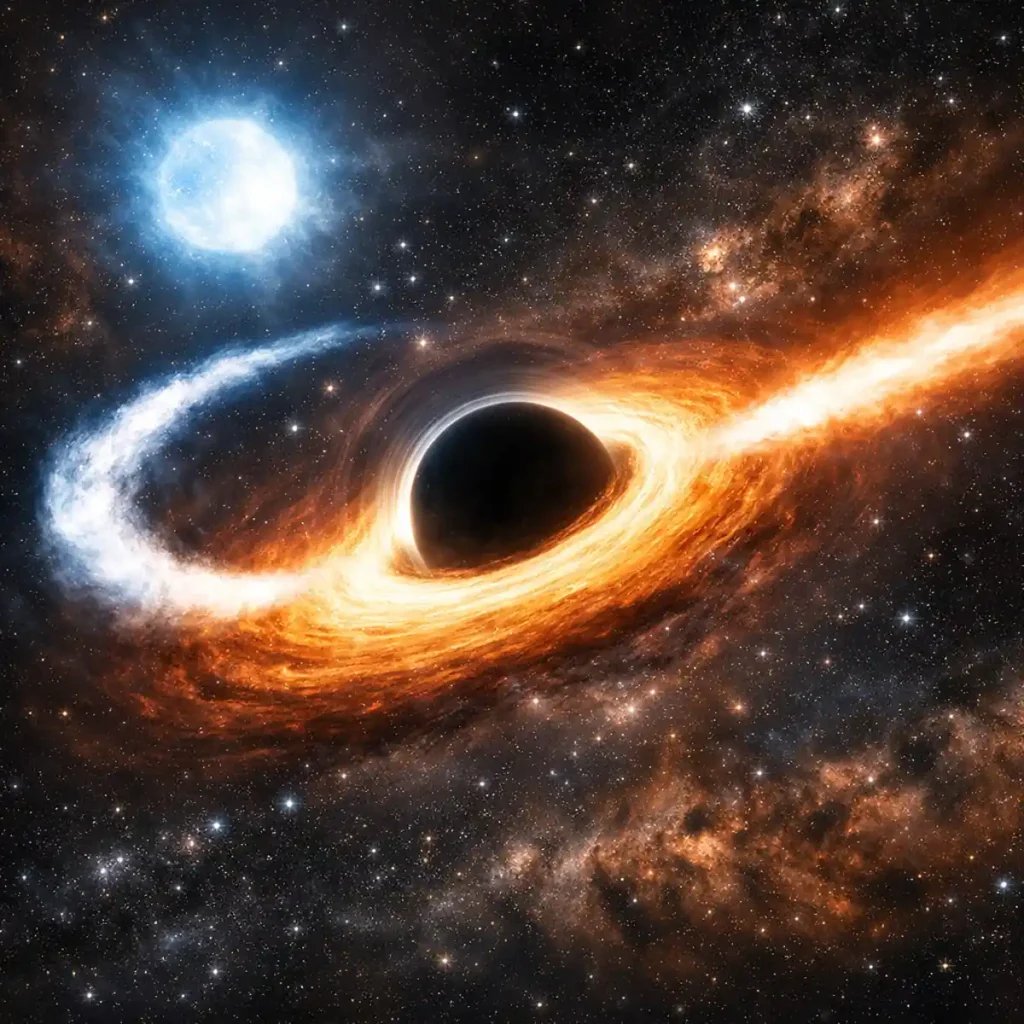

Astronomers have, for the first time, directly measured the real-time power and speed of jets blasting out of a black hole — and the numbers are extraordinary. The jets, coming from the well-known Cygnus X-1 system, are traveling at around 540 million kilometers per hour, roughly half the speed of light, and carry energy equivalent to 10,000 suns.
While black hole jets have been observed for decades, scientists until now could only estimate their strength by studying their long-term impact on surrounding space. This new research changes that by capturing a near-instantaneous measurement, offering a clearer picture of how black holes interact with the universe around them.
How scientists measured the ‘dancing jets’
The breakthrough comes from nearly 18 years of high-resolution radio observations gathered using global telescope networks, including the Very Long Baseline Array (VLBA) in the United States and the European VLBI Network. By combining this long-term data, researchers were able to track subtle movements in the jets that had previously gone unnoticed.
These jets appear to “dance” in space — a term scientists use to describe how they sway back and forth. This motion is caused by powerful stellar winds from a nearby companion star, a massive blue supergiant known as HDE 226868. The black hole and the star orbit each other closely, and the star continuously blows out streams of charged particles.
As the black hole launches jets from its poles, those stellar winds push against them, bending their path. By carefully measuring how much the jets are deflected, scientists were able to calculate the force behind them — effectively revealing their true power for the first time.
This method marks a major shift. Instead of relying on indirect evidence spread over thousands of years, researchers now have a way to measure black hole jet energy in real time.
Cygnus X-1: a rare cosmic laboratory
The system at the center of this discovery is not just any black hole. Cygnus X-1, located about 7,200 light-years from Earth in the Cygnus constellation, was the first black hole ever confirmed, more than 50 years ago. It has remained one of the most studied objects in astronomy.
This black hole is about 20 times the mass of the sun and is locked in a tight orbit with its companion star. The star feeds material to the black hole, creating a bright, superheated accretion disk. While most of this matter disappears beyond the event horizon, a portion is redirected into powerful jets that shoot outward in opposite directions.
What makes Cygnus X-1 especially valuable to scientists is how well-understood its environment is. The strong stellar wind from its companion star creates ideal conditions to observe jet behavior in detail — something that is not possible in most other black hole systems.
Researchers say this unique setup allowed them to observe “jet bending” with exceptional clarity, making Cygnus X-1 one of the few places in the universe where such precise measurements can currently be made.
Why this discovery matters
One of the most important findings from the study is that about 10% of the energy released as matter falls toward the black hole is carried away by its jets. This number has long been assumed in theoretical models, but until now, there had been no direct observational confirmation.
This has major implications for understanding how black holes shape the universe. Jets are not just dramatic outflows — they play a critical role in regulating the behavior of galaxies. As they blast into surrounding space, they create shock waves, stir turbulence, and can either trigger or suppress star formation.
In larger systems, especially those containing supermassive black holes, jets can influence entire galaxies or even clusters of galaxies. They can heat vast clouds of gas or push them out entirely, determining whether new stars can form.
Even though Cygnus X-1 is a smaller, stellar-mass black hole, scientists believe the same physical processes apply across all scales. That means this measurement can act as a benchmark for understanding jet behavior in much larger and more distant systems.
As one researcher noted, the physics around black holes appears to be remarkably consistent, whether the object is 10 times the mass of the sun or millions of times larger.
The study also highlights how challenging it has been to measure jet properties accurately. Factors like jet speed, composition, and the density of surrounding space can all affect results. By using the interaction between jets and stellar winds, this research reduces many of those uncertainties.
For those interested in the full scientific details, the findings were published in Nature Astronomy, marking a significant step forward in black hole research.
After more than half a century of study, Cygnus X-1 continues to surprise astronomers. This latest discovery shows that even the most familiar objects in space can still reveal new insights — especially when observed with patience, precision, and new techniques.
Black holes are often described as cosmic destroyers, consuming everything that comes too close. But this study is a reminder that they are also powerful engines, sending energy back into the universe in ways that help shape galaxies, stars, and the structure of space itself.
You may also like: Astra Militarum Rules, Commissar Graves, and New Vehicles

Make Swikblog your go-to source on Google for reliable updates, smart insights, and daily trends.