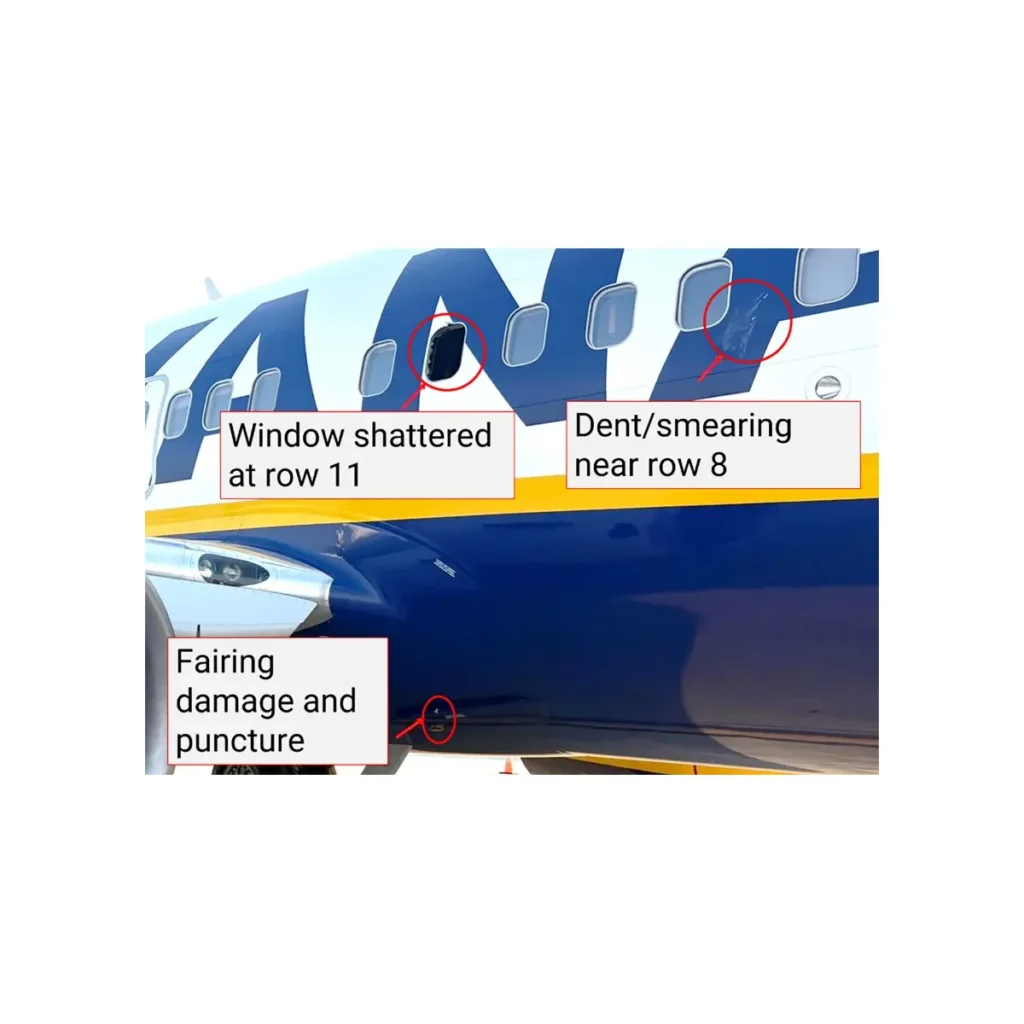

A Ryanair-branded Boeing 737-800 suffered a serious engine failure during a July 10, 2026 flight from Thessaloniki, Greece, to Memmingen, Germany, after a fan blade fractured in the right-side engine. Debris penetrated the fuselage, destroyed a passenger window and triggered cabin depressurization, leaving one passenger seriously injured.
The aircraft was Malta Air flight 1879, operating for Ryanair. The Boeing 737-8AS, registration 9H-QEU, was carrying 149 passengers, including one lap child, and six crew members when the failure occurred near Polykastro in northern Greece.
The latest preliminary findings from the US National Transportation Safety Board, updated on August 13, show that part of the fractured fan blade had features consistent with fatigue. Investigators have not yet determined the probable cause, and the investigation remains ongoing.
Engine vibration increased minutes after takeoff
According to the NTSB, the pilots received a high-vibration indication from the No. 2 engine while climbing through about 16,000 feet. They reduced engine power and began the high-engine-vibration checklist, after which the indicated vibration temporarily decreased.
The vibration later climbed rapidly. Cockpit recorder information shows the crew called for the checklist about seven and a half minutes after the takeoff roll began. A loud bang was recorded roughly nine minutes and 20 seconds after the start of the takeoff roll.
The cabin altitude warning then sounded. The pilots put on oxygen masks, declared an emergency and began an immediate descent. After descending below 10,000 feet, they shut down the right engine and returned safely to Thessaloniki.
Cabin crew reported that oxygen masks deployed and passengers began asking for help. At row 11, the entire window beside seat 11F was missing and the passenger seated there was partially lodged in the opening. Other passengers pulled the injured person back into the cabin, where a doctor traveling on the flight provided assistance.
Investigators found fatigue features in the fractured fan blade
The damaged engine was a CFM International CFM56-7B26, produced by the GE Aerospace and Safran Aircraft Engines joint venture. Investigators found that fan blade No. 10 fractured through its dovetail, the root section that connects the blade to the fan disk.
About 37% of the fracture surface showed features consistent with fatigue. Laboratory examination also found fatigue striations and characteristics the NTSB said were consistent with high-amplitude fatigue, a form of cyclic loading that can occur more frequently than once per flight cycle.
The finding is important, but it is not a final cause determination. Investigators are still examining how the crack developed, what loading produced it and whether other evidence contributed to the failure.
The engine’s maintenance history has therefore become a major part of the inquiry. Its fan blades underwent ultrasonic inspections on November 11, 2025, and again on May 24, 2026, just 253 cycles before the accident. No crack indications were recorded during either inspection.
A separate Qantas Boeing 737 engine failure linked to a turbine blade fatigue crack shows why investigators examine the location, growth and detectability of cracks closely. That event involved a different engine component and does not establish a direct connection with flight 1879.
Bird remains are being examined alongside the blade damage
Investigators recovered feathers and other bird material from several areas of the right engine. Samples from the engine and fan blades were sent to the Smithsonian Institution’s Feather Identification Lab in Washington for examination.
Maintenance records also show that crews reported four suspected bird strikes involving the same engine during the 12 months before the accident. No damage was identified during the maintenance actions that followed, although bird remains were reported in two of those cases.
The NTSB has not said that a bird strike caused the fan blade to fracture. The presence of bird material and the fatigue evidence are separate findings at this stage, and investigators still need to determine whether there is any connection between them.
Three FAA-mandated engine hardware changes had not yet been installed
The preliminary report adds another technical detail: hardware changes covered by three Federal Aviation Administration airworthiness directives had not yet been incorporated on the engine inlet cowl, fan cowl and exhaust nozzle.
Those directives call for strengthened fasteners, an external doubler and additional exhaust-nozzle brackets on affected hardware. The NTSB noted that the compliance deadline for all three directives is July 2028, meaning the aircraft was still within the required implementation period when the accident occurred.
The report does not state that the absence of those modifications caused the fan blade failure. Their relevance will depend on how investigators assess the path of the engine debris, the resulting cowling damage and the penetration of the fuselage.
The damage extended beyond the engine. Investigators documented punctures and dents in the fuselage, damage around the wing-to-body fairing and marks on the right horizontal stabilizer. A different Boeing 737 event, in which a Southwest Airlines flight diverted after a cockpit windshield cracked at 37,000 feet, involved a different type of window problem but similarly shows why crews treat compromised aircraft glazing as an immediate safety issue.
Read More
Why investigators are comparing this failure with earlier CFM56 events
The CFM56 family has a long service history, and investigators are aware of previous fan-blade-out events involving similar engine models that damaged engine inlets, cowlings and aircraft structures.
One of the best-known cases was Southwest Airlines flight 1380 in 2018. A CFM56-series fan blade fractured, debris damaged the fuselage and a passenger window failed. The accident led to new fan-blade inspection requirements, including the ultrasonic inspection program referenced in the maintenance history of the engine on flight 1879.
The NTSB has cautioned that any meaningful similarities between earlier failures and the July 2026 accident are still being investigated. Previous events can help identify patterns, but they do not establish the cause of a new accident on their own.
The investigation remains open
Greece’s Hellenic Air and Railway Safety Investigation Authority delegated the investigation in full to the NTSB on July 16. The FAA, Boeing and GE Aerospace are participating, while authorities and technical representatives from Greece, Malta, France, Malta Air, Safran and the European Union Aviation Safety Agency are involved under international accident-investigation arrangements.
The official NTSB investigation into flight 1879 remains listed as ongoing. Investigators have retained the right engine, its inlet, fan components and the row 11 window structure while work continues on materials, recorder data, maintenance history, structural damage and survival factors.
The evidence released so far establishes the sequence more clearly: engine vibration increased during the climb, a fan blade fractured, debris breached the aircraft and the cabin depressurized. What caused the blade to develop fatigue damage, whether the bird evidence played any role and why the crack was not detected during recent ultrasonic inspections remain central questions for the final investigation.

Make Swikblog your go-to source on Google for reliable updates, smart insights, and daily trends.