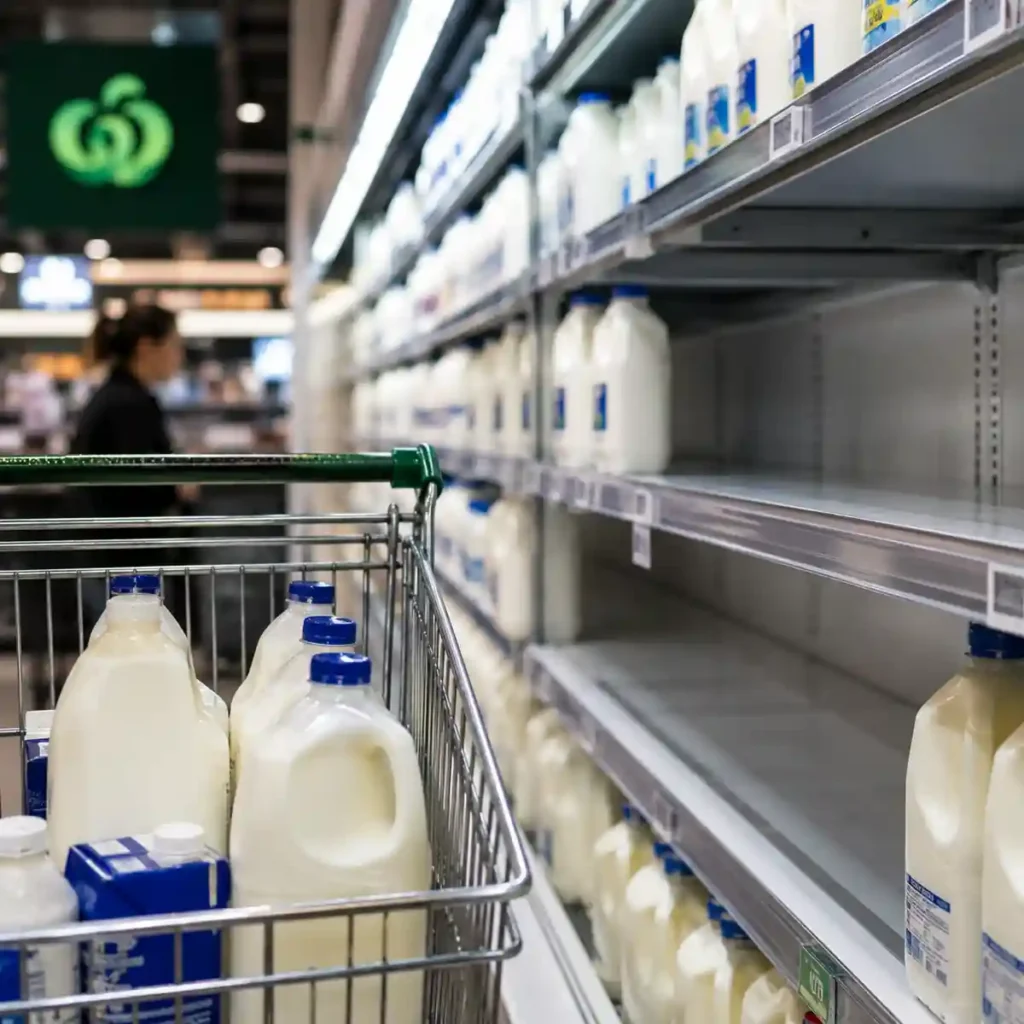

Woolworths is phasing out Farmers’ Own milk across Australia, ending a direct-supply program that has connected the supermarket with a small group of dairy farmers since 2013.
The range has already disappeared from shelves in South Australia. Western Australia, Queensland, New South Wales and Victoria are expected to follow as remaining supply agreements wind down through 2027.
Woolworths says existing contracts will be honoured and participating suppliers have an option to extend their agreements for another 12 months. The retailer has not given a detailed public explanation for ending the brand.
For shoppers, the change removes a familiar premium milk option. For the farmers involved, the bigger concern is securing another buyer for milk that must be chilled, collected and processed every day.
Why Woolworths is ending Farmers’ Own milk
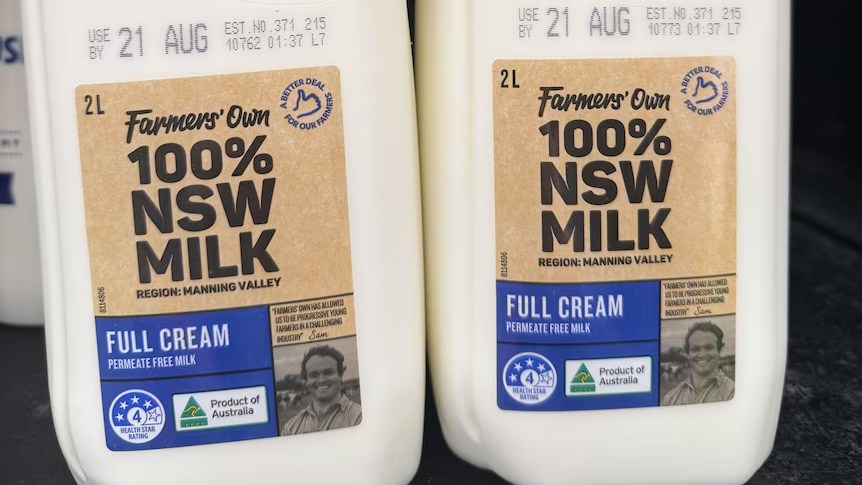
Farmers’ Own was launched in 2013 after Woolworths developed direct supply arrangements with dairy farmers, including producers in the Manning Valley region of northern New South Wales.
The model differed from the usual supermarket milk supply chain because Woolworths contracted directly with participating farmers for raw milk rather than relying entirely on a processor to manage the farm relationship.
Northern New South Wales dairy farmer Tim Bale, who helped establish Farmers’ Own, has said the economics became harder as sales weakened. Milk produced above the volume needed for the brand still had to be sold, while the premium product competed for shelf space against cheaper alternatives.
That price gap matters when households are trying to control weekly grocery spending. A customer may want to support farmers but still choose a lower-priced bottle when the difference adds up across regular purchases.
Cost pressure has already been visible elsewhere in Woolworths’ dairy business. Earlier coverage of Woolworths milk and bread price pressures explains how higher supplier, fuel, packaging and production costs can flow through the grocery chain.
Farmers received extra support only months before the phase-out
The decision comes after Woolworths increased payments to its direct Farmers’ Own suppliers earlier in 2026.
In April, the supermarket committed an additional 10 cents per litre to fewer than 20 farmers supplying the brand as dairy businesses faced higher fuel, fertiliser and other operating costs. Woolworths indicated at the time that it would absorb that increase rather than pass it directly to customers through the Farmers’ Own retail price.
Bale was already expressing uncertainty about the brand’s future in April. By August, Woolworths had confirmed that Farmers’ Own would be phased out nationally.
The sequence shows how quickly conditions changed for participating suppliers: additional short-term support was followed only months later by confirmation that the direct-supply brand itself would end.
Finding another buyer could be the hardest part
Dairy production cannot simply stop when a contract expires. Cows continue producing milk, and raw milk has to be refrigerated, collected and delivered to a processor on a regular schedule.
That makes access to another buyer critical. A processor needs enough factory capacity, a practical tanker route and a commercial reason to take additional volume from a particular farm.
Bale has warned that alternative buyers are not guaranteed. His concern is especially significant because a farm can be in a region with strong consumer demand and still have no nearby processor willing to collect more milk.
A separate Queensland case reported in August 2026 illustrates the problem. Dairy farmer Jason Rozynski was struggling to secure another processor after losing a supply contract, despite Queensland importing a significant share of the milk it consumes.
The apparent contradiction comes down to logistics and processing capacity. State-level demand does not mean every processor needs more raw milk from every location.
The issue goes beyond one supermarket brand
Australian Dairy Farmers president Ben Bennett has argued that small direct-supply programs cannot solve the broader pressures facing the dairy industry.
Farm businesses must cover feed, fertiliser, electricity, fuel, water, labour, machinery and transport while depending on farmgate milk prices that can change with market conditions.
Dairy Australia says the 2025–26 season has been shaped by global supply growth, volatile input costs and changing demand. Its latest milk production and sales statistics provide national context for how Australian supply is moving.
Supermarket regulation is another part of the picture. New rules have increased scrutiny of pricing and supplier relationships at major grocery chains, as outlined in our report on Australia’s supermarket pricing rules affecting Coles and Woolworths.
Those measures may influence how retailers deal with suppliers, but they cannot create processing capacity or force another dairy company to collect milk from a farm whose contract has ended.
Will other Woolworths milk become more expensive?
There is no confirmed evidence that ending Farmers’ Own will directly push up the price of Woolworths’ wider fresh milk range.
Retail prices are influenced by farmgate payments, processing, packaging, electricity, refrigeration, freight, fuel and competition between supermarkets and dairy brands.
The phase-out also does not mean Woolworths is abandoning Australian fresh milk. Other Woolworths milk products and third-party dairy brands will continue to be sold separately from Farmers’ Own.
No national replacement using the same direct-supply model has been announced.
Read More
The phase-out will continue through 2027
Availability will differ by state while remaining agreements run their course. South Australia has already lost Farmers’ Own, while customers in other states may continue to see the bottles until local supply arrangements finish.
For affected farmers, the key issue is whether another processor can collect their milk on commercially workable terms. That depends on location, tanker routes, factory capacity, required volumes and the farmgate price another buyer is prepared to offer.
Farmers’ Own represents only a small part of Australia’s milk market, but its closure highlights a larger weakness in the supply chain: strong demand for dairy products does not automatically guarantee every farm a nearby buyer.
More than a decade after Farmers’ Own was created to build a closer commercial link between farmers and a major supermarket, the most important outcome now will be whether its remaining suppliers can secure sustainable new agreements before their Woolworths contracts finally end.

Make Swikblog your go-to source on Google for reliable updates, smart insights, and daily trends.