
The women’s super-G at the Milan-Cortina Olympics turned into a high-speed test of nerve, visibility, and split-second precision — and it delivered a dramatic mix of triumph and heartbreak. U.S. downhill gold medalist Breezy Johnson, carrying big expectations after her earlier title, crashed out after clipping a gate relatively early on the Olimpia delle Tofane course, slamming into the catch fence before standing up and skiing away under her own power.
While Johnson’s run ended in an instant, Italy’s Federica Brignone produced the sort of home-Games performance that becomes part of Olympic folklore: a fierce, attacking line through difficult sections and flat-out commitment when the course stopped forgiving mistakes. In challenging, foggy conditions that contributed to multiple “did not finish” results, Brignone kept her speed, stayed clean, and delivered the run that mattered most.
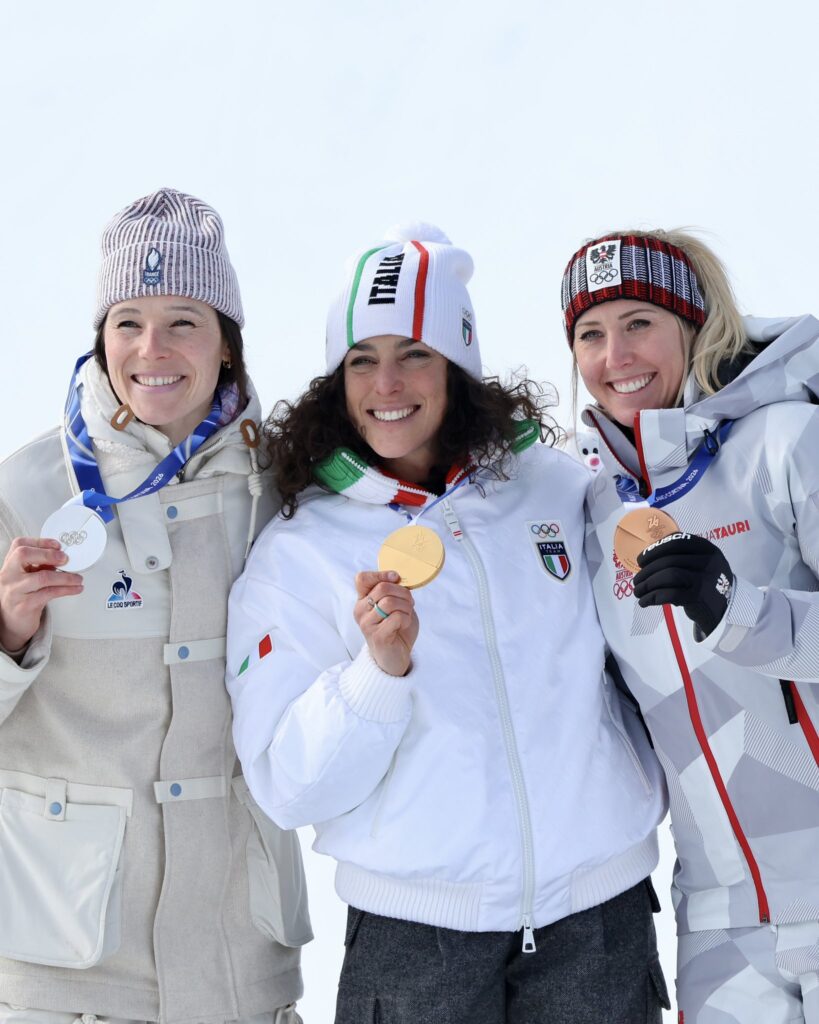
Brignone stopped the clock at 1:23.41 to secure gold, giving the host nation a signature alpine moment. France’s Romane Miradoli claimed silver, finishing 0.41 seconds back, while Austria’s Cornelia Huetter completed the podium with bronze. The margins were tight, the tempo relentless, and the consequences for a fraction of an error were immediate — exactly the super-G story on a day when the slope demanded total respect.
| Medal | Athlete | Nation | Time / Gap |
|---|---|---|---|
| Gold | Federica Brignone | Italy | 1:23.41 |
| Silver | Romane Miradoli | France | +0.41 |
| Bronze | Cornelia Huetter | Austria | Podium finish |
The spread between gold and silver was under half a second, the kind of gap that often comes down to a single line choice through a blind roll, a fraction of confidence at the gate, or one extra breath of patience before letting the skis run.
Johnson’s crash was the sharpest reminder of how quickly super-G can flip. She appeared to catch a gate in the early portion of her run and was thrown off balance, making heavy contact with the fencing that protects athletes and spectators on the outside of the course. The positive note was immediate: she was able to get up, gather herself, and ski off, signaling that the incident looked far better than it could have in a discipline where speeds punish the smallest miscue.
She wasn’t alone. Slovenia’s Ilka Stuhec also crashed and did not finish, and another American, Mary Bocock, went down as well. The combined effect of fog, a technically demanding track, and high stakes created a race where simply reaching the finish cleanly became an accomplishment — and where athletes who usually hover near the podium suddenly found their Olympic day ending behind the netting.
For Brignone, the win lands with extra weight. Super-G rewards the rare skier who can blend downhill bravery with giant-slalom sharpness: the willingness to go straight when instinct says brake, and the discipline to stay compact and exact when the terrain turns choppy. On home snow, she found that balance. Every section looked purposeful — not cautious, not reckless — just fully committed. When others were sliding wide or arriving late to the next gate, she was already moving to the next decision.
The crowd response in Cortina felt like part of the race itself. Even on television, the noise swelled as the Italian kept her speed through the trickiest passages, and the finish area reaction made it clear that this wasn’t simply another medal. It was a home-Games scene: a champion crossing the line, a nation exhaling, and a podium that will replay for years whenever Milan-Cortina 2026 is mentioned.
For Team USA, the super-G delivered a sobering follow-up to a gold earlier in the week. Johnson came in with the kind of momentum that can snowball at the Olympics — one great result building belief for the next start. Instead, the discipline’s brutal truth arrived: the margin for error is microscopic, and Olympic courses rarely offer a second chance. The most important outcome now is that she walked away from the crash, because the schedule moves fast and the body is always the first priority.
The super-G is often described as “the racer’s race,” because it tests everything at once — speed, tactics, timing, and courage — without giving athletes enough repetitions to solve the mountain the way a multi-run event might. Thursday’s race proved that description again. One skier turned a demanding day into a gold medal for the host country. Several others discovered how thin the line is between a great split and a sudden stop.
If you’re tracking the wider Olympic picture beyond alpine racing, you can keep a running read of Swikblog’s sports coverage here: Swikblog trending sports update.
For official context on the race storyline and podium, see this report from the sport’s governing-body coverage: FIS race recap on Brignone’s super-G gold.

Make Swikblog your go-to source on Google for reliable updates, smart insights, and daily trends.