Written by Jordan Mitchell
Sunday night’s late semifinal at the 2026 IIHF World Junior Championship has everything: a recent rivalry, a tournament’s worth of pressure, and two teams that arrive believing they’re built for the biggest moments. The puck drops at 8:30pm ET, and it’s hard to imagine a matchup carrying more emotional and competitive weight.
Game snapshot
- Match: Canada vs Czechia (World Juniors semifinal)
- When: Sunday, 8:30pm ET (Canada time)
- What’s at stake: A place in the gold-medal game
- Official tournament hub: IIHF World Juniors (2026)
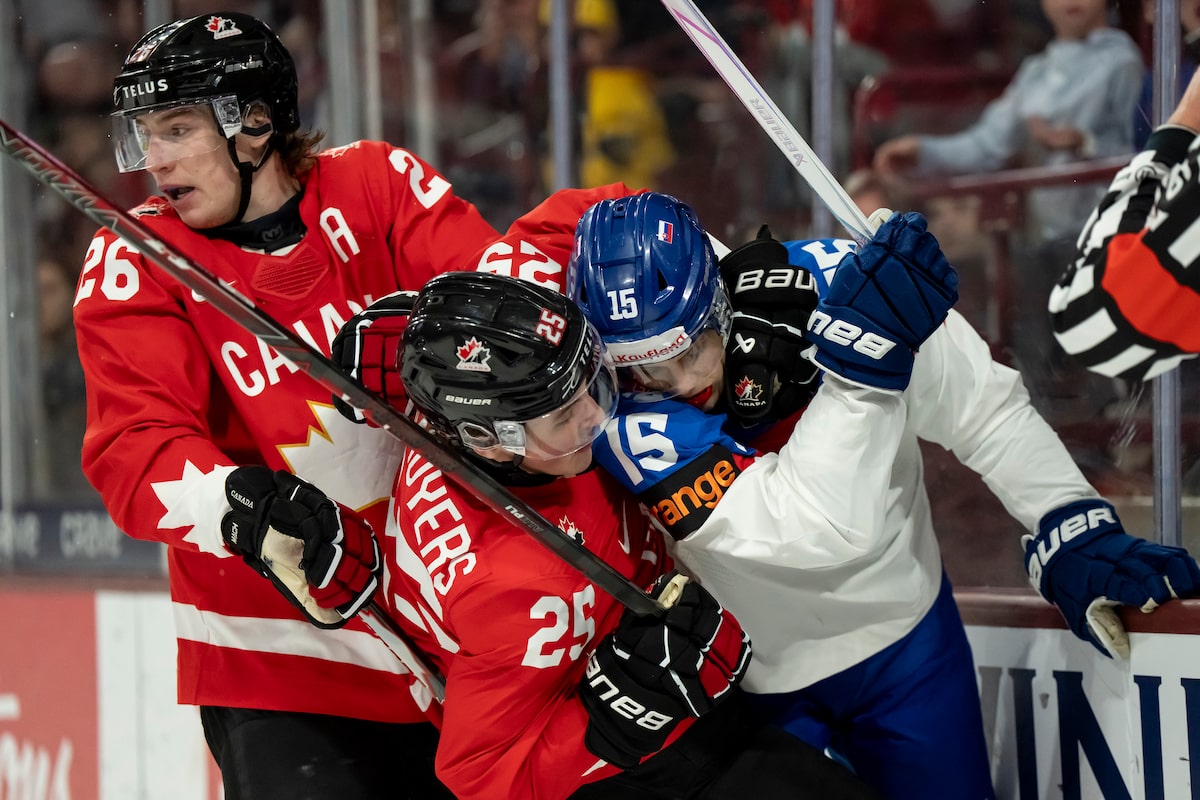
Canada powered its way into the World Junior Hockey Championship semifinals with a ruthless 7–1 quarterfinal win over Slovakia, a performance that combined early aggression with clinical finishing and finally ended two years of knockout-round frustration. A five-goal first period, sparked by Cole Reschny, blew the game open inside six minutes, with Michael Misa, Sam O’Reilly, Porter Martone and Cole Beaudoin all recording a goal and an assist as Canada overwhelmed an outmatched Slovak side in Minneapolis. Tij Iginla and Brady Martin added further goals, Jack Ivankovic turned aside 21 shots in a calm display between the pipes, and the Canadians never eased off after pressing hard from the opening faceoff. The victory not only
Canada comes in riding momentum after a commanding quarterfinal win, while Czechia arrives with the calm confidence of a program that has turned deep World Juniors runs into a habit. Put simply: this isn’t just a semifinal. It’s a test of discipline, composure, and identity — and it’s been building for years.
Canada’s mindset: talent, pressure, and discipline
Canada’s roster is built to attack in waves, but the story around this semifinal isn’t only about skill. It’s about maturity. Earlier in the tournament, Canada’s opener against Czechia (a high-scoring win) came with extra heat — scrums, chirps, and moments that later became talking points. Since then, the message has been consistent: play with emotion, not recklessness.
That balance matters against a Czech team that thrives when opponents lose structure. Canada’s best version looks fast and direct, but also patient: hunt pucks, win races, and keep the game five-on-five whenever possible.
The crease feels settled
The steadying force for Canada has been goaltender Jack Ivankovic, who has looked composed in the tournament’s most tense minutes. A calm goalie doesn’t just stop pucks — he slows the chaos. That matters in a semifinal where momentum swings can arrive in seconds.
A blue-line engine
On the back end, Zayne Parekh has driven offense with the kind of confidence that can tilt a single period — especially on the power play. When Canada’s point play is clean, its forwards get to attack from motion instead of from stationary positions, and that makes defending them a long night.
Czechia’s edge: structure, speed, and belief
Czechia’s rise at the World Juniors hasn’t happened by accident. Recent tournaments have proven they can win the most uncomfortable kind of games: the ones that demand patience, collective defending, and timely finishing.
Under head coach Patrik Augusta, Czechia typically leans into a clear identity: smart routes through the neutral zone, quick support on retrievals, and fast transitions that turn a defensive stop into an immediate scoring chance. In short, they don’t just “hang around” — they create danger.
Leadership and bite
Captain Petr Sikora has carried the tone of a group that doesn’t look intimidated by big names or big moments. Czechia doesn’t need to win every shift — it needs to win the critical ones: late-period minutes, special teams, and the first five minutes after a goal.
Calm response to a chippy start
This matchup also comes with emotional context. The teams’ early-tournament meeting featured plenty of edge, but Czechia has largely framed it as fuel, not distraction. That’s a healthy approach in a medal-round game: you don’t erase emotion — you channel it into details.
Keys to the game
- Discipline decides momentum: Canada can’t afford penalties that hand Czechia free-zone time and rhythm.
- Special teams swing the story: Canada’s power play has a game-breaking ceiling, but only if entries stay clean.
- First 10 minutes: Czechia loves settling into structure; Canada loves turning games into track meets. Whoever imposes pace early gains the psychological edge.
- Net-front battles: This is where “healthy intensity” matters — compete hard, stay controlled, and let the scoreboard do the talking.
- Goaltending composure: In medal-round hockey, one calm save can be louder than a highlight-reel goal.
Why this semifinal feels different
Canada’s talent is never in doubt — the pressure is learning to win with poise when the stakes climb. Czechia’s challenge is continuing to prove that its recent success is not a hot streak but a standard. That’s why Sunday’s meeting resonates: it’s not just about one night — it’s about who owns the present era of World Junior hockey.
For fans following along, the best version of this rivalry is intense but respectful: fast, physical, and disciplined. If both teams stay on the right side of the line, the result should come down to execution — not emotion.
For official tournament context and semifinal setup, see the IIHF’s semifinal preview. For a broader day-by-day tournament viewing guide, NHL.com’s “On Tap” coverage is also useful.
More hockey and match coverage: Swikblog Sports

Make Swikblog your go-to source on Google for reliable updates, smart insights, and daily trends.