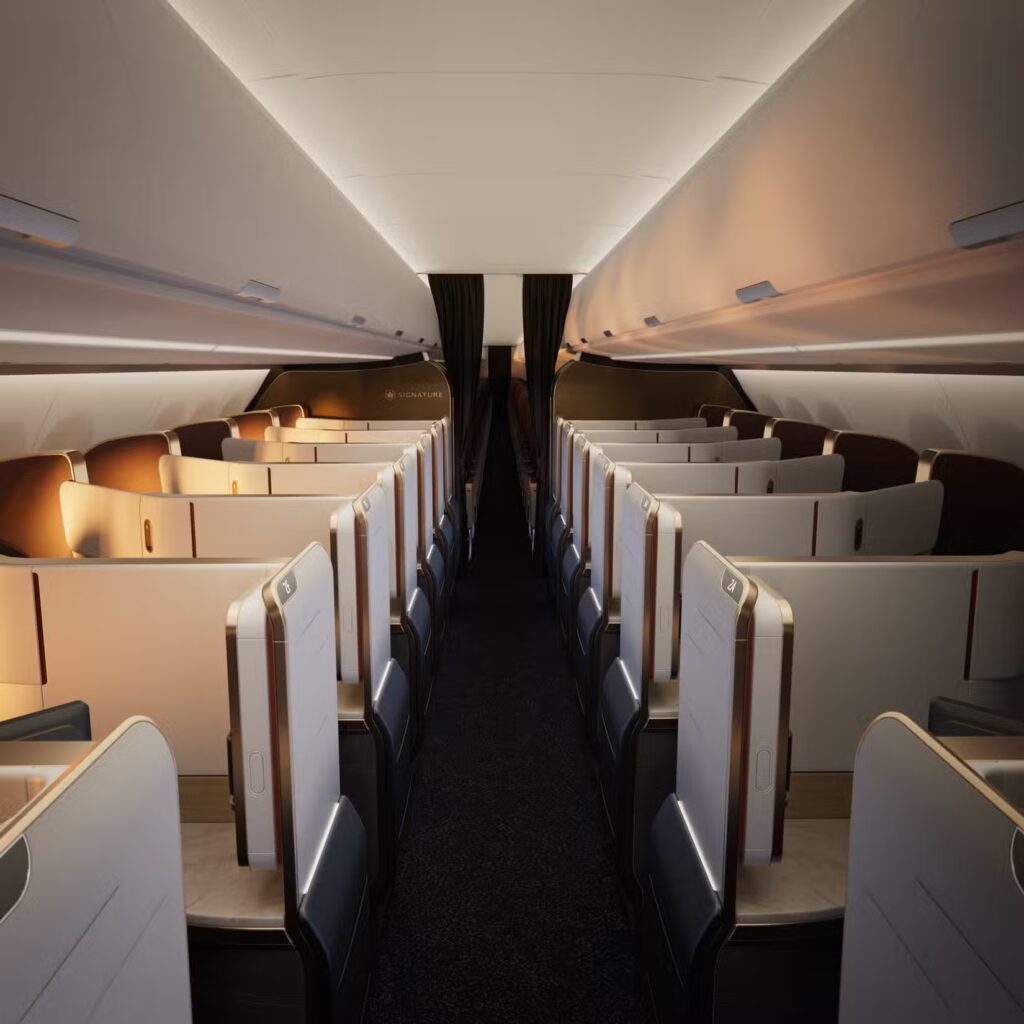

Canadian airlines are accelerating cabin upgrades in 2026 as competition for premium travellers intensifies, with Air Canada unveiling one of the most significant redesigns in its history at the Aircraft Interiors Expo in Hamburg this week. The overhaul, centred on new Airbus A321XLR and Boeing 787-10 aircraft entering service from this year, introduces lie-flat seats on single-aisle jets, upgraded premium suites and a broader push toward higher-end passenger experiences.
The announcement is gaining attention because it reflects a wider shift in aviation. Airlines are investing more heavily in onboard comfort as they try to attract premium passengers, defend margins and make newer, more fuel-efficient aircraft work on longer routes. In Canada, Air Canada’s redesign offers one of the clearest signs yet that airlines now see cabin experience as a competitive tool rather than a finishing touch.
At the centre of the upgrade is the Airbus A321XLR, which Air Canada says will become the first single-aisle aircraft in Canada to offer lie-flat Signature Class seats. The aircraft is due to enter service this summer and is expected to support new transatlantic services as well as premium-heavy longer North American flights. That matters because narrowbody aircraft have traditionally been associated with tighter cabins and reduced comfort, even as airlines increasingly use them on routes once dominated by widebody jets.
Air Canada is aiming to change that perception. Its A321XLR fleet will be fitted with 14 Collins Aerospace Aurora business-class suites at the front of the aircraft and 168 Meridian+ economy seats behind. The Aurora suites have been designed specifically for the aircraft’s dimensions, using angled installation and integrated cabin architecture to maximise living space, create room for an extra row of premium seating and expand galley capacity for long-haul catering needs.
The message is clear: airlines want smaller aircraft to deliver a product that feels much closer to a widebody experience. For passengers, that means the difference between aircraft types may matter less than before, especially if single-aisle jets begin offering lie-flat seats, upgraded privacy and stronger technology across the cabin. More details on the aircraft platform can be found on Airbus’s A321XLR page.
Premium cabins are becoming more important
Air Canada’s redesign is not limited to the A321XLR. Its Boeing 787-10 aircraft will introduce Signature Plus Suites, a more exclusive front-cabin product with larger beds, taller privacy walls and a dedicated guest seat. The two centre suites will also include retractable privacy panels, allowing up to four passengers to share space during cruise, a detail aimed at making the cabin more flexible for both business and leisure travellers.
Those additions show how premium cabins are becoming central to airline economics. Business-class and premium-economy travellers generate a disproportionate share of revenue, and carriers are increasingly willing to invest in suites, upgraded finishes and privacy features to win those bookings. In that sense, cabin design is no longer just about aesthetics. It is about pricing power, loyalty and brand position.
Across all cabins, Air Canada says passengers will see more practical changes as well. These include larger 4K OLED entertainment screens, Bluetooth audio, high-powered USB-C and AC outlets at every seat, more ergonomic seating with extra personal space and larger overhead bins. Premium Economy passengers will also get extended privacy wings, reinforcing the airline’s effort to improve the experience beyond its most expensive seats.
The economy section of the A321XLR will use Collins Aerospace’s Meridian+ seats, which have been designed to reclaim more space around the hips, knees and elbows. That detail may sound modest compared with the lie-flat suites up front, but it speaks to a broader trend. Travellers are now more aware of aircraft types, seat layouts and inflight technology, and airlines know that comfort in economy can shape how a product is judged overall.
Why this matters for Canadian travellers
Air Canada is also using the redesign to reinforce its identity. The new interiors draw on Canadian themes, with wood-grain textures, bronze metal finishes, leather-inspired materials and subtle red stitching. On the A321XLR, passengers will board under a backlit canopy of maple leaves, while the 787-10 will feature a sculpted entryway inspired by Canadian waterways. The design choices are meant to make the cabin feel more distinctive at a time when airlines are paying more attention to brand presentation onboard.
The upgrade is part of a broader fleet modernisation effort. Air Canada says Rouge aircraft will move between mainline and leisure operations with refreshed interiors, while Air Canada Express aircraft operated by Jazz will also receive cabin updates and next-generation free Wi-Fi. The airline plans to reveal updated onboard hospitality later this year, including new food, beverage and service elements, completing what it describes as a fully reimagined travel experience.
For Canadian travellers, the practical impact is straightforward. Flights on smaller aircraft are no longer guaranteed to mean a scaled-down experience, especially on longer routes. As airlines invest in better seating, larger screens, power access and more premium options, the onboard experience is becoming a larger part of how carriers compete. That shift is likely to influence how passengers choose flights in the years ahead, not only by price or schedule, but by how comfortable the journey looks before they even board.
You may also like: Wisconsin weather alert leaves over 51,000 without power after severe storms.

Make Swikblog your go-to source on Google for reliable updates, smart insights, and daily trends.