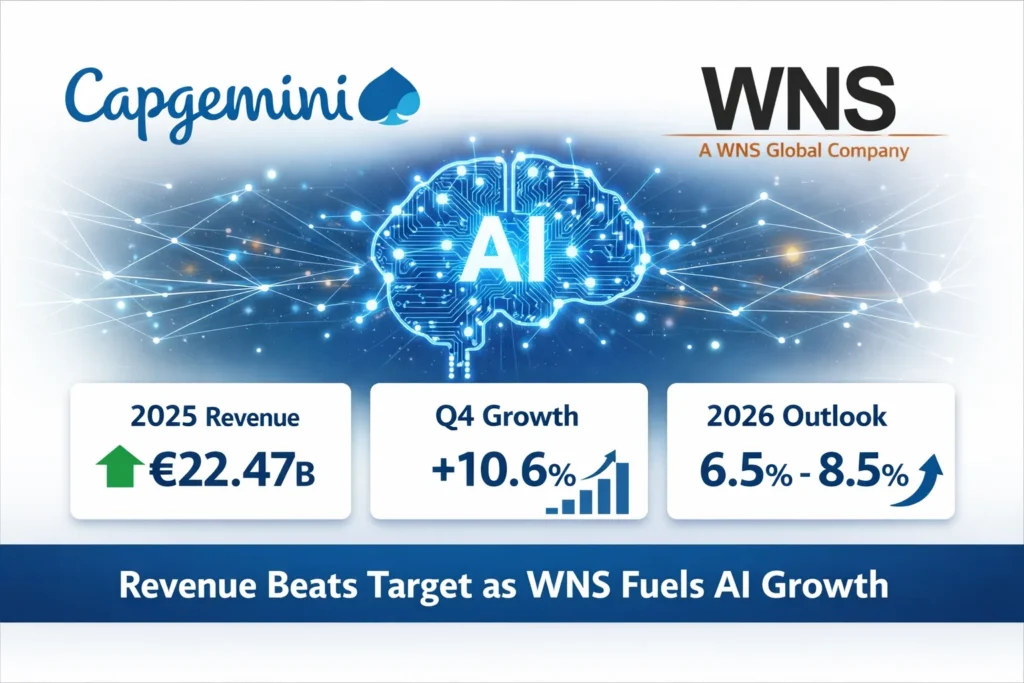

A stronger fourth quarter and fresh acquisition momentum pushed Capgemini beyond its own growth guidance, while management signaled a bigger AI footprint in bookings and a workforce reset aimed at scaling AI-led delivery.
2025 revenue (constant FX)
€22.47B
2025 growth vs. guidance
+3.4%
2026 growth outlook (constant FX)
6.5%–8.5%
USD reference rate in the update: $1 = €0.8432.
Capgemini’s latest results landed with a clear message for investors: the company is no longer talking about AI as a future catalyst, it’s treating it as the commercial engine inside its day-to-day pipeline. The French IT services group said full-year 2025 revenue rose 3.4% at constant exchange rates to €22.47 billion, surpassing the company’s October target of 2% to 2.5% growth. The standout detail was how sharply momentum improved late in the year, with fourth-quarter sales up 10.6% after newly consolidated acquisitions contributed materially.
At the center of that fourth-quarter acceleration was WNS, the business-process services group that Capgemini recently added to broaden its ability to run and automate enterprise operations. Management explicitly linked WNS to rising demand for AI-powered business process services, a fast-growing slice of the market where clients want automation that goes beyond pilots and proofs of concept and into repeatable operating workflows. Capgemini also pointed to Cloud4C as another significant consolidation contributor in the quarter, underscoring that the “growth story” is increasingly tied to what the company can bundle around cloud, operations, and AI delivery at scale.
Investors also got a cleaner read on how quickly AI is moving from “initiative” to “booking driver.” CEO Aiman Ezzat said generative and agentic AI represented more than 10% of group bookings in the fourth quarter, roughly doubling from around 5% earlier in the year. In plain terms, that suggests more client work is being sold with AI embedded in the scope, not bolted on later. For a large services firm, that shift matters because it tends to influence everything: the mix of higher-value programs, staffing intensity, pricing power, and how sticky client relationships become once AI touches core workflows.
For 2026, Capgemini’s forecast is ambitious on the surface and very acquisition-heavy underneath. The company guided for 6.5% to 8.5% revenue growth at constant exchange rates, and said around 4.5 to 5 percentage points of that should come from acquisitions, primarily WNS. That breakdown will shape how the market judges execution. If the headline growth prints, but most of it is acquisition-driven, investors will still look for evidence that organic demand is strengthening across the base business — especially as customers rationalize spending and shift budgets toward the most measurable AI outcomes.
Why the WNS addition matters now: AI-led process change is where many enterprises expect near-term payback. Pairing consulting and IT delivery with business-process services can make it easier to sell “end-to-end” transformations — from redesigning a process to running it with automation baked in.
Profitability guidance points to a subtle but important balancing act. Capgemini expects its operating margin to improve to 13.6% to 13.8% in 2026, up from 13.3% in 2025. At the same time, it expects organic free cash flow of €1.8 billion to €1.9 billion, slightly below last year’s €1.95 billion, because restructuring costs will rise. The company said it plans around €700 million in restructuring charges over the next two years, with most of that hitting in 2026, as it adapts workforce capacity and skills to match AI-driven demand.
That restructuring line is likely to be one of the most watched items across European IT services this year. It can be interpreted two ways: as a proactive reset to redeploy talent into fast-growing AI delivery work, or as a sign that legacy capacity is less in demand and needs to be reshaped quickly. Capgemini framed the move as necessary preparation for “enterprise-wide AI adoption,” positioning itself as a catalyst for large transformation programs, intelligent operations, and sovereignty-related projects — a theme that has grown more prominent as European clients weigh where data, cloud workloads, and regulated operations should reside.
In markets, the immediate reaction can be noisy, especially when a stock is moving on a single results headline. But the deeper question for the next few quarters is whether Capgemini can keep expanding the AI share of bookings while converting that into stable revenue, margin, and cash generation. Investors will be watching for three signals: continued strength in late-year momentum beyond acquisition consolidation, proof that AI-led programs are scaling across multiple sectors, and signs that restructuring spend is translating into a more efficient delivery model rather than becoming a recurring cost line.
For readers tracking European large-cap tech and services alongside broader risk appetite, you can keep an eye on how this theme intersects with bigger index moves and rate expectations by following Swikblog’s ongoing market coverage at Swikblog. And for the original results details and management commentary as reported, see the Reuters report.
Quick takeaways to remember:
- 2025 revenue rose to €22.47B at constant FX, beating Capgemini’s own growth guidance.
- Q4 sales growth accelerated sharply, helped by the consolidation of WNS and Cloud4C.
- Generative and agentic AI rose to more than 10% of bookings in the quarter.
- 2026 growth outlook leans heavily on acquisitions, while margins are guided higher.
- Restructuring costs are set to rise, with a €700M charge plan over two years, mostly in 2026.

Make Swikblog your go-to source on Google for reliable updates, smart insights, and daily trends.