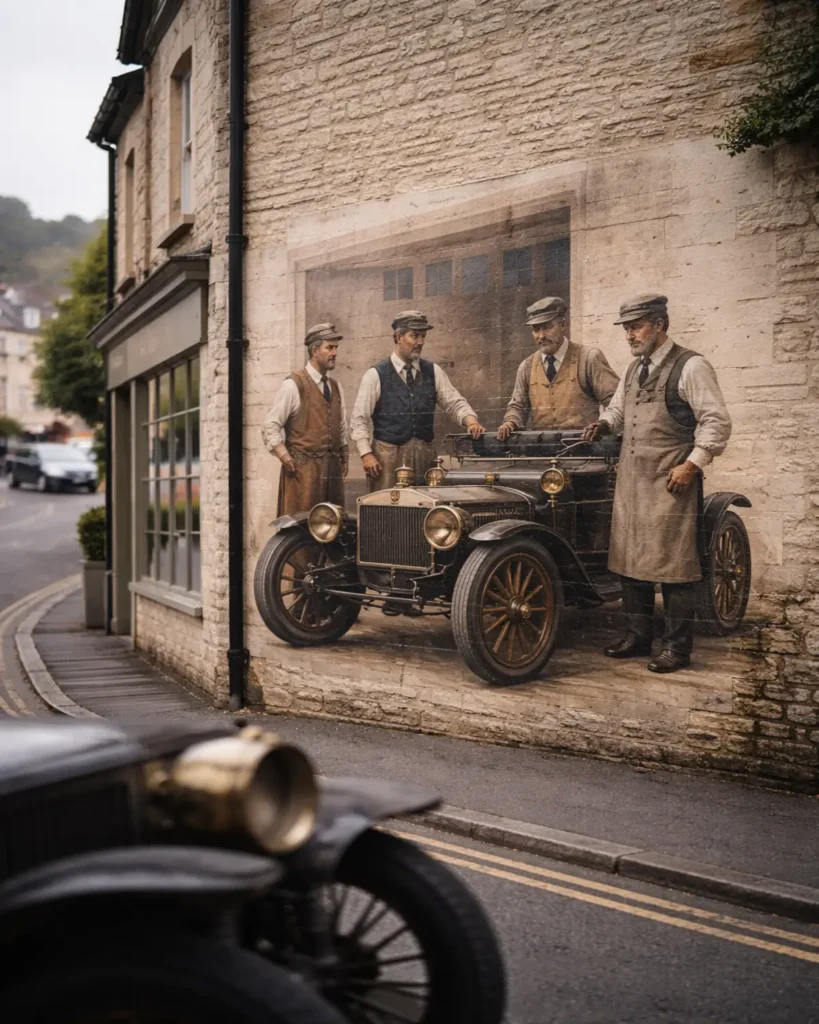

A new mural in Clevedon, North Somerset, is bringing fresh attention to Richard Stephens, a late-Victorian engineer and cycle maker linked to one of Britain’s earliest locally built motor cars. The artwork marks a story rooted in The Triangle, where Stephens worked in the 1890s as Britain’s motor industry was still taking shape.
Clevedon is better known for its seafront and pier, but the mural highlights a lesser-known chapter of the town’s industrial past. Stephens is remembered for attempting to build an “all-British” motor car at a time when road vehicles were still experimental, expensive, and far from common.
Why Richard Stephens matters to Clevedon’s story
In the late 1890s, small workshops played an important role in early vehicle design. Engineers were testing engines, steering systems, belts, chains, and lightweight frames with limited resources. Stephens’ work fits into that period of practical invention, when motor-car production had not yet become the preserve of large factories.
The significance of the Stephens car lies not in mass production, but in ambition. It showed that a coastal town workshop could take part in a national engineering shift. Only a small number of Stephens cars were made, but surviving examples have helped keep the name alive among motoring historians and local heritage groups.
The mural now gives that history a visible place in the town. Instead of leaving the story only to specialist books or private collections, the artwork places it back in the public space where residents, visitors, and schoolchildren can encounter it during an ordinary walk through Clevedon.
A local mural with a wider message
The artwork was created by local tattoo artist Hans Heaton, who reportedly spent around 80 to 100 hours on the mural and gave his time without charging. That detail adds a modern community layer to the project: one craftsperson honouring another across more than a century.
Public heritage projects like this can change how a town sees itself. A blue plaque may mark a location, but a mural often does something different. It stops people in the street, invites photographs, and makes a forgotten name easier to remember.
Clevedon’s celebration of Stephens also arrives at a time when the car industry is again being reshaped by new technology. Electric vehicles, battery supply chains, and changing transport habits have reopened questions about where innovation begins. Stephens’ story is a reminder that major industries often start with small experiments in local workshops.
For more background on similar stories across public life, technology, and culture, visit the latest news and features section.
Clevedon’s mural does not simply preserve a name from the 1890s. It restores a piece of British motoring history to the street where it belongs. Features from Autocar have also explored the forgotten Somerset car maker and its place in early UK automotive history.
The result is a clear local message: Clevedon was not just watching the motor age arrive. For a brief but important moment, it helped build it.

Make Swikblog your go-to source on Google for reliable updates, smart insights, and daily trends.