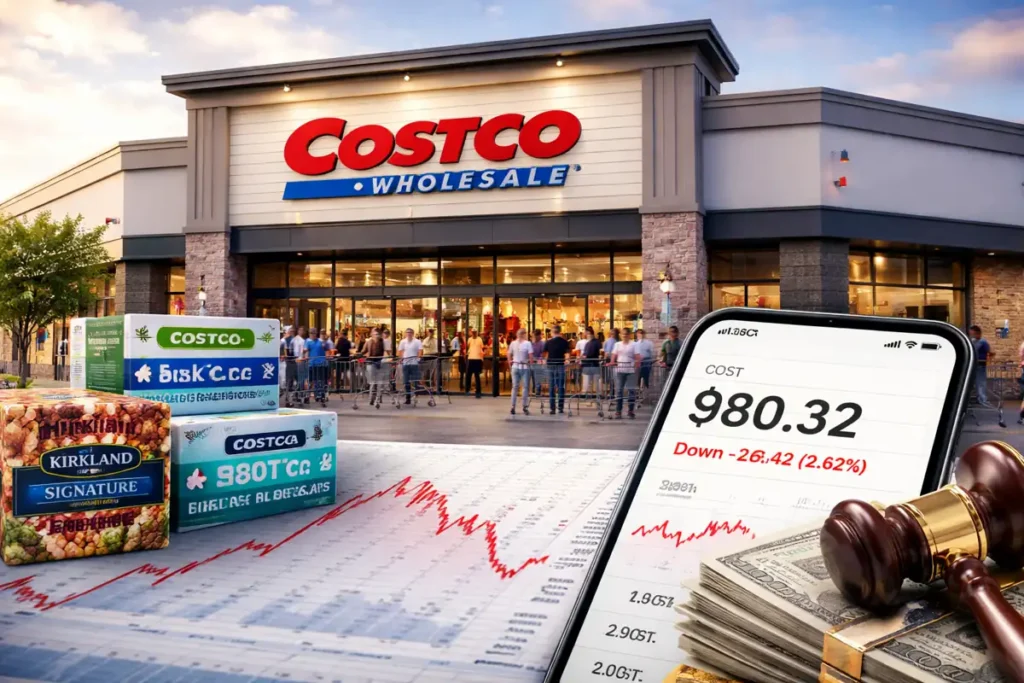

Costco Wholesale (COST) slipped to around $980 as a volatile mix of trade-policy headlines, geopolitics, and valuation nerves hit consumer defensives at the same time investors brace for the next earnings checkpoint. The move looks dramatic on the tape, but it lands on a stock that has still delivered a 16.9% year-to-date gain, a sharp contrast to the broader retail group’s -0.8% average return. In other words, the selloff reads less like a broken story and more like an expensive favorite being stress-tested in a choppy market.
Tariff refund ruling adds a fresh layer of uncertainty
The immediate catalyst on traders’ radar is a court-driven reset in the tariff landscape. A federal judge ordered the U.S. government to begin issuing more than $130 billion in tariff refunds to businesses, after the Supreme Court struck down wide-reaching “reciprocal” tariffs. More than 2,000 companies have filed lawsuits seeking refunds for tariffs deemed illegal, and high-profile names listed among those seeking relief include Costco and FedEx.
The ruling also clarified process mechanics that had been murky, with Judge Richard Eaton set to hear cases tied to the refund of those duties. Even with added clarity, the timeline remains extended—refund proceedings could take years to fully play out—leaving investors to model near-term pricing, sourcing, and competitive dynamics with incomplete visibility.
New 10% tariffs keep the backdrop unsettled
While refunds are poised to unwind parts of the prior regime, policy risk did not leave the stage. The administration moved ahead with new 10% tariffs under Section 122 of the Trade Act of 1974, with the rate described as potentially rising to 15% “sometime this week.” Under that authority, tariffs can run up to 150 days, after which congressional approval would be needed for an extension. Officials also signaled that other legal avenues are being explored to implement levies, with expectations that rates could revert toward older levels within roughly five months, while duties for certain countries could exceed 15% “where appropriate.”
For Costco, the market debate is less about a single quarter and more about whether a shifting tariff structure disrupts the company’s trademark value perception, and whether competitors gain breathing room if price gaps compress temporarily.
Market tone turned defensive, then defensive stocks fell
Costco’s decline unfolded alongside a broader risk-off wave: the S&P 500 fell 1.31%, and the consumer defensive cohort dropped 2.36%. That pattern captures a key feature of the session—investors sought shelter, then sold parts of that shelter as uncertainty intensified. The result is a market that can punish premium multiples quickly, particularly when macro headlines collide with a richly valued leader.
Valuation debate intensifies around fair value and targets
Analysts remain broadly constructive on Costco’s operating model, but valuation is the pressure point. A central argument in the current debate puts the stock near $1,006 against a fair value estimate of $726.29. At the same time, Wall Street price targets still sit high, spanning roughly $1,025 to $1,200. That range reflects a market split between two narratives: Costco as a compounding membership machine that deserves a structural premium, and Costco as a stock priced so tightly that even strong fundamentals can struggle to “beat” expectations.
Earnings bar rises with 13.2% growth projection
The next earnings release arrives with a robust bar already baked in. Consensus expectations point to a 13.2% year-over-year increase in earnings per share, with projected revenue of $69.12 billion. Those forecasts underscore the market’s stance: Costco is expected to keep delivering, not merely stabilize.
Q1 FY26 results show the engine still running hot
Costco’s most recent quarter offered plenty of evidence that demand and execution remain strong. The company posted Q1 FY26 net sales of $65.98 billion, up 8.2% year over year, and EPS of $4.50, a gain of 11.4% year over year. Excluding tax items, EPS growth was cited at 13.6%. Comparable sales rose 6.4% overall, and 7.1% excluding gas and foreign exchange, driven by 3.1% higher traffic and a 3.2% lift in average ticket.
Digital momentum stood out: digital comparable sales surged 20.5%, supported by personalization efforts, app improvements, and seasonal demand. Membership economics also strengthened, with membership fee income at $1.329 billion, up 14% year over year. Management attributed less than half of that growth to fee hikes, with executive upgrades and base growth providing meaningful support.
Margins, costs, and a few notable operational signals
On profitability, gross margin came in at 11.32%, up 4 basis points year over year, with commentary pointing to supply chain gains and greater Kirkland Signature penetration. SG&A ran at 9.6%, up 1 basis point year over year, as productivity gains offset wage and hour pressures while healthcare costs remained a headwind. The membership renewal rate slipped 10 basis points quarter over quarter, attributed to a higher mix of digital signups that tend to renew at lower rates.
Category strength, travel demand, and expansion plans
Category performance was broad. Fresh foods showed mid-to-high single-digit growth led by double-digit meat sales. Non-foods posted mid-single-digit comps with strength in jewelry, health and beauty, and appliances. Food and sundries also delivered mid-single-digit comps, aided by candy and viral “trendy” items such as Dubai chocolate. Ancillary businesses remained strong across pharmacy, hearing aids, and optical; pharmacy script growth was in the mid-teens, supported by an AI inventory system.
Travel demand added another bright spot, with $100 million-plus in gross bookings after Thanksgiving, up 12% year over year, and a Cyber Monday daily record in the U.S. On the footprint, management reiterated a long-term ambition of 30-plus warehouses per year, while FY26 was revised to 28 due to timing, including a delay in Spain. The company highlighted “creative” real estate solutions such as conversions and vertical builds to keep the pipeline moving.
AI-led efficiency push shows up in checkout and inventory
Costco’s technology agenda is increasingly central to the margin conversation. Checkout productivity in pilot locations was cited as up 20%, driven by pre-scan technology, digital wallet adoption, and personalization. In pharmacy, AI improved in-stocks to above 98% and supported margins, with expansion efforts extending toward gas and procurement. Retail media remains early-stage—examples include gas pump ads—framed around member value rather than aggressive monetization.
Insider activity stays within routine patterns
Insider filings in January 2026 showed 5 transactions totaling $2,684,208.20: 2 stock gifts and 3 stock sales. Gifts accounted for 5,415 shares and were valued at $0.00, while sales covered 2,808 shares totaling $2,684,208.20. The average sale value was $894,736.07, with individual sales of $838,318.20, $437,390.00, and $1,408,500.00. Participants included Teresa A. Jones (two transactions), Jeffrey S. Raikes, Susan L. Decker, and James C. Klauer, with no anomalies flagged in the activity.
Costco’s core case remains intact, the market is testing the price
The near-term setup is a tug-of-war: strong operating performance and an earnings growth outlook running above 13% face off against tariff-policy turbulence and an ongoing valuation dispute. If Costco sustains traffic, membership upgrades, and digital acceleration, the premium narrative stays alive—especially as AI efficiencies scale across more parts of the business. If policy uncertainty compresses pricing confidence or the market keeps de-risking expensive defensives, the stock can remain sensitive around headline volatility even with solid fundamentals. Additional market coverage and live updates can be followed via Yahoo Finance.

Make Swikblog your go-to source on Google for reliable updates, smart insights, and daily trends.