
Key Takeaways
- AI rivalry is escalating globally: The U.S. warning signals that artificial intelligence is now a geopolitical battleground, not just a tech industry competition.
- DeepSeek has become a focal point: The Chinese startup’s rapid rise with low-cost models is challenging assumptions about the resources needed to compete in advanced AI.
- Model distillation is under scrutiny: While widely used, the technique is now being questioned as a potential pathway for replicating proprietary AI systems without full investment.
- National security concerns are growing: Governments are increasingly treating AI models like strategic assets similar to semiconductors and defense technologies.
- Transparency remains a major challenge: Proving misuse of AI outputs is difficult due to limited visibility into training data and development methods.
- US-China tech tensions are intensifying: The dispute adds pressure to an already fragile relationship shaped by trade, chips, and technological dominance.
- Businesses face new compliance risks: Choosing AI vendors now involves evaluating security, data handling, and regulatory alignment—not just performance.
- Legal frameworks are lagging behind: Existing intellectual property laws are struggling to keep pace with how modern AI systems are built and trained.
- Global AI investment dynamics could shift: If cheaper models can match performance, it may disrupt the massive spending plans of leading tech companies.
The global race for artificial intelligence has entered a more confrontational phase after the United States moved to warn foreign governments about alleged attempts by Chinese AI companies to copy or extract value from American-developed models. The warning places DeepSeek, one of China’s fastest-rising AI startups, at the center of a widening dispute over intellectual property, national security, and the future of AI leadership.
The issue is no longer limited to competition between private technology firms. Washington’s latest move shows that advanced AI systems are now being treated as strategic assets, similar to chips, cloud infrastructure, and defense technology. For the U.S., the concern is that rivals may be able to narrow the AI gap without investing the same level of money, computing power, or research time required to build frontier models from the ground up.
According to reporting from Reuters, U.S. diplomatic staff have been directed to raise concerns internationally about the risks linked to AI model “distillation,” a process in which outputs from a larger model are used to train a smaller or cheaper system. Distillation is not new, and it can be a legitimate engineering method. But the political debate has intensified because U.S. officials believe the technique can also be misused to imitate proprietary systems without permission.
Why AI distillation has become a national security issue
In simple terms, AI distillation allows developers to transfer some behavior or performance from a powerful model into another model. Companies use it to reduce costs, improve speed, and make AI tools easier to deploy. The controversy begins when one company is accused of using another company’s model outputs at scale to train a competing product.
That is why the DeepSeek case has drawn attention. The company shocked global markets and policymakers with low-cost AI models that appeared highly capable despite being developed under China’s constrained access to advanced U.S. chips. Its rise challenged the assumption that only firms with huge compute budgets and unrestricted access to top-tier semiconductors could compete at the frontier of AI.
U.S. officials argue that models created through unauthorized distillation may look competitive on selected benchmarks while failing to match the deeper reliability, safety, and security controls of the original systems. There are also concerns that copied or distilled models could remove safeguards designed to limit harmful outputs, misinformation, or misuse.
For policymakers, this creates a difficult challenge. Distillation itself is widely used across the AI industry, so banning or restricting the technique entirely would be unrealistic. The harder question is whether governments and companies can prove when model outputs have been used improperly, especially when training data, prompts, and development methods are not fully transparent.
The U.S. National Institute of Standards and Technology has already emphasized the importance of trustworthy and risk-managed AI systems through its AI Risk Management Framework, which has become an important reference point for governments and companies working on responsible AI governance.
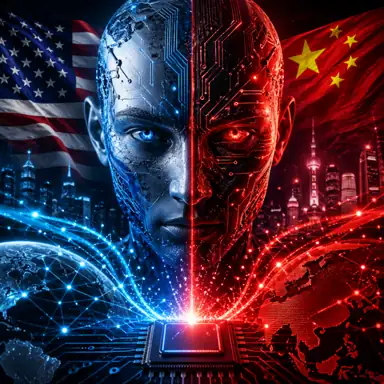
DeepSeek’s rise adds pressure to the US-China tech rivalry
China has rejected the American accusations, describing them as politically motivated and aimed at slowing its technological progress. DeepSeek has previously said its models were trained using publicly available information and web-crawled data, while denying intentional use of synthetic data generated by rivals such as OpenAI.
Still, the timing of the dispute is important. DeepSeek has continued pushing ahead with new model development, including work adapted for Huawei chip technology. That matters because Huawei has become central to China’s effort to build an AI ecosystem less dependent on American hardware and export-controlled semiconductors.
The broader picture is clear: the AI race is becoming deeply tied to industrial policy. The U.S. wants to protect its lead in frontier models, chips, and cloud infrastructure. China wants to reduce reliance on foreign technology and prove it can build competitive AI systems despite restrictions. DeepSeek’s progress sits directly at the intersection of those two goals.
Several governments have already restricted the use of DeepSeek-linked tools in official environments, largely over privacy and security concerns. At the same time, Chinese AI models remain popular on global open-source and developer platforms, where cost efficiency and accessibility are major advantages.
The controversy also arrives ahead of a sensitive diplomatic period between Washington and Beijing. Technology, trade, export controls, and AI governance are expected to remain major points of friction. Even if both sides seek stability, accusations involving AI theft could make negotiations harder and increase pressure for tougher rules.
For businesses, the message is that AI vendor selection is becoming a compliance and security issue, not just a productivity decision. Companies using third-party AI tools may need to examine where models are hosted, how user data is handled, what training sources are disclosed, and whether the system follows recognized safety practices.
The stakes are enormous. Big technology companies are preparing to spend hundreds of billions of dollars on AI infrastructure, from data centers to chips and energy supply. If lower-cost rivals can narrow the performance gap quickly, it could reshape investment assumptions across the global technology sector.
At the same time, the dispute highlights a legal gray area. Traditional intellectual property rules were not designed for AI systems that learn from massive datasets, generate synthetic outputs, and can be queried repeatedly to imitate behavior. Courts and regulators are still working out where fair use, competition, security, and model ownership begin and end.
More coverage on AI, technology policy, and market-moving global developments is available on Swikblog.
For now, DeepSeek has become more than just another AI startup. It is a symbol of how quickly the balance of power in artificial intelligence can shift. The U.S. warning shows that governments are no longer watching the AI race from the sidelines. They are actively trying to shape who builds the most powerful systems, who controls the infrastructure behind them, and who gets to define the rules for the next generation of technology.
You may like: Melbourne Arson Attacks: Bar Bambi Fire, 3 Arrested

Make Swikblog your go-to source on Google for reliable updates, smart insights, and daily trends.