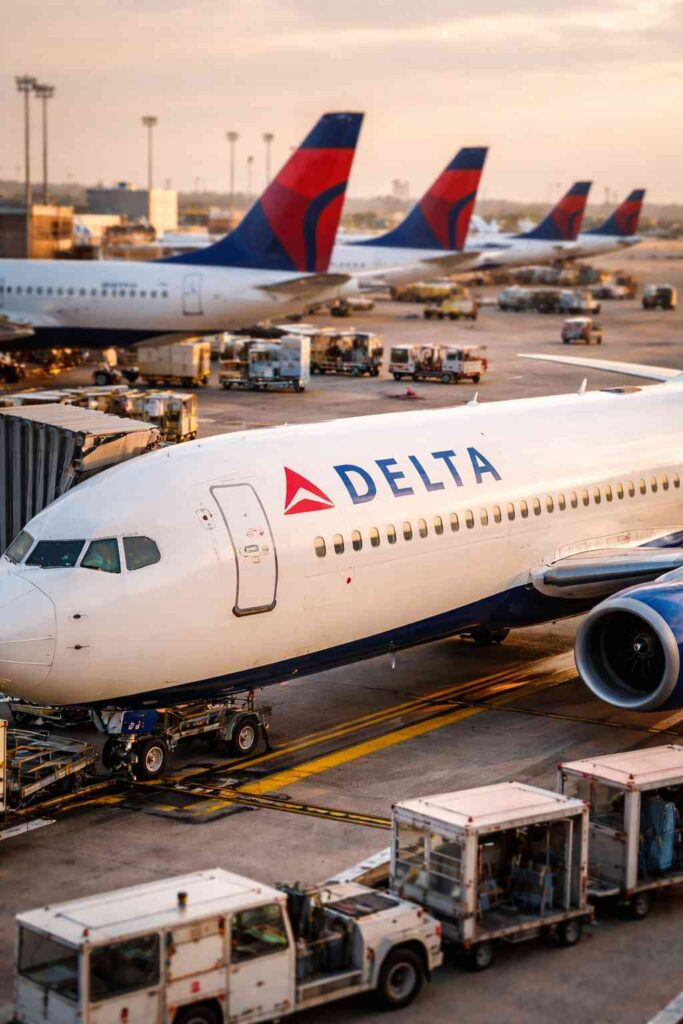

Delta Air Lines (NYSE: DAL) stock surged 7% to around $70 on Wednesday after the airline reported stronger-than-expected first-quarter earnings and maintained a confident outlook, even as fuel costs surged sharply and operational headwinds emerged late in the quarter. The rally came as investors focused on Delta’s ability to sustain revenue growth, protect margins, and leverage its premium and loyalty-driven business model despite rising cost pressures.
For the first quarter, Delta reported adjusted revenue of $14.2 billion, beating Wall Street expectations of approximately $14.11 billion and marking a 9.4% year-over-year increase. Adjusted earnings per share came in at $0.64, ahead of the $0.57 consensus estimate. The airline posted operating income of $652 million with an operating margin of 4.6%, reflecting stable profitability even in a challenging cost environment.
However, the biggest concern for investors remains fuel. Delta’s fuel expenses reached $2.591 billion in the quarter, rising 8% compared to last year. Management highlighted that jet fuel prices have more than doubled in the past month due to geopolitical tensions linked to the Iran conflict, significantly increasing cost pressure across the airline industry. According to Federal Reserve data on jet fuel prices, energy costs have seen sharp volatility over the past year.
Despite this, Delta’s ability to beat expectations and maintain forward guidance reassured markets. The company expects second-quarter revenue to grow in the “low teens,” with operating margins projected between 6% and 8% and adjusted earnings per share ranging from $1 to $1.50. Delta also forecasts approximately $1 billion in pretax profit for the quarter, even as fuel expenses are expected to increase by more than $2 billion.
One of the key differentiators supporting investor confidence is Delta’s ownership of the Monroe refinery. The company expects a $300 million benefit from refinery operations in the second quarter. This asset allows Delta to produce its own jet fuel and benefit from widening “crack spreads” — the difference between crude oil and refined fuel prices — giving it a structural advantage over competitors that rely entirely on market fuel pricing.
Beyond cost management, Delta’s growth continues to be driven by its premium-focused strategy. Premium revenue rose 14% year over year, while loyalty and related revenue increased by 13%. Revenue from its American Express partnership exceeded $2 billion, up 10%, highlighting the strength of its high-margin, recurring revenue streams.
This shift toward premium and loyalty-driven income is critical. Unlike traditional ticket sales, these segments offer higher margins and more predictable cash flow, making Delta more resilient in volatile economic conditions. The airline’s total adjusted revenue per available seat mile (TRASM) increased 8.2% to $0.2292, indicating strong pricing power and sustained demand from higher-income travelers.
At the same time, Delta is actively responding to rising costs. The company has reduced planned capacity growth, cut flights in lower-demand markets, and trimmed midweek schedules to better align supply with demand. It has also increased ticket prices and ancillary fees, including baggage charges, to offset higher fuel expenses.
Management emphasized that these actions are not temporary adjustments but part of a disciplined approach to maintaining profitability. The airline is “meaningfully reducing capacity” with a cautious stance until fuel prices stabilize, signaling a proactive strategy rather than reactive cost-cutting.
Operational challenges also played a role during the quarter. Delta noted that demand was impacted in late March due to disruptions caused by the U.S. government funding impasse, which left thousands of TSA workers unpaid and led to longer airport security lines. This particularly affected short-haul and business travel demand, though the overall impact was limited and did not derail broader growth trends.
Investor sentiment was further boosted by Delta’s decision not to revise its full-year outlook. The company previously guided for full-year adjusted earnings per share between $6.50 and $7.50, representing around 20% year-over-year growth at the midpoint, along with free cash flow in the range of $3 billion to $4 billion.
Adding to the positive momentum, broader airline stocks rallied following news of a geopolitical ceasefire that could ease oil price pressures. However, Delta outperformed peers due to its strong earnings delivery and structural advantages, reinforcing its position as a leader in the airline sector.
The market’s reaction suggests investors are increasingly viewing Delta as more than just a cyclical airline stock. Its combination of premium travel demand, loyalty-driven revenue, operational discipline, and refinery ownership creates a more diversified and resilient business model compared to traditional carriers.
Looking ahead, the key question will be how effectively Delta navigates the elevated fuel environment through the summer travel season. If demand remains strong and pricing power holds, the airline could continue to outperform expectations and sustain its upward momentum.
For now, the latest results indicate that Delta is not only weathering the current cost pressures but potentially strengthening its competitive position. A stock trading near $70 after a 7% gain reflects growing investor confidence that the airline can maintain profitability and growth even in a volatile macro environment.
Track Delta’s latest stock performance on Yahoo Finance.
You may like: Dow Jones surges 1,248 points as ceasefire sparks massive market rally
Make Swikblog your go-to source on Google for reliable updates, smart insights, and daily trends.