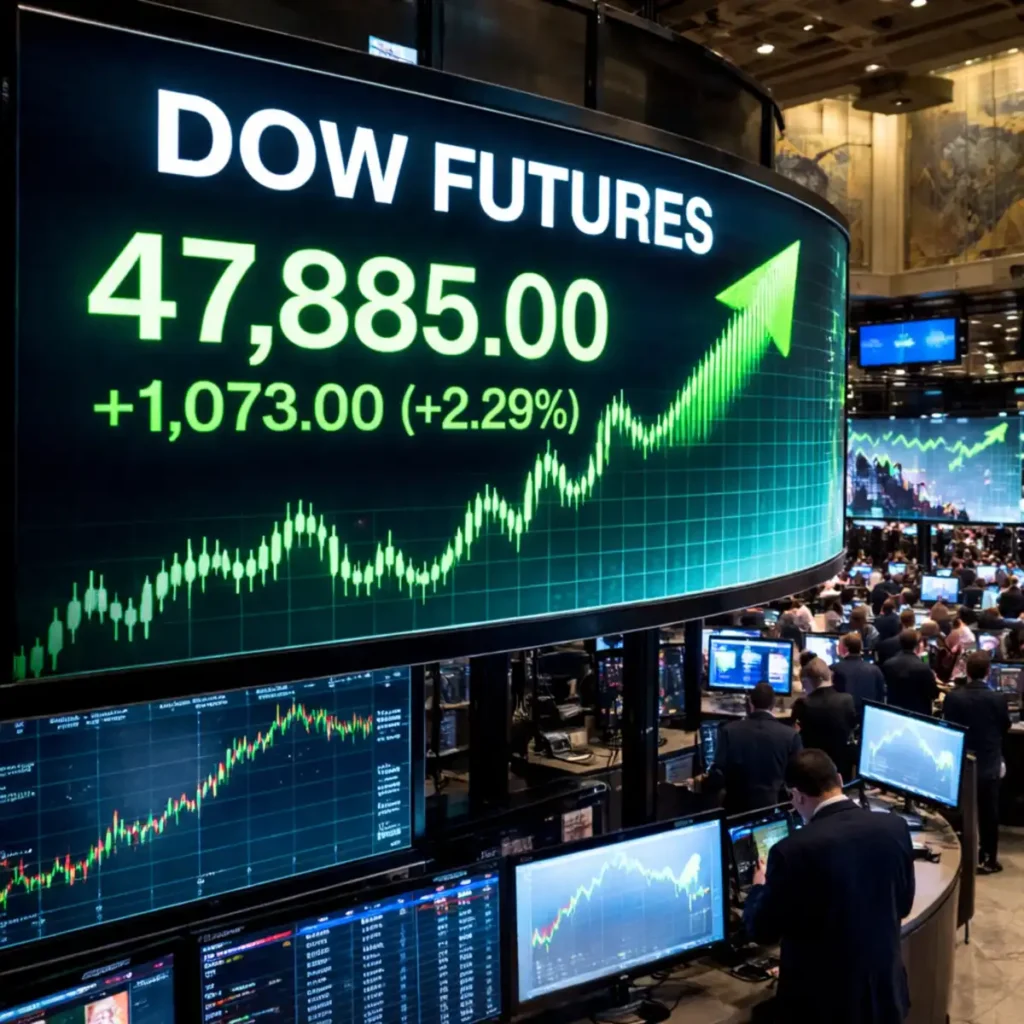

Dow Jones Industrial Average futures (YM=F) surged in early trading today, climbing to 47,885, up 1,073 points or +2.29%, as global markets reacted sharply to news of a temporary ceasefire in the Middle East. The rally was mirrored across major indices, with S&P 500 futures (ES=F) rising about +2.4% and Nasdaq 100 futures (NQ=F) jumping nearly +3.2%, signaling a broad return of risk appetite among investors.
The surge marks a decisive shift from the previous session, where the Dow Jones Industrial Average (^DJI) closed lower by roughly 85 points or -0.2%, while the S&P 500 (^GSPC) and Nasdaq Composite (^IXIC) posted modest gains of about +0.1% each. The sharp reversal highlights how quickly sentiment has turned following a major geopolitical development that eased fears of prolonged conflict.
Key market snapshot: Dow futures (YM=F) at 47,885 (+1,073, +2.29%); S&P 500 futures (ES=F) +2.4%; Nasdaq futures (NQ=F) +3.2%; Brent crude (~$91) and WTI (~$94) both down around 16%.
Geopolitical Breakthrough Drives Market Rebound
The primary catalyst behind the rally was the announcement of a two-week ceasefire between the US-led coalition and Iran. The development significantly reduced fears of disruption in the Strait of Hormuz, a critical global oil transit route responsible for roughly 20% of the world’s oil supply.
Energy markets reacted immediately. Brent crude futures dropped to around $91 per barrel, while US benchmark West Texas Intermediate (WTI) fell to just above $94, both marking declines of nearly 16%. The sharp fall in oil prices eased inflation concerns and improved the outlook for corporate margins, especially for sectors sensitive to fuel and transportation costs.
Market Drivers and Cross-Asset Reaction
The Dow futures rally reflects a classic “risk-on” shift. Investors quickly moved back into equities as the probability of a prolonged geopolitical crisis declined. Lower oil prices reduce pressure on inflation, which in turn supports expectations that the Federal Reserve can maintain a stable rate environment.
Technology and growth stocks led the rebound, as seen in the +3.2% jump in Nasdaq futures. Meanwhile, industrial and cyclical sectors embedded within the Dow also benefited from expectations of stable input costs and improved global trade flows.
Gold prices, however, moved higher as well, trading above $4,800 per ounce, reflecting a partial hedge positioning among investors who remain cautious despite the ceasefire. This mixed signal suggests that while sentiment has improved, markets are not fully dismissing geopolitical risks.
Earnings Focus and Corporate Signals
With geopolitical tensions easing, attention is shifting back to corporate fundamentals. Delta Air Lines (DAL) is among the key companies set to report earnings, and investors are closely watching for updates on fuel costs, travel demand, and margin performance.
Lower oil prices could provide immediate relief for airline and logistics companies, potentially improving earnings outlooks in the near term. Across the broader market, analysts are expected to revisit earnings projections if energy prices remain subdued.
While Dow futures themselves do not report earnings, their movement reflects expectations for the underlying components of the index, including major industrial, financial, and consumer companies. Stabilizing macro conditions could support earnings growth across these sectors.
Investor Sentiment Shifts Rapidly
The speed and scale of the move — a gain of over 1,000 points in Dow futures — indicates strong buying momentum and short-covering activity. Investors who had positioned defensively amid rising geopolitical risks are now rotating back into equities.
The broader rally across indices suggests that this is not a narrow rebound but a widespread shift in sentiment. Institutional investors appear to be re-entering the market, particularly in sectors that had been under pressure during the recent volatility.
At the same time, the continued strength in gold and cautious positioning in some defensive assets indicate that investors are still hedging against potential setbacks, keeping volatility expectations elevated.
Outlook for Markets
The trajectory of Dow futures will depend heavily on whether the ceasefire holds and whether oil prices remain stable. If geopolitical tensions continue to ease, the market could sustain its upward momentum, supported by improved earnings visibility and reduced inflation risks.
However, any disruption in the ceasefire or renewed tension around the Strait of Hormuz could quickly reverse gains, bringing volatility back into equities and commodities.
For now, the surge to 47,885 reflects a strong vote of confidence from investors reacting to reduced global risk. The combination of lower oil prices, improved sentiment, and stable macro expectations has created a favorable environment for equities — at least in the near term.
You may like UnitedHealth stock surges 8% on Medicare boost and fresh analyst upside calls.
Author Bio
Swikriti is a Swikblog writer with 9 years of experience focusing on financial markets, stock analysis, and high-impact global news with a strong editorial perspective.

Make Swikblog your go-to source on Google for reliable updates, smart insights, and daily trends.