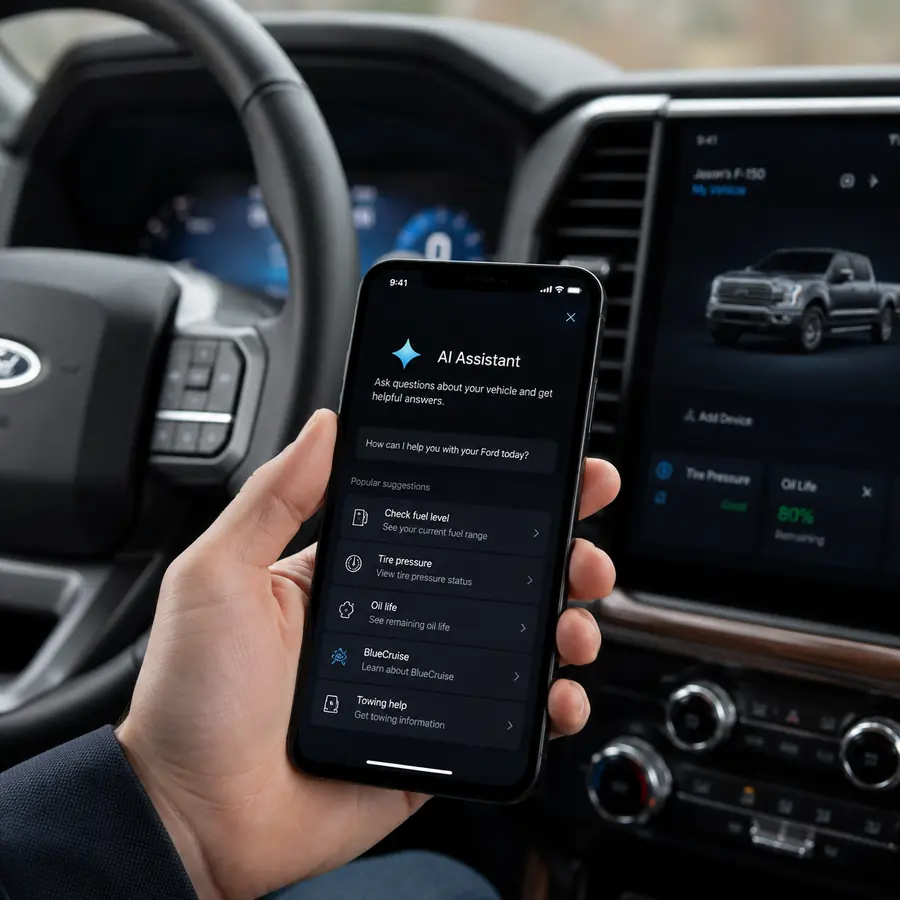

Ford is expanding its new AI Assistant across the Ford and Lincoln mobile apps, giving eligible owners a faster way to understand vehicle features and check information such as fuel or charge level, tire pressure and remaining oil life.
The rollout could eventually reach around 8 million eligible Ford and Lincoln customers. Ford began introducing the feature earlier in 2026 and is now expanding it in waves across vehicle lines. The company plans to take the technology directly into select vehicles beginning in 2027.
What can the Ford AI Assistant do?
Unlike a general chatbot, Ford’s assistant is connected to the vehicle associated with the customer’s app. That means owners do not have to repeatedly specify their model year and trim before asking vehicle-related questions.
Owners can ask how features work, check specifications and get guidance for simple problems. Ford gives examples including learning how to use BlueCruise hands-free highway driving, understanding tow/haul mode, getting help with Pro Trailer Backup Assist and checking whether furniture or other items will fit in the cargo area.
The assistant can also provide step-by-step troubleshooting for certain issues, such as a window that keeps bouncing back up instead of closing properly.
Software is becoming an increasingly important part of the ownership experience. Developments such as Tesla’s FSD V14.3.3 software rollout illustrate how automakers are increasingly using software to add and refine vehicle capabilities.
It can access fuel, tire pressure and oil-life information
The most notable part of Ford’s system is its ability to work with current vehicle information available through the app.
The assistant can use data including fuel or battery charge level, tire pressure and remaining oil life. Before a road trip, for example, an owner could check the vehicle’s fuel or charge status, review tire information or see whether service may be approaching.
This does not make the AI a replacement for a mechanic. Serious warning lights, braking problems, unusual noises or other safety-related issues may still require professional diagnosis. Its advantage is making existing vehicle information easier to find and understand.
Owners can upload images
The assistant accepts more than typed questions. Ford says customers can upload an image and ask about what it shows.
A truck owner, for example, could photograph cargo and ask about fitting it into the vehicle. The assistant can combine the image with specifications associated with that particular vehicle. The same approach could help someone check whether furniture will fit before making a trip to a store.
How to find the Ford AI Assistant
Ford is releasing the feature gradually. When it becomes available, customers should see a blue oval and spark icon near the top-right corner of the vehicle home screen in the Ford or Lincoln app.
Tapping the icon opens the chat interface, where users can type questions or upload an image. If the icon is not currently visible, it may simply mean the phased rollout has not yet reached that customer.
Ford says the gradual release will allow it to gather feedback and improve answer quality. More details about availability and capabilities are available in Ford’s official AI Assistant announcement.
Ford AI Assistant and Google Gemini have different roles
Ford is separately bringing Google Gemini to vehicles equipped with Ford and Lincoln Digital Experience, where it will be available as an opt-in alternative to Google Assistant.
The distinction is important. Gemini handles broader tasks such as sending messages, changing cabin temperature and playing music. Ford’s AI Assistant focuses on information about the owner’s vehicle, including its features, capabilities and current status.
Conversational AI is becoming increasingly connected with driving beyond Ford as well. The Google Maps Gemini AI and immersive navigation update shows how Google is extending similar technology into navigation and route-related experiences.
Read More
Ford plans in-car AI for 2027
The mobile app is only the first stage. Ford says its AI Assistant will be directly integrated into select Ford and Lincoln vehicles beginning in 2027.
The company says this will go beyond simply mirroring the phone interface. Ford intends to build a more deeply integrated voice experience using its vehicle data and services.
Ford has also previously described its approach as flexible enough to work with different large language models rather than permanently depending on a single AI provider.
What owners should know now
The app-first strategy means eligible existing owners do not have to purchase a new 2027 vehicle to begin using Ford’s AI technology.
For most drivers, its immediate value is straightforward: ask about fuel or charge, check tire pressure and oil life, understand an unfamiliar feature, confirm towing or cargo specifications, or find instructions without searching through a lengthy manual.
The bigger test comes when Ford moves the assistant into vehicles in 2027. Accuracy will matter more than novelty, particularly when answers involve vehicle condition or operation. If Ford can make its existing vehicle data easier to understand without adding complexity, conversational AI could become a practical part of everyday car ownership rather than simply another dashboard feature.

Make Swikblog your go-to source on Google for reliable updates, smart insights, and daily trends.