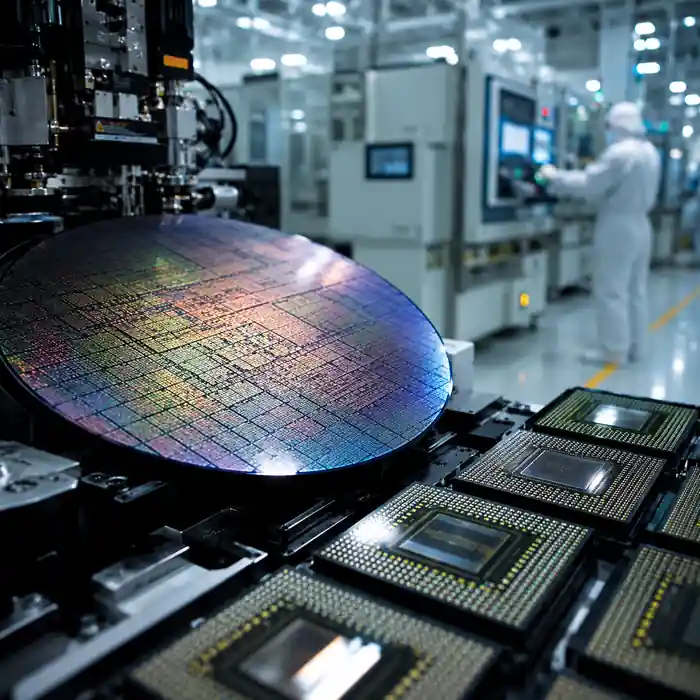

Taiwan Semiconductor Manufacturing Company has delivered another strong signal that demand for advanced artificial intelligence chips remains robust, even as semiconductor stocks face volatility and investors question whether Big Tech’s AI spending can continue at its current pace.
TSMC reported July 2026 revenue of NT$467.58 billion, roughly $14.5 billion, up 44.7% from a year earlier. The world’s largest contract chipmaker sits at the center of the AI supply chain, manufacturing advanced processors for customers including Nvidia and custom silicon used by Google.
The figures matter beyond TSMC. Its factories provide investors with a view of actual semiconductor production at a time when markets are debating whether the AI infrastructure boom is beginning to cool.
TSMC’s July revenue extends a powerful growth run
July revenue was about NT$144.4 billion higher than the NT$323.17 billion recorded in July 2025. Sales also increased about 5.6% from NT$442.68 billion in June.
For January through July, TSMC generated approximately NT$2.87 trillion in revenue, up about 37% from the same period last year. The company’s official monthly revenue figures provide the latest breakdown.
Monthly sales can fluctuate because of shipment schedules and customer orders, so July should not be viewed in isolation. Still, producing 44.7% annual growth from TSMC’s already enormous revenue base suggests substantial demand is continuing to reach the manufacturing stage.
The company’s second-quarter results reinforce that picture. High-performance computing, which includes much of TSMC’s AI-related business, accounted for 66% of revenue. Chairman and CEO C.C. Wei also described AI-related demand as “extremely robust.”
TSMC expects its 2026 revenue to grow slightly above 40% in U.S. dollar terms and has raised planned capital expenditure to between $60 billion and $64 billion. Those investments are intended to support leading-edge fabrication and other capacity required for increasingly powerful processors.
What TSMC’s numbers mean for Nvidia and AI stocks
Nvidia is one reason investors pay close attention to TSMC’s monthly sales. TSMC provides the advanced manufacturing needed to turn Nvidia’s AI processor designs into physical chips, while also serving other major technology companies.
That means TSMC’s 44.7% revenue increase cannot be treated as Nvidia revenue or attributed entirely to AI. However, the combination of strong foundry sales and high-performance computing’s 66% share of TSMC’s quarterly business provides evidence that demand for advanced computing remains substantial.
The wider semiconductor supply chain is increasingly important as investors assess the AI boom. Recent moves involving Nvidia, AMD, Micron and other AI semiconductor stocks show how markets are looking beyond individual chip designers to memory, manufacturing and data-center demand.
TSMC has guided third-quarter revenue to between $44.6 billion and $45.8 billion. After July’s strong start, August and September will indicate whether the company can maintain enough momentum to reach that range.
Advanced packaging is another piece of the story. Modern AI accelerators require sophisticated manufacturing and packaging to combine processors and high-bandwidth memory. Expanding wafer production alone cannot satisfy AI demand if other parts of the manufacturing chain become bottlenecks.
Read More
Strong chip demand meets a volatile semiconductor market
The contrast between TSMC’s business and semiconductor share prices is particularly important. The PHLX Semiconductor Index was roughly 15% below its June high around the time of the July revenue report, despite remaining substantially higher for the year. TSMC shares had also gained about 50% during 2026.
Strong sales and falling share prices can happen simultaneously. After large rallies, investors may take profits or become less willing to pay high valuations, even when companies continue growing.
TSMC’s own share-price performance illustrates how rapidly expectations have increased. Its earlier rally toward $380 amid strong AI chip demand showed how much optimism surrounding AI manufacturing had already entered the stock.
Other chip companies have faced similar pressure. AMD shares recently dropped about 8% even after reporting sharply higher data-center revenue, showing that investors are demanding more than rapid growth from AI-related businesses.
European semiconductor stocks reacted positively on Monday, with ASML rising more than 2% while Infineon and STMicroelectronics also moved higher. TSMC’s sales can influence sentiment across chip designers, manufacturers and equipment suppliers because of its central position in global semiconductor production.
There are still risks. AI infrastructure spending could slow, customer orders can change quickly, and TSMC’s $60 billion to $64 billion capital program requires sustained demand to keep new capacity productive. Geopolitical and supply-chain risks surrounding advanced semiconductor manufacturing also remain important.
For investors, July provides a useful distinction between market sentiment and operating demand. Semiconductor stocks may fluctuate sharply, but TSMC’s 44.7% annual revenue increase shows that significantly more money is still flowing through advanced chip manufacturing than a year ago. August and September will provide the next evidence of whether that momentum can carry through the rest of the third quarter.

Make Swikblog your go-to source on Google for reliable updates, smart insights, and daily trends.