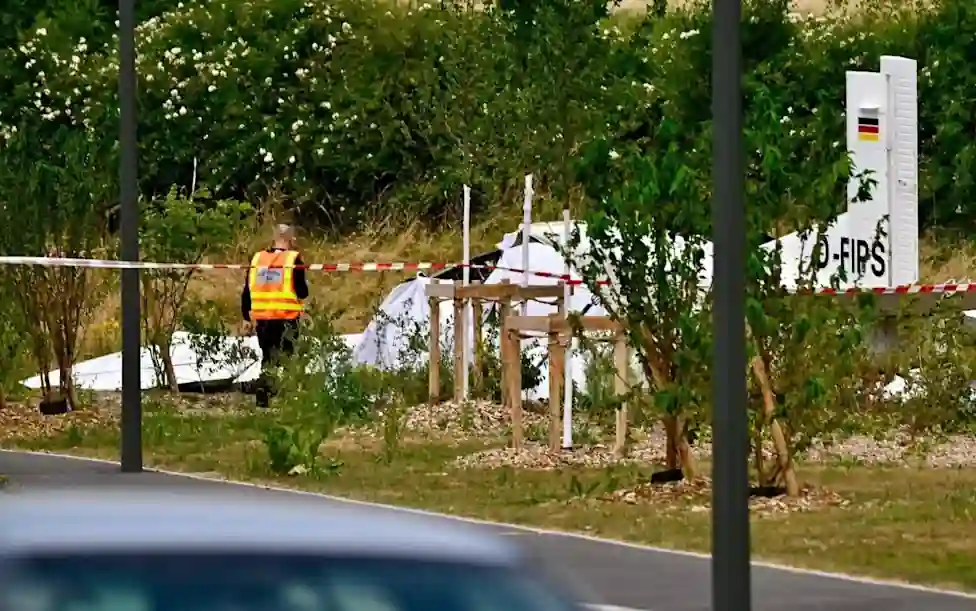

Eleven people were killed after a skydiving aircraft crashed shortly after takeoff near Nancy in northeastern France, triggering a major emergency response and a formal investigation into one of the country’s deadliest recent civilian aviation accidents.
The aircraft came down on Sunday morning in Tomblaine, a town on the outskirts of Nancy, after departing from Nancy-Essey aerodrome. Local authorities said everyone on board died, including the pilot, five skydiving students and five instructors.
The crash happened at around 11 a.m. local time near Rue Salvador Allende, close to a residential area and a bicycle path. Officials said no one on the ground was injured, but police quickly sealed off the area and asked residents to stay away so emergency crews could work safely.
What Happened In The France Skydiving Plane Crash?
The aircraft was being used for a parachuting activity when it crashed shortly after leaving Nancy-Essey aerodrome. It was linked to a skydiving school and was carrying a group made up of instructors and students.
Authorities confirmed that 11 people were on board: one pilot, five instructors and five student skydivers. All were killed in the crash.
French media reported that some of the student skydivers may have been independent nurses taking part in a first-time skydiving experience. Officials had not immediately released the victims’ names, and formal identification work was expected before personal details were confirmed.
Crash Site Was Near A Bicycle Path
Tomblaine mayor Hervé Féron told French media that the aircraft crashed on a bicycle path shortly after takeoff. He said there were no collateral casualties, meaning no pedestrians, cyclists or residents were reported killed or injured on the ground.
The location of the crash raised immediate safety concerns because it was near local homes and roads. Police urged people to avoid the Rue Salvador Allende area and asked motorists to make way for emergency vehicles.
Regional reports also mentioned an early risk linked to fuel and possible explosion concerns, which is common after serious aircraft crashes until firefighters and specialists secure the wreckage.
Emergency Response Was Activated Quickly
Meurthe-et-Moselle Prefect Yves Séguy activated the departmental operational centre, known as the COD, to coordinate the response in real time. The prefect also went to the scene as police, firefighters, medical teams and investigators arrived.
French Interior Minister Laurent Nuñez was reported to be travelling to the crash site. Local authorities also prepared spaces to support victims’ families and allow the community to pay respects.
The first priority for officials was to secure the area, prevent crowds from blocking emergency access, preserve evidence and support relatives waiting for confirmed information.
Why The Takeoff Phase Is Important
The aircraft crashed shortly after takeoff, one of the most critical stages of flight. At low altitude, pilots have very little time to respond if an aircraft loses power, becomes unstable or suffers a sudden control issue.
That does not mean investigators already know what caused the crash. It means the first minutes of the flight will likely be central to the inquiry.
Investigators are expected to examine the aircraft’s maintenance records, takeoff sequence, weather conditions, weight and balance, pilot communications and any available witness accounts or flight data.
Aircraft Details Remain Under Review
Some local reports suggested the aircraft may have been rented in Germany, while other reports identified it as a German-registered aircraft commonly used for parachuting operations. Officials had not fully confirmed all aircraft details in the first hours after the crash.
Skydiving aircraft often operate in repeated short cycles, climbing with groups of jumpers before returning for another flight. That makes maintenance checks, safe loading and takeoff performance especially important.
For official aviation safety updates, readers can follow the French aviation accident investigation authority, which handles civil aviation accident investigations in France.
What Investigators Will Look For
Aviation investigators are likely to focus on whether the aircraft experienced a mechanical fault, engine problem, control issue, loading concern or another difficulty after departure.
They may also review the operator’s procedures, the aircraft’s recent use, maintenance history and whether all pre-flight checks were completed properly.
At this stage, authorities have not blamed any specific factor. The cause remains unknown, and officials are expected to avoid firm conclusions until technical evidence has been reviewed.
Why This Crash Has Hit The Local Community Hard
The tragedy has shaken Tomblaine and the wider Nancy area because the flight appears to have been a recreational skydiving trip involving both experienced instructors and students.
For many people, a first skydive is planned as a milestone experience. Reports that some passengers may have been nurses taking part in a first jump added to the sense of shock, though officials had not immediately confirmed every personal detail.
The scale of the loss also makes the crash stand out among small-aircraft accidents, where a single incident can devastate multiple families and professional communities at once.
Read More
How This Fits Into Wider Aviation Safety Concerns
Small-aircraft crashes are investigated differently from major airline accidents, but they can be just as devastating. These flights often involve specialist operators, smaller aircraft and passengers who may not be regular flyers.
Questions about aircraft operations, emergency response and accident investigation have also followed other fatal aviation incidents, including the fatal plane crash at Statesville Regional Airport in North Carolina.
In the France skydiving plane crash, the focus now is on evidence rather than speculation. Investigators will need to determine what happened between takeoff from Nancy-Essey aerodrome and the impact in Tomblaine.
The next major updates are expected from French authorities and aviation investigators. They may confirm the aircraft model, operator details, victim identities and early technical findings from the crash site.
Until then, the confirmed facts remain stark: the aircraft departed Nancy-Essey aerodrome, crashed shortly after takeoff in Tomblaine, and all 11 people on board were killed.
The tragedy has left northeastern France mourning while investigators work to explain how a skydiving flight carrying students, instructors and a pilot ended moments after departure.

Make Swikblog your go-to source on Google for reliable updates, smart insights, and daily trends.