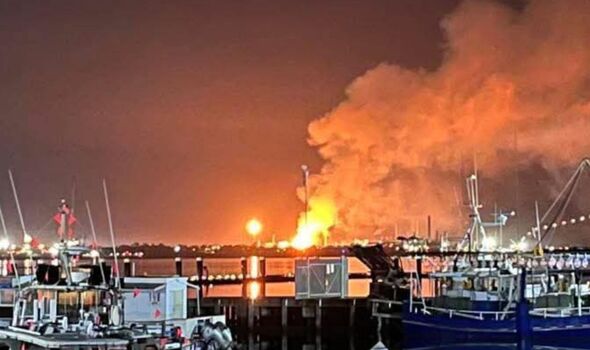

A major fire at the Geelong refinery in Victoria triggered an overnight emergency warning after explosions were reported and thick, toxic smoke spread across parts of the city. The blaze broke out shortly after 11pm on Wednesday at the Viva Energy refinery in Corio, drawing a huge emergency response and raising concern because the site is one of only two operational oil refineries left in Australia.
Emergency calls reported flames and explosions at the refinery, and fire authorities later said the incident had erupted in a section of the facility known as the Mogas plant. Fire officials described a blaze covering roughly 30 metres by 30 metres, with flame heights reaching an estimated 50 to 60 metres as crews battled to stop it spreading inside the complex.
The scale of the response underlined the seriousness of the incident. About 50 firefighting vehicles were sent to the site, with crews continuing operations through the night as the fire remained active. Authorities focused on both suppressing the blaze and managing the public safety risks linked to smoke drifting into nearby suburbs.
Smoke warning, shelter advice and shifting impact zone
A wind change several hours after the fire started pushed toxic smoke towards greater Geelong, prompting an emergency warning for residents in affected areas. People were told to stay indoors, shut doors and windows, and turn off heating and cooling systems to reduce exposure to smoke and airborne particles. Motorists were also urged to avoid the area so emergency crews could access the refinery without obstruction.
The warning zone was initially broader as smoke moved across the city overnight, but authorities later scaled it back to suburbs closest to the refinery. Officials said there was no immediate direct threat to the wider public, though smoke and air-quality concerns remained central to the response as emergency teams worked around the site.
Images and videos from the scene showed flames and dense smoke rising high above the industrial complex, highlighting the intensity of the blaze. The visuals quickly spread across social media and added to public concern, particularly because the refinery sits close to residential communities in Geelong’s north.
Why the Geelong refinery fire matters beyond the immediate emergency
The Corio refinery is not just a local industrial site. It is a critical part of Australia’s fuel system, supplying about 50% of Victoria’s fuel needs and around 10% of Australia’s fuel supply. The facility is capable of processing up to 120,000 barrels of oil per day, making it one of the country’s most strategically important remaining refining assets.
That wider significance is why the fire has attracted attention beyond Victoria. Any prolonged disruption at the refinery could place fresh focus on fuel supply resilience in southeastern Australia, particularly at a time when energy markets remain sensitive to global instability. Concerns about domestic fuel security have already been heightened by Australia’s relatively limited refining capacity and the heavy dependence on a small number of major processing sites.
The broader backdrop has added another layer to the story. Earlier this week, federal Energy Minister Chris Bowen said Australia’s fuel reserves stood at around 38 days of petrol, 28 days of jet fuel and 31 days of diesel. While there has been no formal statement yet that this fire will affect supplies, the incident is likely to sharpen scrutiny on how vulnerable fuel distribution can become when one of the country’s last operating refineries is hit by a major industrial emergency.
The refinery itself has deep roots in Victoria’s industrial history. Originally constructed by Shell, the site dates back to 1954 and employs more than 1,100 people. Its long-standing role in fuel production means any major incident there is watched closely not only because of the immediate fire risk, but because of what it could mean for jobs, operations and energy infrastructure more broadly.
Despite the scale of the blaze and the reports of several small explosions, authorities said there have been no reported injuries. That remains one of the most important early outcomes from the emergency response, given the height of the flames and the complexity of fighting a fire inside a major refinery.
Investigators are expected to assess the cause of the fire once crews fully contain the blaze and the area is safe to examine. In the meantime, the priority remains controlling the incident, protecting nearby communities from smoke exposure and determining whether refinery operations have suffered damage that could affect fuel production in the days ahead.
Residents looking for the latest warning changes and incident updates can continue to monitor Victoria’s emergency services website as officials respond to changing conditions.
You may also like: Winners Bathroom Closures in Canada: What Shoppers Need to Know

Make Swikblog your go-to source on Google for reliable updates, smart insights, and daily trends.